Escambia County deputies search for work-release escapee; later apprehended
Escambia County deputies searched for Hunter Craig Madden after he escaped from a work-release program; he was later apprehended and returned to jail.
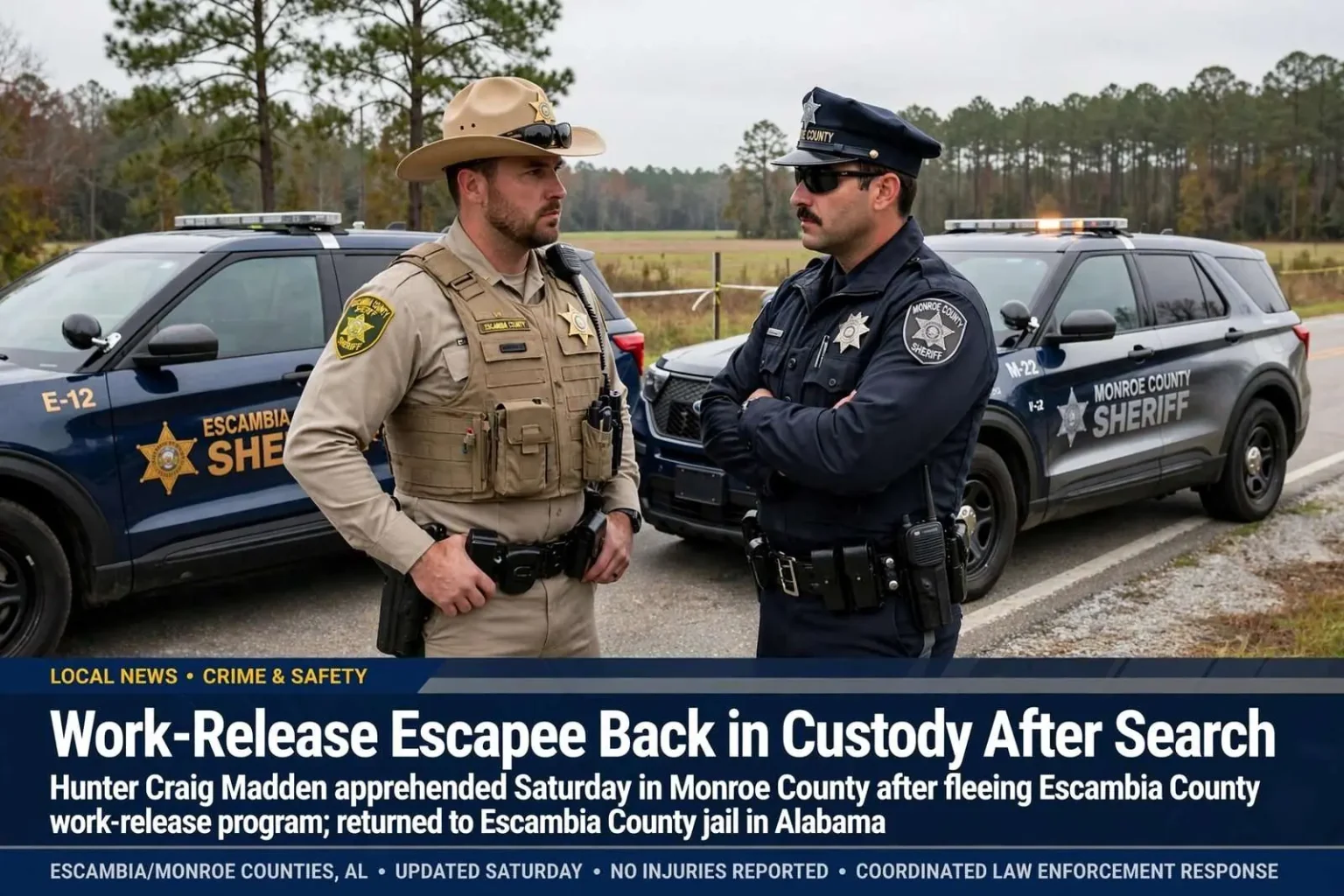
Work-Release Escapee Back in Custody After Search
Escambia County sheriff’s deputies were searching for a man who escaped from a work-release program Saturday morning, according to the Sheriff’s Office. The agency said Hunter Craig Madden fled from work release and deputies launched a search to locate him. In an update, the Monroe County Sheriff’s Office said Madden was later apprehended and returned to the Escambia County jail in Alabama.
The search that began on a Saturday morning ended the way authorities hope every such case ends: with the escapee back behind bars and no one hurt in between. Hunter Craig Madden fled from a work-release program in Escambia County early in the weekend, and the Sheriff’s Office moved immediately into the pursuit posture that absconded inmates demand — spreading the word to surrounding agencies, canvassing the areas an escapee is most likely to head, and asking the public to keep its eyes open.
Work-release programs occupy a deliberate middle ground in corrections. Inmates approved for them serve the final stretch of their sentences in a structured transition — holding jobs in the community, returning to custody at the end of each workday, and paying toward their support and any restitution they owe. The programs reduce recidivism by teaching inmates to hold a job and manage money before their release, and they let inmates support families who would otherwise depend on others. The bargain rests entirely on trust: walk away, and the privilege becomes a new charge.
When Madden fled on Saturday morning, he converted that trust into a manhunt. Deputies’ first hours are spent on the basics: where was he last accounted for, does he have a vehicle, who in the area might shelter him, and what direction was he moving? The Sheriff’s Office circulated his description to other agencies, and because county lines sit close together in south Alabama, that meant departments in every direction were watching for him within hours of the report.
The Saturday timing shaped the search as well. Weekend staffing is thinner than weekday coverage, and the jobs that work-release inmates report to run on different schedules when Saturday arrives. Deputies had to account for both — checking whether the flight began on the way to a job site or from the program itself, and adjusting the search pattern to the lighter weekend traffic on rural roads. The agency’s public confirmation that it was searching gave residents the information they needed, and the case moved on the same clock any abscondee case does: every hour the man remained at large, the circle of likely places to look grew wider.
How the Search Works Across County Lines
Escambia County, Alabama, sits against the Florida line in the state’s southwestern corner, with Brewton as its county seat and a landscape of pine forests, farms and small towns. Its neighbor to the east, Monroe County, is largely rural — the home of Monroeville and the wide, wooded country around it. A man moving quickly on rural roads can cross from one county into another in minutes, which is why the Monroe County Sheriff’s Office became part of the story: it was there that Madden was later apprehended, according to the update authorities provided.
The coordination between the two agencies is routine by design. Alabama’s county sheriff’s offices maintain the relationships — shared radio traffic, direct phone lines, joint operations — that let a search jump a county line without missing a step. An inmate who absconds from work release in one county is, from the first moment, a matter for every agency between the escape point and wherever he stops moving, and the departments along that path are brought in as a matter of course.
The public’s role in the search is the quiet half of every manhunt. Residents who see someone matching an escapee’s description, notice a stranger walking along a farm road, or hear from a friend who spotted something unusual are asked to call — not to intervene. In rural counties, hunters and landowners are often the most valuable eyes of all, moving quietly through exactly the terrain an abscondee favors, and a single well-placed call can end a search that might otherwise stretch for days.
Madden’s flight ended in Monroe County with his apprehension, and the update from the Monroe County Sheriff’s Office carried the detail that closes every such case: he was returned to the Escambia County jail in Alabama. The return matters legally as well as practically. An escape from work release is itself a criminal offense in Alabama, a new felony charge layered on top of whatever sentence the inmate was serving, and it typically costs the offender any credit for the privileges the program provided — including the prospect of early release the program was designed to offer.
What Work Release Is — and Why Escapes Are Taken Seriously
The work-release model exists in county and state systems across Alabama because it works when it works. Inmates in the program hold real jobs — often in construction, food service, manufacturing or the trades — and their earnings go toward court costs, restitution to victims, child support and the costs of their own custody. The structure is strict: documented movement between work and the facility, check-ins, and automatic termination from the program for any violation. The Saturday-morning flight that put Madden in the news is the failure mode the entire system is built around, and the response it triggers is deliberately immediate.
That urgency has a public-safety logic. An inmate who flees custody is unknown territory until he is found: authorities do not know his intentions, his resources or his state of mind, and they treat him accordingly. The description circulated to other agencies and the public is aimed at safe identification — see him, call it in, and let officers make the stop. Residents of the counties involved were asked for exactly that kind of help, and the search’s progress was reported in updates as agencies confirmed the pieces of the case.
The apprehension in Monroe County also illustrates the geography of south Alabama law enforcement. The counties here are wide, the populations are spread thin, and a sheriff’s office in one county cannot watch every road that leads out of it. What it can do is tell its neighbors immediately, and that network — Escambia, Monroe, Conecuh, Baldwin and the Florida counties across the line — functions as a net rather than a fence. Madden moved from one county into another and was taken into custody there, which is the system operating as intended.
Back at the Escambia County jail, the case shifts from pursuit to paperwork. The escape charge will be added to the record, the district attorney’s office will weigh how to charge the flight, and Madden will answer in court not only for the offense that put him in custody but for the decision to walk away from the program that was preparing his return to freedom. For the deputies who spent a weekend Saturday chasing him, and for the Monroe County officers who took him into custody, the outcome was the standard they work to: an escaped inmate recovered, returned, and facing the consequences.
A Reminder About the System’s Expectations
Cases like this one serve as a periodic reminder of how the work-release bargain is enforced. The program offers inmates a bridge back to ordinary life — a job, a paycheck, a schedule — and it withdraws nothing more loudly than when an inmate breaks its terms. The felony escape charge that follows a flight from work release can add years to a sentence, and judges in south Alabama have historically treated absconsion as evidence that the inmate was not ready for the trust the program extended.
For the public, the lasting takeaway is the role residents played in closing the search. Escambia County authorities asked for information; the search crossed into Monroe County; and Madden was apprehended and returned to the Escambia County jail. The machinery worked — agencies shared information, the public stayed alert, and a man who fled custody on a Saturday morning was back behind bars before the search could stretch into a new week. It is the ending every work-release escape case hopes for, and the one that keeps the program’s difficult balance intact.
The case also closes cleanly for the community’s sense of security, which is not a small thing in a rural county. An unsolved absconsion leaves residents wondering for weeks whether a man who fled custody is living somewhere in their midst; an apprehension the same weekend answers the question before it becomes a worry. Sheriff’s offices in counties like Escambia and Monroe serve populations that know them personally — deputies who coach ballteams and attend the same churches — and the prompt resolution of a case like this one is part of the trust that makes everything else they do possible.