Escambia County Deputy Hurt in Crash During Pursuit That Crossed Into Florida
An Escambia County, Alabama deputy was hurt after crashing into trees during a pursuit that crossed the state line into Florida, the sheriff said.
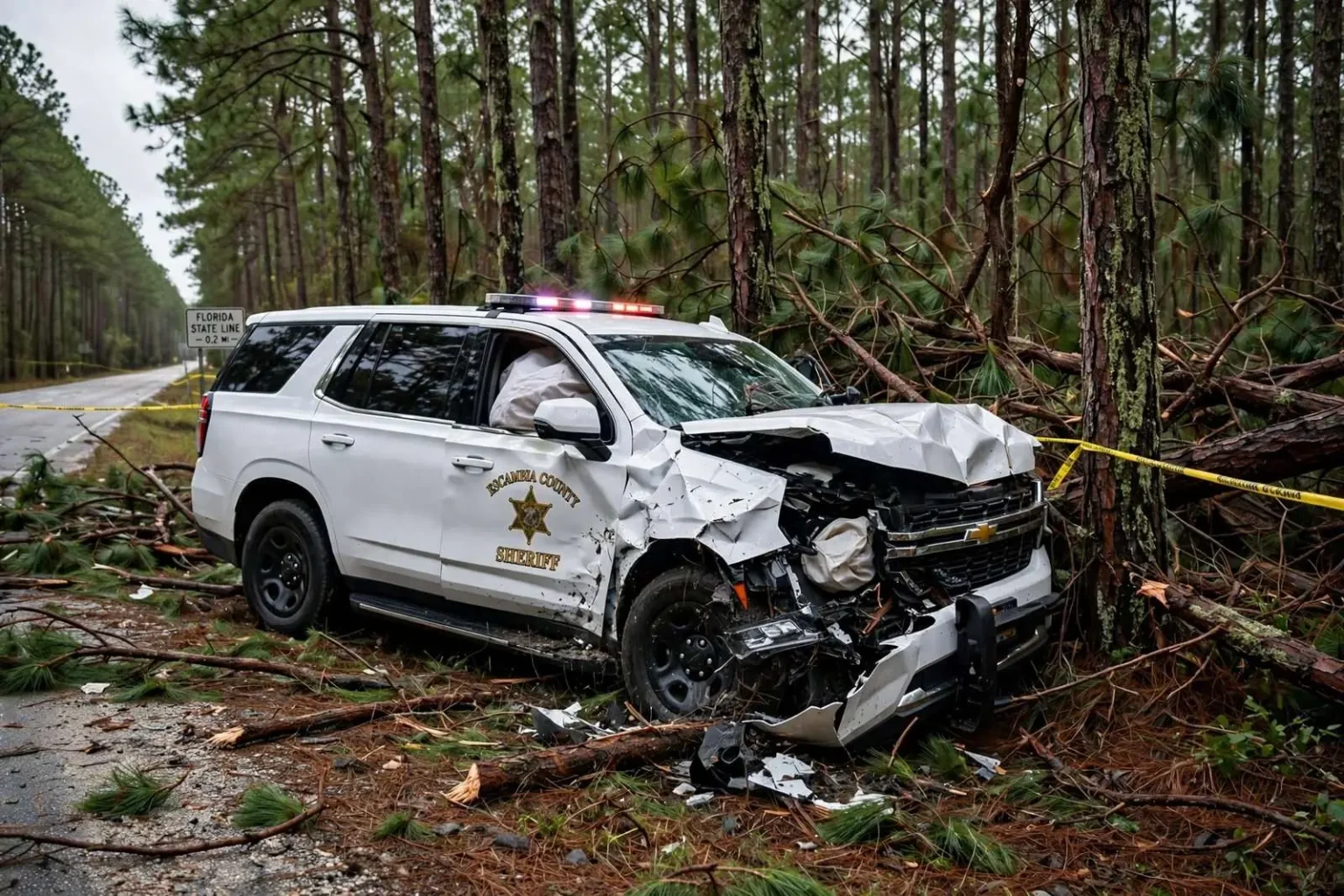
A deputy with the Escambia County Sheriff’s Office in Alabama was injured when her vehicle left the road during a pursuit that carried across the state line into Florida, authorities said. Sheriff Heath Jackson said the deputy lost control of her Tahoe and struck several trees. According to the sheriff, her injuries were limited to bruising and she is expected to recover. The chase began in the Flomaton area of Escambia County before crossing into Florida. No further details about the pursuit or its outcome were released by the sheriff’s office.
The crash was the occupational hazard every deputy in a rural border county knows by heart. A pursuit that starts in the Flomaton area — where Alabama’s Escambia County presses against the Florida line — can cross the state border in the time it takes a dispatcher to relay the description. State lines mean nothing to a fleeing driver, and they change surprisingly little for the pursuing one: deputies keep driving, while radios, jurisdictions and legal boundaries complicate everything that happens next.
In this case, the pursuit ended the way too many do: not with an arrest but with a wreck. The deputy lost control of her Tahoe on a Florida road and struck several trees. The trees took the impact, and the deputy — according to Sheriff Heath Jackson — walked away from the wreckage with bruising and an expected recovery. Given the violence of a vehicle leaving the road at pursuit speed and meeting timber, the outcome was a fortunate one, and everyone involved knew it.
Flomaton and the state-line chase corridor
Flomaton sits at the southeastern corner of Alabama, a small Escambia County town whose geography is defined by the state line it straddles. U.S. Highway 29 and the rail lines that built the town run straight through it into Florida, and the crossings around Flomaton and nearby Brewton-to-Pensacola corridors carry daily traffic between the two states. For the Escambia County Sheriff’s Office, the border is not an abstraction; it is a feature of nearly every serious pursuit that starts in the county’s southern end.
A driver heading south out of Flomaton can be in Florida in seconds. What follows is governed by interstate pursuit agreements and mutual-aid custom: Alabama deputies continue the chase into Florida as the pursuing agency, while Florida authorities — county sheriffs, municipal police, and eventually the Florida Highway Patrol — are notified and begin to position. Which agency ultimately leads, and where an arrest must be booked, are questions that get sorted out during and after the run, not before it.
The terrain adds its own dangers. The pine forests of south Alabama and the Florida Panhandle line their rural roads with ditch banks and trees planted close to the pavement, and a vehicle that leaves the road at speed meets them hard. Deputies know the arithmetic: the same trees that shade the highway in July will end a pursuit violently when a Tahoe leaves the road at sixty miles an hour.
Inside a law-enforcement pursuit
Every pursuit begins with a decision that looks different in the moment than it does afterward. A deputy who initiates a stop believes the driver will pull over; the moment the driver instead accelerates, the deputy is managing a rolling risk calculation — the seriousness of the suspected offense against the speeds, traffic and road conditions of the chase. Policies across Alabama and Florida require deputies to keep assessing that balance continuously, and to break off when the danger to the public outweighs the need to stop the vehicle.
The Tahoe, in this case, was the standard platform of American rural policing: a full-size SUV capable of highway speeds and equipped for the crash-worthiness that pursuits demand. Even so, the machines and their occupants are subject to the same physics as any other car. A high-speed turn, a patch of gravel, an animal in the road — any of it can end a pursuit at the roadside instead of the arrest. The deputy’s loss of control and collision with several trees was the abrupt, unforgiving version of that truth.
The bruising injuries Sheriff Jackson described put the deputy on the short list of lucky outcomes in tree-line crashes. Vehicles strike trees with no crumple zone to speak of; the tree does not move, and the cabin decelerates instantly. Seat belts and airbags do the rest, and in this case they apparently did enough. The sheriff’s account that she is expected to recover was the good news in an otherwise unrecorded incident.
What the sheriff’s office said — and did not say
The public account of the incident was deliberately narrow. Sheriff Heath Jackson confirmed the essentials: a deputy injured, a Tahoe that left the road and hit trees, bruising and an expected recovery, a chase that began around Flomaton and crossed into Florida. What the sheriff’s office did not release was everything else — why the pursuit began, who was being chased, how fast the vehicles ran, where exactly the crash occurred, and whether the fleeing driver was ever caught.
That restraint is both policy and prudence. An active pursuit is an active case, and the details of why a chase started can determine the legal exposure of everyone involved. Until the person being pursued is identified and charged, offices routinely decline to describe the underlying offense, because every word in the public record becomes part of the case file the defense will read. The sheriff’s brief statements preserved the deputy’s condition — the piece the public most wanted — while holding the rest for the investigation.
The omissions also reflect how border-county pursuits actually close. The chase that crossed into Florida became, at minimum, a two-state incident: Alabama’s sheriff’s office investigating its deputy’s crash, Florida authorities handling whatever happened on their side of the line. Coordination between those inquiries takes days, and the public narrative often never catches up. Many border pursuits end with the driver escaping on foot into pine woods, being picked up hours later, or surfacing in another county’s jail — outcomes that reach the public slowly, if at all.
The risks of the job on rural roads
Nationwide, vehicle incidents — crashes and pursuits alike — are among the leading causes of line-of-duty deaths for law enforcement officers, ahead of gunfire in most years. The deputies who patrol rural counties spend their shifts on exactly the kind of roads where that risk concentrates: two-lane highways edged with timber, long sight lines that invite speed, and long gaps between patrols that make every stop feel like it matters.
Escambia County, Alabama, is a compact county of small towns — Flomaton, Brewton, East Brewton, Atmore on its northern edge — where the sheriff’s office is the primary law-enforcement presence outside municipal limits. Deputies there cover wide territories with small shifts, and when a driver runs, the decision to pursue carries the added knowledge that backup may be many minutes away. A solo deputy in a crash on a Florida pine road, as this incident showed, is a long way from the nearest helping hand until other agencies arrive.
The deputy’s expected recovery will return her to service; the county’s fleet will absorb the loss of the Tahoe as a cost of doing business. What the incident leaves behind is the familiar after-action review: dispatch recordings, dash camera footage, a reconstruction of the crash, and the policy questions every agency asks after a pursuit ends in injury — when it began, whether it should have continued across the line, and what could have ended it sooner.
Cooperation across the line
For all the legal complexity a state line adds, the normal course of an incident like this one is cooperation. Alabama and Florida agencies along the border work the same criminals, share the same dispatch channels and assist each other daily. An Alabama deputy crashed on a Florida roadside will be found by Florida responders first; her agency will learn the details of her rescue from the agencies that performed it. The reverse happens just as often, with Florida deputies chasing drivers north into Escambia County, Alabama.
The pursuit that injured the deputy began in the Flomaton area, crossed the line, and ended with her Tahoe against the trees — a sequence that compresses into a few sentences but unfolds over minutes of radio traffic, sirens and split-second decisions. The sheriff’s office released no further details about the pursuit or its outcome, and this account preserves the incident as authorities stated it: a deputy hurt, expected to recover, and a chase whose full story was never made public.
For residents along both sides of the border, the episode is a reminder of what the patrol cars flashing past them are actually doing. Deputies in Escambia County’s towns chase stolen cars, fleeing felons and impaired drivers down these same highways, across this same line, every year. Most end quietly. This one ended in a stand of Florida pines — and, fortunately, with the deputy expected to come back to work.