Escambia County Sheriff Eases Martial Law Fears, Calls for Shoppers to Stop Hoarding
Escambia County Sheriff David Morgan addresses COVID-19 fears, calls for shoppers to stop hoarding and assures no martial law.
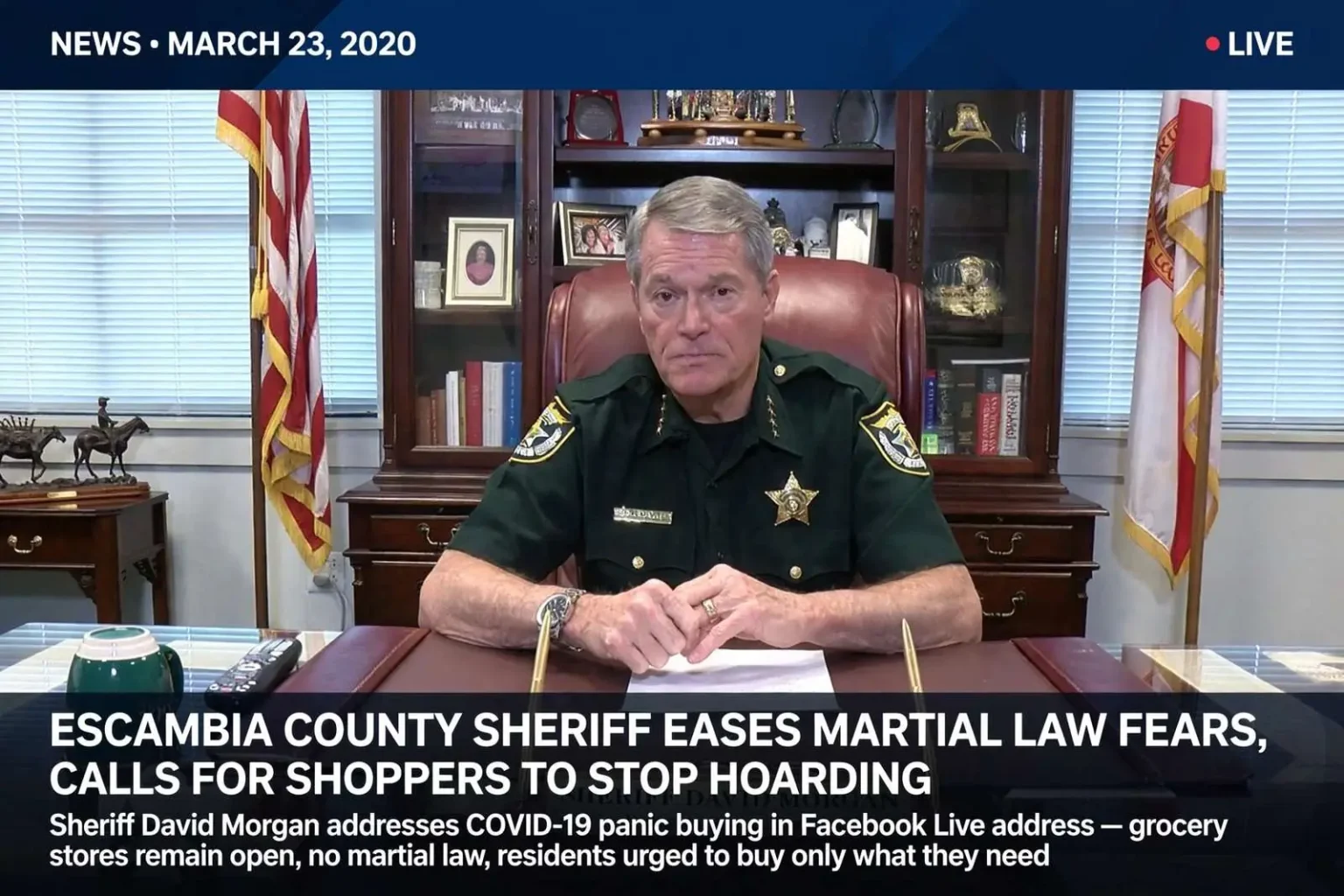
Escambia County Sheriff David Morgan took to Facebook Live Monday to ease the fears of citizens in the area who are panicking amid the Coronavirus crisis. Sheriff Morgan called for people to stop hoarding items from the grocery store and assured everyone that grocery stores will remain open even if there is a statewide or national shutdown, delivering his message directly to residents at a moment when empty shelves and viral rumors had frayed nerves across the region.
The video address came during the earliest and most disorienting stretch of the pandemic, when uncertainty about what closures might be coming next drove shoppers across the Gulf Coast to stockpile food, paper goods and cleaning supplies faster than stores could restock them. Morgan, whose jurisdiction includes communities along Florida’s western edge near the Alabama line, used the department’s social media platform to speak to residents without the filter of a press conference.
“There Is No Need for You to Hoard”
“There is no need for you to hoard any goods and services,” Sheriff Morgan said. “It’s going to be there in the grocery stores. The grocery stores are part of that supply chain which are necessity items for the sustaining of life.”
The sheriff’s point addressed one of the central anxieties of the moment: the fear that a statewide or national shutdown would cut off access to food and essentials. Federal and state emergency guidance at the time consistently classified grocery stores, pharmacies and other food retailers as essential businesses that would remain open even under the strictest stay-at-home orders, and Morgan leaned on that framework to tell residents their stockpiling was unnecessary.
Store Shelves Empty
Across the area, the panic buying had visible effects. Many grocery stores limited high-demand items like toilet paper and water to one pack per customer, and many store shelves were still empty. The shortages were not the product of any actual break in the food supply, but of a surge in demand that outpaced normal stocking rhythms — a self-reinforcing cycle in which every empty shelf persuaded more shoppers to buy more the next time they found an item in stock.
“It’s been very frightening,” shopper Leigh Galloway said. Galloway said she’s been able to find what she needs but she has noticed some items running low. She, like the sheriff, hopes everyone will stop buying more than they need for the week.
“I mean the key is to share and be a kind person and to work with each other,” Galloway said.
Others like Eric Schmitz said he had to go to several stores to find one item. “It’s not good for people to do that because you’re risking more exposure if you’re having to go to three different stores just to get a few items,” Schmitz said.
Schmitz’s observation captured one of the ironies of panic buying: the hoarding that shoppers hoped would protect their households actually increased everyone’s risk, sending people into more stores, more lines and more contact with more people in the middle of a viral outbreak. Public health guidance at the time urged residents to limit trips out of the house, a goal undermined when no single store could supply a week’s necessities.
No Martial Law, No House Arrest
Sheriff Morgan also addressed concerns about a possible shutdown or stay-at-home order, moving to shut down rumors that circulated widely on social media in the pandemic’s early days. He says there will be no martial law and says people would still be able to leave their houses if they need to.
“Sheltering in place does not mean that you are a prisoner in your own home,” Morgan said. “You can certainly go to all those places that are essential services.”
The sheriff’s reassurance spoke to a genuine confusion that gripped many communities that spring. The phrase “shelter in place,” borrowed from severe-weather and hazardous-materials language, led some residents to imagine soldiers at roadblocks or arrests for stepping outside. In practice, the orders being discussed across the country restricted gatherings and nonessential business activity while explicitly allowing grocery shopping, pharmacy visits, medical care, outdoor exercise and travel to essential jobs.
For a sheriff, the message carried practical weight as well. Law enforcement agencies in the region were being asked to answer pandemic-related calls, enforce new public health rules where applicable and maintain normal public safety services, all while protecting their own deputies from exposure. Clearing up misconceptions about martial law reduced the volume of panicked calls and let deputies focus on genuine emergencies.
The Supply Chain Behind the Shelves
Morgan’s assurance that groceries would remain stocked rested on how the food distribution system actually works. Grocery retailers operate on thin inventories and frequent deliveries, so a sudden spike in demand — everyone buying two weeks of goods in the same weekend — empties shelves even though trucks continue to run. Once purchases returned to normal weekly quantities, the stores’ restocking cycles could catch up, which is precisely what officials asked the public to allow.
The panic buying episode that prompted the sheriff’s video played out in communities across the country in those early weeks of the pandemic. Bottled water, toilet paper, hand sanitizer, canned goods and cleaning supplies were the most commonly stripped items, and stores responded with purchase limits, signage and, in some cases, dedicated early-morning hours for elderly and vulnerable shoppers.
Community Response and the Weeks Ahead
The sheriff’s Facebook Live format reflected how local officials were communicating during the crisis. With public meetings canceled and news cycles dominated by shifting statistics, social media video allowed sheriffs, mayors and health officers to speak to residents directly, answer the concerns surfacing in comments and push back against rumors in real time.
For Escambia County residents, the takeaway from the sheriff’s address was straightforward: the grocery stores would stay open, the shelves would refill, and any stay-at-home measures on the horizon would allow people to buy food, seek medical care and take care of essential business. What the moment required, as both the sheriff and the shoppers he quoted suggested, was patience and consideration for neighbors — buying what a household needs for the week, leaving stock for the next customer and keeping trips out of the house to a minimum until the crisis passed.
Morgan’s message closed the loop between public safety and public calm. In a pandemic, a sheriff’s office deals not only in crime and emergencies but in reassurance — and that Monday, the reassurance was that no one needed to fear going hungry, and no one was about to be confined to their home.
How Panic Buying Took Hold Across the Gulf Coast
The phenomenon Sheriff Morgan addressed was not unique to his county, and that was precisely why his office stepped into the conversation. Beginning in late February and early March of 2020, reports of hoarding in other parts of the country spread faster than the virus itself, and images of bare shelves in other states primed shoppers everywhere to grab what they could before their own local stores ran out. The behavior was rational at the level of the individual household and destructive at the level of the community — a textbook collective action problem that local officials spent weeks trying to talk their way out of.
Grocery workers bore much of the burden of that moment. Store employees faced relentless restocking cycles, growing customer frustration and, in an era before masks and vaccines, elevated exposure risk of their own. Purchase limits such as the one-per-customer rules on toilet paper and water were as much a protection for the next shopper as a matter of inventory management, and they remained in place in many stores long after the worst of the initial rush had passed.
Public officials at every level made the same appeal Morgan did. Governors, mayors, health officers and agriculture department leaders across the country repeated the central fact of the food system: the supply chain was functioning, shipments were arriving, and the empty shelves reflected distribution timing rather than scarcity. The message was consistent because it needed to be — every rumor of an imminent shortage triggered another wave of buying that made the rumor briefly true.
What “Essential” Meant Under Stay-at-Home Orders
Morgan’s answer on martial law and confinement aligned with how emergency orders were actually drafted. The lists of essential activities in the orders debated and adopted around that time consistently included shopping for groceries and takeout food, obtaining medical care and prescriptions, caring for family members, traveling to essential jobs and getting outdoor exercise close to home. Enforcement, where it happened at all, targeted businesses operating against the rules — crowded bars, gyms, theaters — rather than individuals running ordinary errands.
Sheriffs’ offices occupy a particular position in that landscape. In many communities the sheriff is an independently elected official whose views on enforcement carry weight with rural and suburban residents who may not follow city leadership, and Morgan’s video reflected an awareness that law enforcement’s tone in a crisis shapes public behavior. Promising no martial law was both an accurate description of the legal reality and a deliberate effort to keep panic from metastasizing into fear of government itself.
The Longer Arc of the Crisis
The panic-buying wave that prompted the address eventually subsided, as shelves refilled and residents settled into the rhythms of shopping less frequently and planning ahead modestly — a cart’s worth of extras rather than a bunker’s worth. But the episode left lasting lessons for the region: about the fragility of just-in-time retail inventories, about the speed at which social media amplifies scarcity, and about the value of a familiar local official standing in front of a camera to say, plainly, that the stores will stay open and the trucks will keep coming.
For Escambia County, the sheriff’s Monday video was an early artifact of a long crisis — the moment a top law enforcement official told his neighbors to put the extra packages back on the shelf, trust the supply chain, and save their exposure risk for errands that actually mattered. As Galloway put it, the key was to share and be a kind person and to work with each other. As Morgan put it, there was no need to hoard. Both, as it turned out, were right.