Escambia County students return to school with new safety measures in place
Students in the Escambia County School District in Pensacola, Florida returned to class with armed safety officers at every school and other changes.
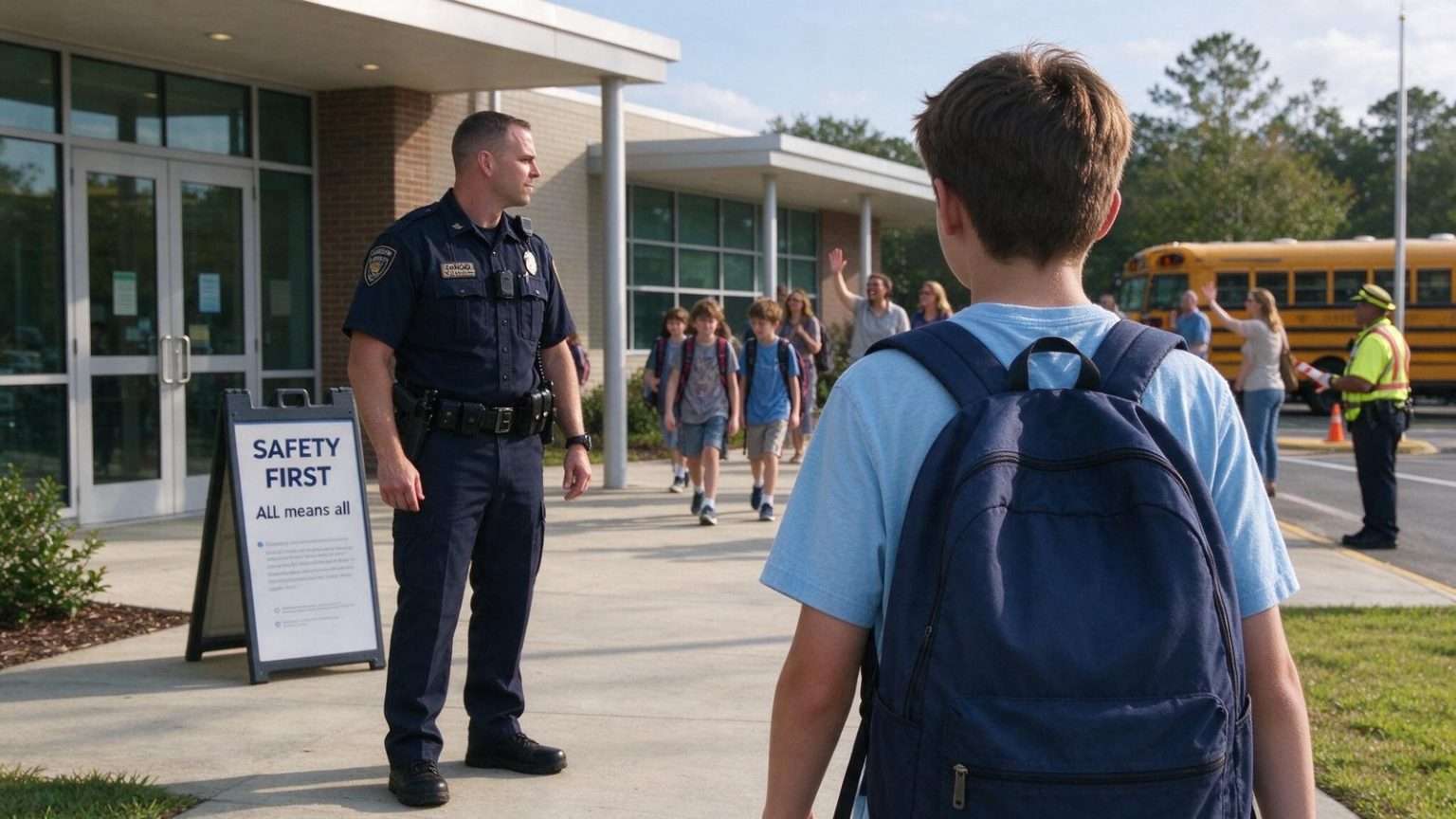
PENSACOLA, Fla. — Students in the Escambia County School District headed back to class Monday for the start of a new school year, and this year every school in the district has armed safety officers on campus from the first bell to the last.
The districtwide coverage of armed officers is the headline change in a security push that has moved quickly in the wake of national school shooting incidents and Florida’s evolving school-safety laws. For parents dropping off children at any of the district’s campuses — elementary, middle and high school alike — the presence of a full-time armed officer is now the standard, not the exception.
Superintendent Malcolm Thomas said the district also has several other changes in store for the new year, from campus relocations to the ongoing reminders that come with the first weeks of school traffic.
The first day brings its usual logistics — new bus routes, adjusted car lines, crowded sidewalks — but district administrators say this year’s opening is shaped as much by safety planning as by schedules.
Armed officers at every school
The commitment to place an armed safety officer at every school for the full instructional day is the most visible piece of the district’s security program. In previous years, officer coverage varied by campus, with staffing concentrated at secondary schools and shared or part-time arrangements at elementary sites.
The change reflects both state law and local resolve. Florida’s school safety legislation adopted after the Parkland shooting required every school to have either a school resource officer, a guardian-program participant or another armed protection on campus, and Escambia County has moved to fulfill that obligation at every site. The officers come through a mix of arrangements — deputies and officers assigned through agreements with the Escambia County Sheriff’s Office and local police departments, and district employees trained and certified for the safety role.
The Guardian Program, created by the same legislation, allows districts to arm carefully vetted school employees — often veterans or retired law enforcement officers — after completing a training program that includes firearms instruction, scenario exercises and annual recertification. Escambia County’s combination of resource officers and guardians lets the district cover every campus without waiting on agency staffing that is not always available in a competitive law enforcement hiring market.
District officials describe the officers’ duties as broader than security alone. School resource officers mentor students, teach on topics from internet safety to law enforcement careers, and serve as daily connections between campuses and the agencies that serve them. But the core mission this year is clear: an armed, trained adult on every campus whenever students are present.
Two campus moves
West Florida High School has moved from its Long Leaf Drive location to Burgess Road, and Success Academy, previously in Warrington, has relocated to the Long Leaf Drive site.
The swap reshapes the district’s footprint on Pensacola’s western side. West Florida High, the district’s career-and-technical magnet high school, takes over a larger campus on Burgess Road, while Success Academy — the district’s alternative school — moves into the Long Leaf Drive building it leaves behind.
Administrators have framed the moves as a better fit of buildings to programs. The relocation affects hundreds of students’ commutes, bus routes and pickup patterns, and district transportation and school leadership teams spent the summer communicating the changes to families to smooth the first-day transition.
The bus stop warning
Director of Transportation Steve Harrell reminded drivers to use caution around buses and students, and he brought statistics to make the point.
The district has found in past studies that many motorists fail to stop for school buses. ‘We average almost one stop arm violation per bus on the road for that day,’ Harrell said. ‘That is a very scary statistic. I implore the community to make sure when you see that stop arm come out you stop.’
The numbers mean that on a typical school day, each bus running its route in Escambia County is passed illegally — on average — about once. With dozens of buses on the road morning and afternoon, that adds up to hundreds of violations a day, each one a chance for a child stepping off the bus or crossing the road to be struck.
Florida law is explicit: drivers approaching a school bus from either direction must stop when the bus displays its flashing red lights and extended stop arm, and remain stopped until the arm is withdrawn. On undivided highways, traffic in both directions must stop. On divided highways with a raised or grass median, only traffic following the bus must stop. Violations carry fines and, in Florida, the possibility of a camera-recorded citation that reaches the vehicle’s owner by mail.
Why the violations happen
Transportation officials cite a familiar list of causes: distraction, impatience and unfamiliarity with the law’s requirements. The start of a school year sharpens the risk, as summer routines give way to buses on the road at hours drivers have not had to plan for since May, and as new student drivers join the traffic mix.
Harrell’s plea to the community pairs the legal warning with a practical one: the students around a stopped bus are unpredictable. They cross streets, drop belongings and dart after them, and they assume — as children do — that the adults driving around them are paying attention.
The district’s transportation department also uses the opening weeks to re-teach bus safety to students themselves: stay back from the curb until the bus stops completely, use the handrail, cross far enough in front of the bus that the driver can see them, and never return for a dropped item without the driver’s signal.
A district focused on the whole first week
The opening days of school in Escambia County layer all of these efforts together — officers on campuses, drivers adjusting to moved schools, bus routes settling in, and safety messaging aimed at both students and the motoring public.
Superintendent Malcolm Thomas has made the district’s safety posture a central theme of his administration, and the every-school officer coverage is the most visible result. District officials say parents with questions about security at a specific campus can raise them through school leadership, and that the first-week period includes reviews of each school’s emergency plans, drills and communication systems.
The district behind the changes
The Escambia County School District serves tens of thousands of students across Pensacola and the surrounding communities of Florida’s westernmost county — from the beach schools on Pensacola Beach to campuses in Cantonment, Bellview and the century-old neighborhoods around downtown. The district’s scale makes the first day of school a countywide logistical event, and changes at the district level — a new safety program, a campus move — reach families in every corner of the county.
West Florida High School’s move to Burgess Road is the kind of change that reshapes patterns beyond the school itself. The career and technical programs that define the school draw students from across the district, and the new location shifts commutes and bus routing for families who had planned around the Long Leaf Drive campus. District leaders have emphasized that the programs, not just the address, continue — the school’s aviation, health, culinary and technical tracks remain the draw that fills its enrollment.
Success Academy’s relocation to the Long Leaf Drive site similarly repositions the district’s alternative programs into a building designed for smaller enrollments, with room for the counseling and support services that alternative education requires.
What drivers should remember this week
For the motoring public, district and law enforcement officials boil the first-week advice down to a short list: leave earlier, expect buses and school zones, put the phone down, and stop — fully and on both sides of undivided roads — when a bus shows its stop arm.
The reminder is backed by enforcement. Sheriff’s deputies and police officers follow buses and run stop-arm enforcement details during the opening weeks of school, and the violation statistics Harrell cited came from exactly those observation efforts.
School zones bring their own rules back into force with the calendar: reduced speed limits during posted hours, crossing guards at the busiest intersections and stricter enforcement in the stretches around campus entrances. Officials ask drivers to treat the first weeks as a adjustment period for everyone — the students walking to school for the first time in months, the new bus drivers, the parents navigating drop-off lines, and the commuters who forgot what 7:30 a.m. looks like near a school.
Students, meanwhile, will spend their first days learning new buildings, new routes and new routines — including, at every campus in the district, knowing where their armed safety officer is and that the district’s promise of protection runs from the first bell to the last.