
Exceptional Foundation of Baldwin County Announces Fundraiser Dinner With Sarah Palin at Grand Hotel
The Exceptional Foundation of Baldwin County announced a major fundraiser dinner featuring Sarah Palin at the Grand Hotel Marriott in Point Clear.
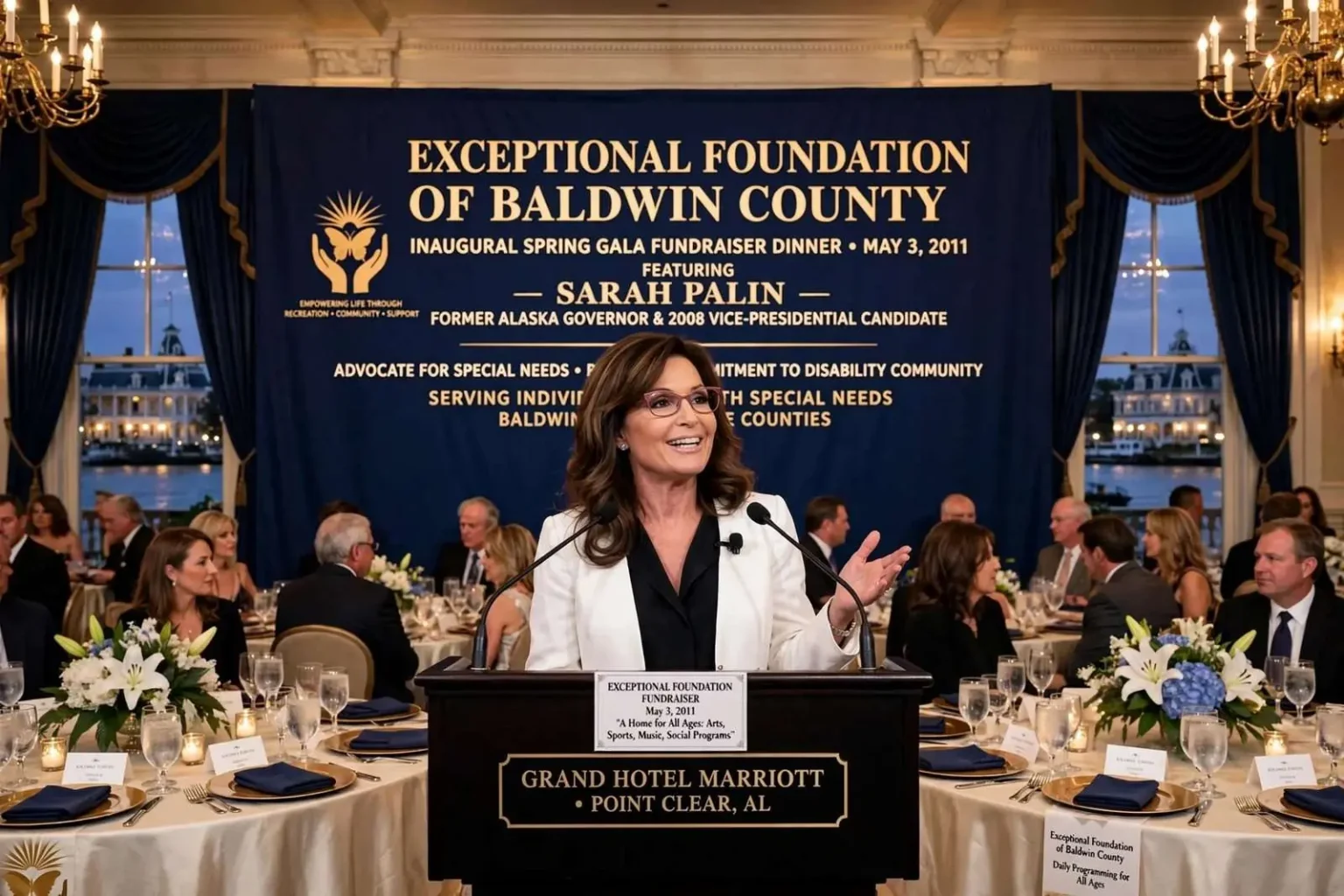
A newly incorporated Baldwin County nonprofit has set its sights on one of the largest single fundraising debuts in the region, announcing ticket sales for a spring 2011 gala headlined by former Alaska Governor and 2008 vice-presidential candidate Sarah Palin. The Exceptional Foundation of Baldwin County, dedicated to serving individuals with special needs along the Gulf Coast, scheduled the dinner for May 3 at the Grand Hotel Marriott in Point Clear.
The organization was founded to fill a gap its leaders saw across lower Alabama: individuals with mental and physical disabilities have access to educational and therapeutic services, but far fewer options for the social and recreational life that makes a community feel like home. The foundation planned to serve participants from age five through adulthood with daily programming spanning both Baldwin and Mobile counties.
A Headliner With a Personal Stake
Foundation President Bob Callahan said the group was enthusiastic about Palin’s involvement, noting that as a mother of a child with Down syndrome she brought a personal connection to the mission and to the families the foundation exists to serve. Her public experience raising a child with special needs made her, in the organizers’ view, more than a celebrity draw — a speaker who understood the daily realities of the audience in the room.
Palin’s appearance gave the young organization immediate visibility. Just two years removed from a national campaign, she remained a figure capable of filling a ballroom on her name alone, and gala organizers across the country had competed for her calendar. Landing her for an inaugural event in Point Clear was a statement of intent for a foundation that had not yet opened its doors.
Tickets, Tables and Tax Deductions
Event organizers built the fundraiser around tiered giving. Sponsor tables seating 10 guests were offered at the $15,000 and $10,000 levels, while individual open-seating tickets were priced at $600 per person, with tables of up to 12 available for individual supporters. Guests at the sponsor level were also offered photo opportunities with Palin during the evening, a perk that historically drives much of the top-tier sales at Gulf Coast charity dinners.
The deduction structure was a central part of the pitch. According to the Foundation, approximately 85 percent of the cost of an open-seating ticket and 90 percent of sponsor-level seating was tax deductible — figures that told prospective supporters the event’s overhead was thin and their dollars were going to programs rather than production.
The tier system also let the dinner serve two audiences at once. Corporate and family sponsors bought visibility and access at the top levels, while $600 open seating kept the room within reach of the broad middle of Baldwin County’s philanthropic community — the teachers, small-business owners and young families who would become the foundation’s long-term donor base.
The Mission: Daily Programming for All Ages
The Exceptional Foundation of Baldwin County was established as a nonprofit organization with a mission to address the social and recreational needs of individuals with mental and physical disabilities across Baldwin County, Mobile County, and the broader lower Alabama region. The organization planned to offer daily programming for participants ranging from children as young as five through adulthood, including arts and crafts, team sports, exercise classes, social events, and music activities.
That age span is the model’s defining feature. Most special-needs programming in the region is organized around school ages, leaving adults with disabilities with the fewest options of anyone in the community. A foundation built to serve a five-year-old and a thirty-five-year-old in the same organization commits to staying relevant across an entire lifetime of its participants.
The activity roster is equally deliberate. Team sports and exercise classes address health and fitness; arts and crafts and music activities build skills, confidence and self-expression; social events give participants friendships and families a network of neighbors navigating the same journey.
A Home in Daphne
Callahan also shared that the Foundation planned to begin operations on September 1, 2011, at St. Paul’s Episcopal Church in Daphne. The congregation, led by Rev. Thack Dyson, offered its facilities to help the organization get started, a partnership that gave the new nonprofit classroom, activity and gathering space months before it could have carried a lease on its own.
Callahan described the Daphne location as ideally situated for easy access throughout lower Alabama. From Daphne, families in Fairhope, Spanish Fort, Loxley and Robertsdale are a short drive away, and the bay crossings keep Mobile County participants within easy reach as well. Central location matters enormously for daily programming — a program families can reach on a weekday afternoon is a program families will use.
The church partnership also reflects how new nonprofits along the Eastern Shore have traditionally gotten started. Congregations with underused weekday space have hosted some of the area’s longest-running charities through their fragile first years, trading facilities for the kind of community good will that defines both institutions.
Point Clear’s Grand Stage
The May 3 venue carried history of its own. The Grand Hotel Marriott has anchored Point Clear since the nineteenth century, growing from a bayfront resort into the Eastern Shore’s signature site for major events. Its ballrooms have hosted the region’s most prominent galas, and for one evening the foundation’s inaugural dinner took its place in that tradition — with the bay as a backdrop and the hotel’s staff managing an event designed to impress first-time supporters.
Charity dinners at the Grand have long functioned as coming-out parties for Baldwin County organizations, and the foundation’s leadership used the setting to maximum effect: a national headliner, tiered sponsorships, photo opportunities and a tax-deduction profile designed to make giving easy.
From Gala to Opening Day
The timeline the foundation laid out in the spring of 2011 ran cleanly from fundraiser to launch: tickets sold through the spring, the Palin dinner on May 3, and daily operations beginning September 1 at St. Paul’s in Daphne. The four-month gap between event and opening gave organizers a window to convert gala attendees into volunteers, hire initial staff and prepare the programming calendar that would greet the first participants.
For families across Baldwin and Mobile counties, the arrival of the Exceptional Foundation promised something the existing service map lacked — a place where individuals with special needs could play sports, make art, take an exercise class and see friends, five days a week, from childhood through adulthood.
And for the region’s philanthropic community, the inaugural dinner made the organization’s ambitions plain. With a headliner whose family lived the mission, a venue steeped in the area’s history and a founding president talking openly about lifetime programming, the Exceptional Foundation of Baldwin County introduced itself the way it intended to operate: at full scale, serving the whole Gulf Coast.
Why Recreational Programming Matters
The distinction between therapy and recreation is at the heart of the foundation’s model, and it is the distinction most families along the Gulf Coast know best. Speech, occupational and physical therapy address specific deficits on scheduled appointments; recreation builds the rest of a life — friendships, fitness, confidence and a calendar full of reasons to get out of the house. For individuals with disabilities, that second category has historically been the scarcer of the two in Baldwin and Mobile counties.
Daily programming also changes the arithmetic for caregivers. A parent or sibling who can rely on structured activity every weekday — not just a weekly event — can hold a job, run errands and manage a household. Service organizations that operate daily are, quietly, workforce supports for hundreds of families whose needs would otherwise fall entirely on relatives.
Adaptive sports deserve particular mention. Team sports scaled to every ability level give participants competition, teamwork and the ordinary experience of practice and game day, and exercise classes build habits that counter the elevated health risks faced by adults with disabilities. Programs of this kind exist in larger cities; the foundation’s founders argued the Gulf Coast had outgrown the excuse of not having its own.
Two Counties, One Community
Serving both sides of Mobile Bay from a single base was a defining choice. Baldwin County’s growth had already made it one of Alabama’s fastest-growing counties, and families of children with special needs had moved east across the bay in the same wave — often finding that services clustered in Mobile left them driving long distances. Mobile County families, meanwhile, faced the same gap in social and recreational programming.
A Daphne headquarters with reach into both counties let the foundation pool families, volunteers and donors into one organization rather than two smaller rivals. It also positioned the foundation to coordinate with schools, churches and existing service providers in both counties, filling holes in the region’s service map rather than duplicating what already worked.
The Fundraiser as Foundation
Every element of the May 3 dinner was engineered to launch an organization, not merely to entertain. The $15,000 and $10,000 sponsor tables provided the large gifts that give a new nonprofit working capital; the $600 open seats built a broad base of engaged supporters; the photo opportunities gave sponsors a memory of the night that outlasts the dinner; and the 85-to-90-percent deduction figures reassured donors that the money was going where promised.
Palin’s role in that design was central. A speaker with a personal connection to special-needs advocacy could tell the mission’s story with authority, and her draw ensured the room would be full of people hearing about the foundation for the first time. First impressions made that night — at the Grand Hotel, in front of the Eastern Shore’s philanthropic establishment — would shape the organization’s reputation for years.
By September, the foundation intended to have moved from ballroom to daily programming, opening at St. Paul’s Episcopal Church in Daphne and beginning the work the gala had been built to fund: a place on the Gulf Coast where individuals with special needs of every age could find activities, friendships and a community built around them.