
Facing Her First Mother’s Day Without Her Son, a Mobile Mother Pleads for Answers in His Killing
A Mobile woman pleads for answers in the unsolved July 2020 shooting death of her son Gregory Sledge as police offer a $2,500 reward.
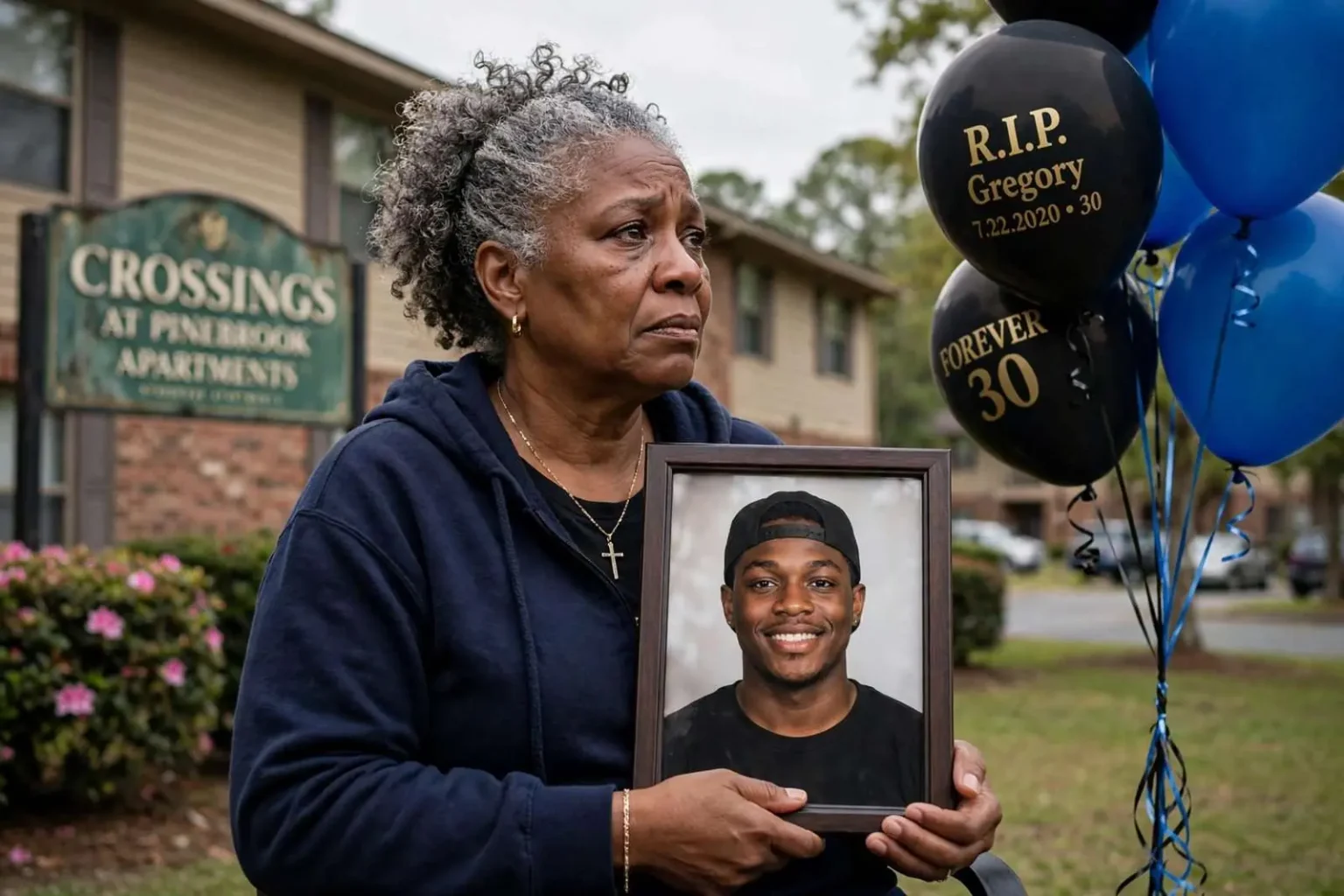
MOBILE, Ala. — Nearly a year after her son was gunned down at a Mobile apartment complex, Brenda Johnson is spending her first Mother’s Day without him — and still waiting for someone to be held accountable.
Gregory Sledge was shot to death the night of July 22, 2020, at the Crossings at Pinebrook apartments on Azalea Road. By the end of last year, his killing remained one of the few unsolved homicides in the city that year.
The loss has hung over every milestone since. Family and friends gathered last weekend to mark what would have been Sledge’s 30th birthday, releasing balloons in his memory — a small ritual that has become familiar at Mobile parks and apartment courtyards as families of homicide victims search for ways to keep their loved ones’ names alive while cases sit unsolved.
“I miss my son every day,” Johnson said. “It’s not a day that goes by that I don’t think about him. We all do. We all think about him. We all miss him because Greg was … the life of the party.”
She said the holiday drives home the loss. “So this is the first Mother’s Day that I have without him, and it’s sad.”
The Case That Remains Open
Sledge’s death came during a violent stretch in Mobile in the summer of 2020, when shootings rose across the city and strained the homicide unit that investigates them. The Crossings at Pinebrook complex sits along Azalea Road in west Mobile, a corridor of apartment communities where police have responded to repeated calls for service over the years, ranging from robberies to shootings.
When a homicide has no arrest by year’s end, it moves into the category of cold cases, but Mobile police stress that cold does not mean closed. Detectives continue to review evidence, re-interview witnesses and compare tips against phone records and surveillance footage as they surface. In many cases, the break that solves a shooting comes not from forensic science but from a single witness deciding, months or years later, to come forward.
That is what families like Johnson’s count on. Investigators know that the people most likely to know who pulled the trigger are often acquaintances of the victim or of the shooter, and the passage of time can loosen loyalties, cool fears of retaliation and make someone willing to talk who would not speak in the weeks after the crime.
Reward Still on the Table
In December, Mobile police announced a $2,500 reward for information leading to an arrest in the case. Rewards of that size are posted periodically in unsolved Mobile homicides, and officials view them less as a purchase of testimony than as a nudge — an added reason for a hesitant witness to pick up the phone.
Separately, Mobile Area Crime Stoppers allows tipsters to submit information anonymously, with no caller ID and no requirement to testify. Cash awards for anonymous tips that lead to arrests can run higher than police-posted rewards, and the program’s tip line has been credited with helping close cases that had sat dormant for years.
Johnson said she prays someone comes forward — and prays, too, for an end to the violence that took her son.
“We have to just pray for one another and pray that all this violence stops,” she said, “because taking a person’s life is never the right thing to do.”
A Mother’s Day Like No Other
Holidays are among the hardest stretches for families of homicide victims, grief counselors say, and Mother’s Day can cut especially deep when the lost child was an adult son or daughter. The day arrives with social media tributes, church acknowledgments and family gatherings, each one a reminder of an empty chair. Mobile’s faith community has long marked the holiday with services that recognize mothers who have lost children, and advocacy groups in the city hold vigils and balloon releases through the year for families living with unsolved cases.
For mothers in that position, the search for accountability often becomes a daily discipline: checking with detectives, sharing the case on social media, appearing at community anti-violence events and keeping the victim’s photograph in public view so the case is not forgotten. Victims’ advocates note that public memory is one of the strongest forces keeping an unsolved homicide active, because witnesses come forward far more often for cases they still hear about than for ones that have faded from the news.
Alabama also provides support structures aimed at these families. The Alabama Crime Victims’ Compensation Commission can help cover funeral and counseling costs for homicide survivors, and the state’s victim notification system alerts registered family members to major developments in a case, including arrests and court dates, once someone is charged.
The Weight of Unsolved Killings in Mobile
Mobile, like many mid-sized Southern cities, has wrestled for years with a homicide clearance rate that falls short of what families hope for. Detectives in the police department’s homicide unit carry multiple active cases at once, and each investigation competes with fresh calls for service. When a case goes more than a year without an arrest, it is typically handed to detectives who specialize in long-term investigations, though the original case detective often remains involved.
The consequences ripple outward. Unsolved shootings can feed cycles of retaliation when victims’ friends and relatives conclude that the justice system will not act, a dynamic community leaders across Mobile have warned about repeatedly. Faith-based anti-violence groups, neighborhood associations and the city’s own community policing efforts have all pushed for more witnesses to come forward, arguing that silence protects shooters and endangers the next family on the block.
Statistically, most homicide victims in Mobile are killed by someone they know or by an acquaintance of someone they know, and most are killed with handguns — patterns that hold across Gulf Coast cities. That reality shapes how investigators work cases like Sledge’s: the answers usually exist within a small circle of people, and the job is persuading one of them to speak.
Anyone with information about the death of Gregory Sledge is asked to call Mobile police at 251-208-7211 or submit a tip at mobilepd.org/crimetip. Tips can be made anonymously, and the $2,500 reward remains available for information leading to an arrest.
Waiting for Answers
Until an arrest comes, Johnson and her family mark the calendar the way so many grieving families in Mobile do — with balloon releases on birthdays, shared photographs on anniversaries and prayers at the family table. What she wants, she has made clear, is the thing no ritual can substitute for: the person responsible for her son’s death in custody, and a Mother’s Day that is not defined by an open case file.
How the Community Has Responded
Across Mobile, families of homicide victims have built their own networks of support, meeting at vigils, churches and annual remembrance events where mothers, fathers and siblings of the slain trade the kind of understanding that is hard to find elsewhere. Those gatherings double as pressure campaigns: speakers routinely call on witnesses to break their silence, and families hand out flyers with case numbers and tip lines at community events, keeping pressure on cases that no longer make the evening news.
City leaders have also responded to the broader violence problem with a mix of enforcement and prevention spending. Mobile has used federal grant funding to support gun violence intervention programs, community outreach workers who mediate conflicts before they turn deadly, and partnerships between police and neighborhood groups in the areas where shootings cluster. Advocates argue that those efforts matter most for the living, but that clearance rates are the measure families of the dead watch closest, because every unsolved case is a signal — fair or not — that a life can be taken without consequence.
For the Crossings at Pinebrook community itself, the shooting left its own residue. Residents of large apartment complexes where violent crime occurs often describe a lingering unease, and property managers typically respond with added lighting, cameras and patrols. None of that changes the outcome for a family like the Sledges, whose loss on that July night in 2020 is now measured in missed birthdays, missed holidays and a Mother’s Day that came and went without the son Brenda Johnson raised.
Her message to anyone who knows something about the case is the same one carried by families at vigils across the city: one call could end the waiting. Investigators can protect the identity of anonymous tipsters, rewards can compensate the risk, and a year’s passage has not erased the evidence. What is missing is a single voice willing to use it.
The Mobile Police Department’s tip line, 251-208-7211, and the online tip form at mobilepd.org/crimetip are staffed to receive information at any hour, and detectives reviewing the Sledge case can be requested directly by callers who prefer to speak with the investigator assigned to it.


