Fairhope Council Approves Emergency Funds to Repair Hurricane-Damaged South Beach Sea Wall
Fairhope's council approved $22,000 in emergency funds to repair the hurricane-collapsed sea wall at South Beach Park near the pier.
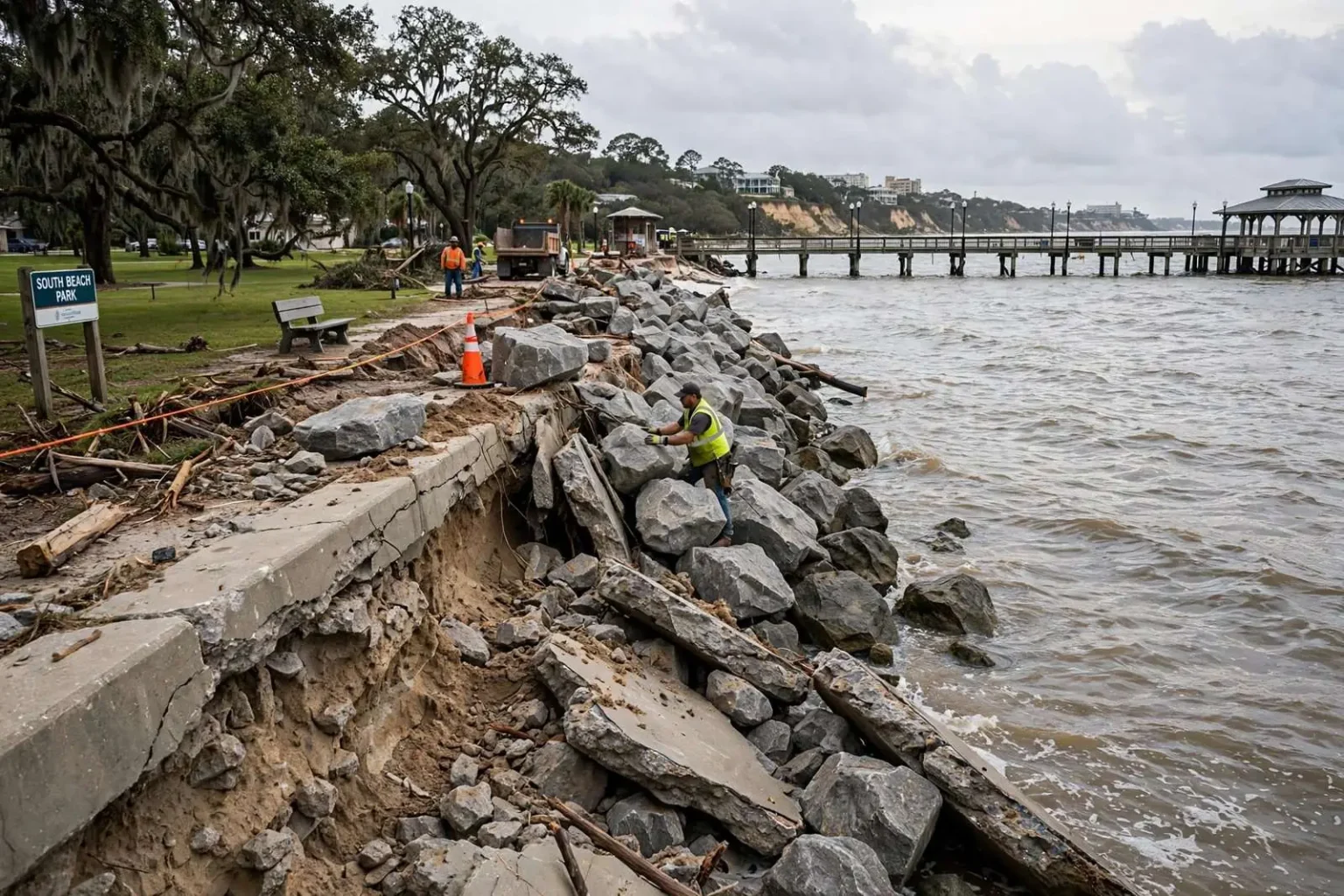
The Fairhope City Council has approved emergency funding to repair a section of sea wall that collapsed after Hurricane Zeta along South Beach Park, one of the busiest stretches of shoreline near the Fairhope Pier area. The emergency appropriation totals about $22,000 and comes from the city’s general fund, an unusually direct response to storm damage that city leaders decided could not wait for a normal budgeting cycle.
South Beach Park sits along the western edge of downtown Fairhope, where the city’s famous bluff slopes down to meet Mobile Bay. The park and the adjacent pier draw a steady flow of residents and visitors year-round: fishermen working the pier at dawn, families launching the day from the park’s beaches, and tourists who come to watch the sunset over the bay from one of the most photographed viewpoints on the Eastern Shore. When a section of shoreline fails there, it is not a hidden problem on some back cove. It is visible to nearly everyone who passes through the heart of town.
What Zeta Took From the Shoreline
Council President Jack Burrell said roughly 220 feet of shoreline was damaged by Hurricane Zeta, the storm that raked the central Gulf Coast with damaging winds and a significant storm surge after making landfall in Louisiana in late October 2020. Along the Eastern Shore of Mobile Bay, surge and waves chewed at bulkheads, piers, and beaches, and Fairhope’s low-lying shoreline parks took some of the worst of it. At South Beach Park, the damage left the bank exposed to the bay, with each subsequent tide and wind event pulling a little more land away.
Rather than hire outside contractors, city crews will handle the repair themselves. The plan calls for placing about 220 tons of large rock as rip rap along the damaged stretch, then backfilling with dirt to protect the bank behind it. Rip rap is a time-tested approach along Mobile Bay: the irregular rock absorbs wave energy instead of reflecting it back, which slows the scouring that hollowed out the shoreline in the first place. Burrell expected the work to wrap up within about two weeks, a timeline made possible by keeping the job in-house with city equipment and personnel.
Racing the Calendar and the Bay
Burrell framed the timing as deliberate. The goal was to complete the stopgap repair ahead of hurricane season, when a new storm could turn a damaged sea wall into a much larger and more expensive loss. Fairhope’s shoreline has been battered repeatedly in recent years by storms that pushed surge up the bay, and each repair undertaken before the next season begins is a race against the calendar.
“We are losing land here — we don’t want to lose any more to the bay,” Burrell said, explaining the urgency behind the emergency spending. The comment captures the arithmetic that shoreline communities along the bay face: every foot of eroded bank is public land and park space that will not come back on its own. For a city whose waterfront is central to its identity and its tourism economy, protecting what remains is not an abstraction. It is a line item that grows more expensive the longer it waits.
A Longer-Term Fix Is Already in Motion
The emergency repair is a stopgap, not the destination. A complete replacement of the park’s aging sea wall is expected to be folded into the city’s $6.2 million “Working Waterfront” grant project, funded through the RESTORE Act, which draws on the settlement money paid after the 2010 Deepwater Horizon oil spill. RESTORE Act funds were designed specifically to help Gulf Coast communities recover and restore their coastal environments and economies, and Fairhope’s waterfront program is exactly the kind of project the money was intended for.
The Working Waterfront project is still in its public input phase, meaning residents have an opportunity to shape how the money is spent before final plans are drawn. That process takes time — public meetings, design work, environmental review, and contracting all sit between an idea and a construction crew — which is precisely why the council moved on the collapsed section now. The rip rap and backfill will hold the line for the months or years it takes to deliver the permanent solution, and the temporary work does not preclude the larger project; it simply keeps the land from washing away while the paperwork advances.
The distinction between emergency work and grant-funded replacement illustrates how coastal cities have learned to operate. Small, fast, locally funded repairs respond to immediate failures. Large, slow, federally supported projects rebuild infrastructure for the long term. Fairhope is running both tracks at once, and the $22,000 emergency appropriation is best understood as the cost of bridging the gap between them.
More Work Just Down the Beach
The South Beach Park section is not the only piece of Fairhope’s shoreline needing attention. Just south of the sea wall at Magnolia Beach, shoreline trees were eroded by Hurricanes Sally and Zeta in the previous year, a one-two combination that hit the Eastern Shore with Sally’s near-direct landfall followed by Zeta’s surge. The council was also weighing an additional $17,000 to replenish sand at Magnolia Beach, a softer approach than rock placement.
Sand replenishment has a mixed record along the bay. Beach sand placed on an exposed shoreline can migrate with currents and storms, and the same waves that stripped the beach can strip the replacement unless the underlying bank is stabilized. City leaders weighing the spending were effectively deciding whether a modest sand investment buys enough time and beach to justify the cost, knowing that nature does not always cooperate with the plan.
The Pier’s Utility Service Returns
Separately from the emergency spending, the city planned to restore utility service to the Fairhope Pier later that week. The pier is more than a fishing platform; it anchors the downtown waterfront with a restaurant, meeting space, and public amenities that all depend on power and water. Storm damage that interrupts utility service to the pier quietly removes a large share of the waterfront’s usefulness, since visitors arriving to find closed facilities simply go elsewhere.
Restoring service was an early priority because the pier operates as the front door to the city’s whole waterfront experience. Fairhopers and visitors alike structure their visits around the pier area — parking nearby, walking the park, fishing off the pier, and watching the sun drop behind the bay. Getting utilities back online restored the basic services that make those visits possible, complementing the physical shoreline repairs happening a short distance away.
What It Means for the Community
For Fairhope residents, the sequence of events — storm damage, emergency repair, grant-funded planning — shows a small city managing a big problem the best way it can. The Eastern Shore’s waterfront property values, tourism traffic, and quality of life all rest on keeping the shoreline intact, and the pace of erosion is not waiting on anyone. Every year that passes without a durable sea wall is a year the bay takes another bite of South Beach Park.
The public input phase of the Working Waterfront project gives residents a direct stake in what comes next. Whether the final design emphasizes a hard replacement of the sea wall, natural shoreline elements, expanded park amenities, or some combination, the money has been awarded and the planning clock is running. In the meantime, the rock and dirt being placed by city crews represents a modest but consequential down payment: about 220 feet of Fairhope’s shoreline saved from the bay, ahead of hurricane season, while the permanent fix takes shape.
How the Emergency Process Works
An emergency appropriation like this one moves faster than ordinary city spending because the council votes to bypass the usual bidding and scheduling steps that govern routine work. The trade-off is that the city pays out of its general fund now rather than waiting for grant cycles or capital budgets to catch up. In Fairhope’s case, council members judged that the alternative — leaving 220 feet of damaged shoreline open to the bay through another storm season — carried far more risk than the $22,000 price tag.
The decision also reflects a hard lesson from recent hurricane seasons along the Alabama coast. After Sally and Zeta, municipalities across Baldwin and Mobile counties learned that small shoreline failures become large ones with a single tide event. A breach in a sea wall lets waves work directly on the soil behind it, and once that interior bank starts washing out, the repair bill multiplies. City crews placing rock quickly is the coastal equivalent of patching a roof before the next rain.
South Beach Park’s role in daily life in Fairhope made the repair a priority beyond simple asset protection. The park is where youth groups gather, where walkers finish their morning routes, and where many of the city’s public events touch the water. Its shoreline is arguably the most used piece of public coast in the city. Keeping it whole, even with a temporary fix, protects both the land and the routine of thousands of residents who treat the waterfront as an extension of their own backyards.