Fairhope police warn of counterfeit money circulating in the city
Fairhope police say counterfeit currency is circulating after juveniles tried to pass a fake $100 bill and a business took a counterfeit $50 bill.
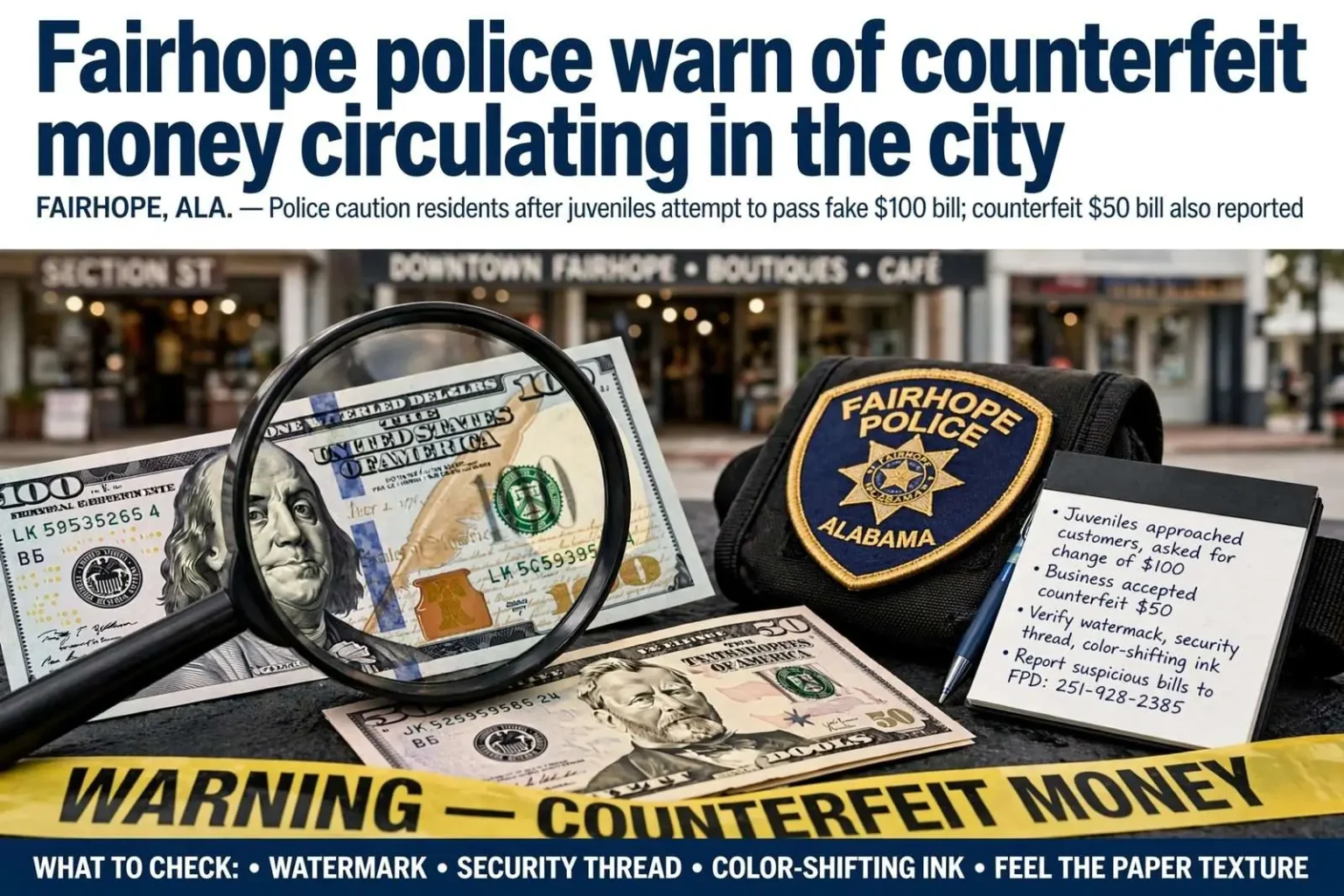
FAIRHOPE, Ala. — Fairhope police are warning residents that counterfeit money has been circulating in the city after several juveniles were seen trying to pass a fake $100 bill. According to a post on the Fairhope Police Department’s Facebook page, the children were seen Wednesday evening approaching customers at a local store and asking them to make change for a $100 bill. Soon after, a business reported that an employee had accepted a counterfeit $50 bill.
Investigators have not determined whether the two incidents are related, and the department’s public post stopped short of connecting the juveniles to the counterfeit $50 that surfaced later. What police could say plainly was that fake currency was moving through the city’s shops, and that both the change-making approach and the accepted bill were the kinds of encounters local businesses needed to watch for.
The change-making scam
Asking strangers to change a large bill is one of the oldest methods of testing counterfeit currency, and it works by shifting the risk. A customer at a register verifies a bill under store lighting with a clerk who has training or at least a reference; a person on a sidewalk has neither. Someone holding a fake $100 bill can approach a series of pedestrians and ask for change, hoping someone will trade real twenties for the fraudulent bill without examining it. Each refusal costs nothing, and a single success makes the effort worthwhile.
The approach also carries an innocent explanation that lowers suspicion. Plenty of legitimate people need change for a large bill, and most residents are reluctant to accuse a stranger — particularly a young one — of passing fake money. Police departments that publicize this pattern, as Fairhope’s did, are asking residents to keep the second look alive: if a stranger offers a large bill for change on the sidewalk, examine it the way a store clerk would or politely decline.
How to spot a counterfeit bill
U.S. currency carries several security features that the department reminded the public to check, and they take only seconds to confirm. On the redesigned $100 bill, a blue three-dimensional security ribbon runs vertically through the paper, woven into the note rather than printed on it; images of bells and 100s shift as the bill is tilted. The bell inside the inkwell changes color from copper to green. The portrait watermark, visible from both sides when held to light, matches the portrait printed on the face, and the security thread glows pink under ultraviolet light.
The $50 bill follows the same design logic. Its security thread glows yellow under ultraviolet light, the watermark shows President Ulysses S. Grant’s portrait, and color-shifting ink on the numeral changes from copper to green as the note is tilted. The feel of the paper matters too — genuine currency is printed on a cotton-linen blend with a raised texture from the intaglio printing process that counterfeits on standard paper cannot reproduce. Clerks are trained to check bills of $20 and above during busy hours, and the simplest habit is holding every large bill to the light for the watermark and thread.
Counterfeiting is a federal crime
Passing or possessing counterfeit currency is a federal offense investigated by the U.S. Secret Service, the agency created in 1865 for precisely that mission. Local police handle the initial report, seize the fake bills as evidence, and coordinate with federal partners; businesses that accept a counterfeit bill absorb the loss, since no reimbursement exists for currency confirmed to be fake. That last point is the practical sting behind incidents like the one Fairhope businesses experienced — the employee who accepted the counterfeit $50 cost the business its full value, plus the legitimate goods or services it was exchanged for.
For juveniles, involvement in counterfeit schemes raises a separate set of questions. Cases involving minors are handled with an eye toward interventions that adult prosecutions do not offer, and police departments often use public warnings rather than charges when juveniles are identified in low-level incidents. The department’s decision to describe the juveniles’ actions publicly, without naming them, fit that approach: alert the community, document the behavior, and leave the determination of what followed to the investigators.
Fairhope’s business community is the natural target for this kind of activity, and that is part of what made the warning useful. The city’s downtown along Section Street and Fairhope Avenue draws heavy foot traffic from shoppers and visitors to the Eastern Shore, with boutiques, restaurants, and galleries whose registers turn over cash steadily during tourist season and holiday periods. High transaction volume and unfamiliar customers make a downtown like Fairhope’s exactly the environment counterfeit passers look for, and local police departments along the coast routinely refresh merchant awareness when fake bills surface.
What businesses should do
The department’s reminder carried the standard advice that retail associations and the Secret Service distribute to merchants. Train every employee who touches the register on the basic checks — watermark, security thread, color-shifting ink — and post a reference card at the counter. Use counterfeit-detection pens as a first screen while understanding their limits: the iodine pens detect wood-pulp paper but not bleached and reprinted genuine currency, so they supplement rather than replace the security-feature check. Compare a suspect bill against a known genuine one of the same denomination, since differences in portrait detail, border engraving, and paper texture become obvious side by side.
If a business receives a counterfeit bill, the guidance is consistent: keep the bill if the passer leaves it, handle it as little as possible, note the description of the person and any vehicle, and call the police. Do not return a bill you know to be fake to the passer, and do not attempt to pass it on to someone else — knowingly doing so is itself a crime. The seized bill goes into the evidence chain, where it may connect to other incidents and support a larger investigation, exactly as the counterfeit $50 reported in Fairhope became part of the record police used to warn the public.
Reading the two incidents together
The Wednesday evening sequence — juveniles seeking change for a fake $100, followed by a report that an employee had accepted a counterfeit $50 — presented investigators with a familiar evidentiary puzzle. The denominations differed, the methods differed, and the connection between the two was unproven. Fake currency investigations often turn on exactly such links: surveillance video from the store where the bill was accepted, descriptions from the customers who were approached, and patterns matching other reports in the area. Until those threads connect, police treat the incidents separately while alerting the public to both.
The department encouraged anyone with information to contact the department directly, the standard closing to such warnings and an invitation aimed at the store’s customers, nearby businesses, and anyone who recognized the pattern from other communities. Tips about where the bills came from, who was passing them, and how many may be in circulation all help investigators map the problem faster than the reports of accepted bills alone.
A small city, a national problem
Counterfeit currency flows respond to technology the way other crime does. Consumer printers and bleaching techniques made passable fakes more accessible than they were a generation ago, which is why the redesigned bills with their layered security features entered circulation and why merchant education remains an ongoing task rather than a one-time briefing. Communities along the Gulf Coast, with their seasonal surges of visitors and cash-heavy events, see the warnings regularly.
For Fairhope residents, the episode was a reminder to do what a good clerk does automatically: look at the money. Hold large bills to the light, feel the paper, tilt the note and watch the ink shift. The juvenile approach outside a local store and the counterfeit $50 accepted inside one happened in a single evening, and whether they were connected or coincidental, the department’s advice to the city was the same in either case — the security features are there to be checked, and checking them costs nothing but a second.
The juvenile element of the case also explains the department’s measured public posture. When young people are involved in minor property offenses, police agencies balance several goals: documenting the conduct, protecting the identities of minors, notifying the affected businesses, and steering the behavior away from escalation. A public warning that describes the pattern without charging anyone accomplishes most of those goals at once, and it puts every shopkeeper in the city on notice without turning a Wednesday evening incident into a lasting record for children whose role in the scheme was not yet established.
Residents who encounter the change-making approach have options short of confrontation. Declining politely ends the exchange; examining the bill and reporting a fake gives police a description worth having. What experts advise against is accepting the bill and forgetting about it — the single lost transaction matters less to an investigator than the pattern, and patterns are built from reports. A phone call to the department after a sidewalk encounter takes minutes and can link one approach to a string of them.
The counterfeit $50 accepted at the business, meanwhile, serves as the concrete reminder of what is at stake in those seconds of checking. Someone’s regular workday included ringing up a sale, making change, and absorbing a loss that no one will reimburse. Multiply that evening’s events across a tourist season and the arithmetic becomes the reason police departments along the Eastern Shore invest in merchant outreach: prevention at the register is where counterfeit currency is actually stopped, and every clerk who instinctively tilts a bill toward the light makes the city a harder place to pass a fake.