
Fairhope-Registered Plane Crashes in Illinois; Good Samaritan Describes Rescue of Family
A plane registered in Fairhope crashed in Illinois with four family members aboard. A Good Samaritan describes pulling victims from the wreckage.
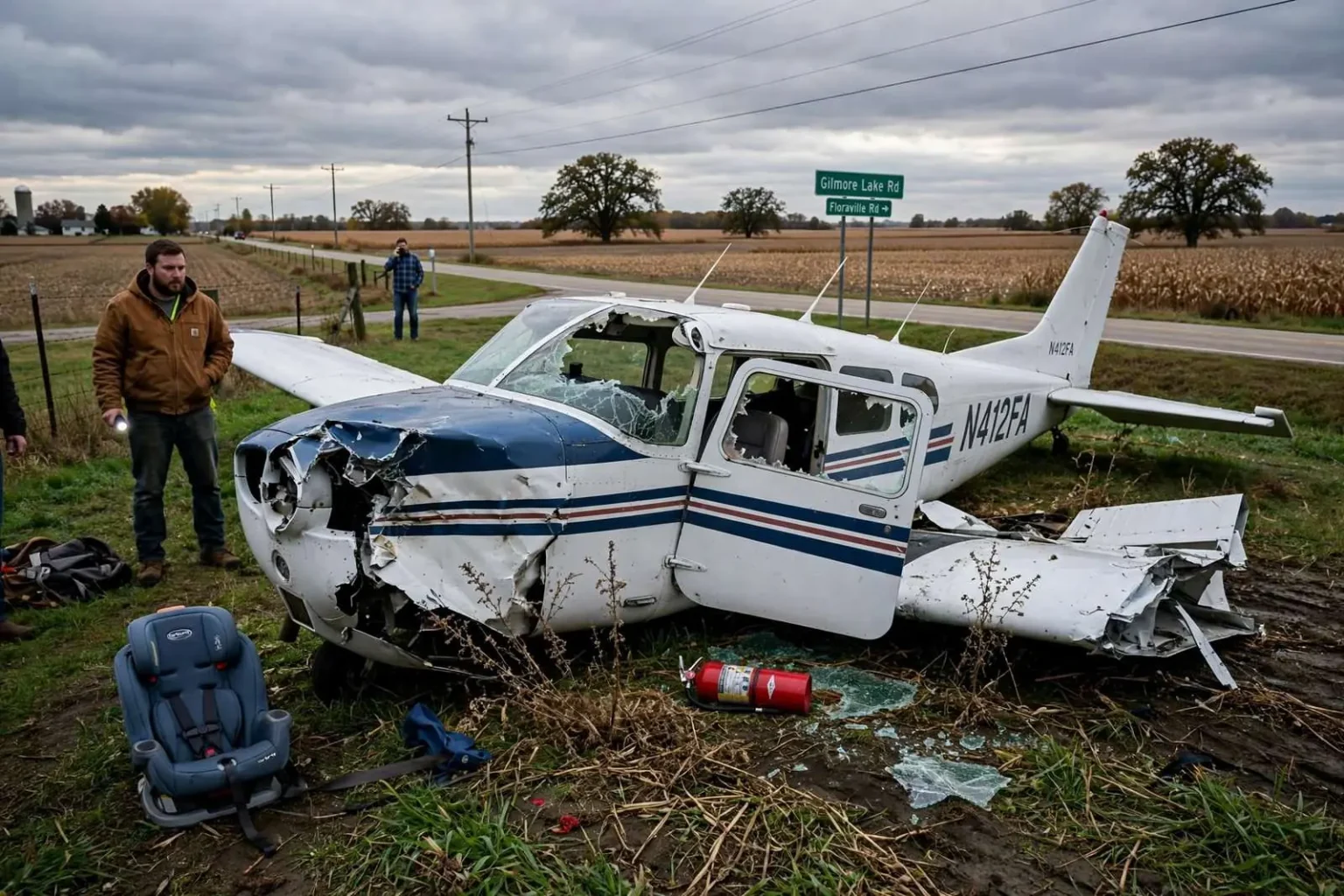
Four members of a family, including a toddler, were aboard a small plane that crashed in Monroe County, Illinois, Tuesday afternoon. The aircraft is registered to a man in Fairhope, Alabama, and had left the downtown airport in Mobile earlier that day before going down in a rural stretch of southern Illinois. The condition of those aboard has not been publicly detailed, but the quick actions of a neighbor who lives near the crash scene are being credited with reaching the family fast.
According to CBS affiliate KMOV in St. Louis, a man who lives near the crash site rushed to help after the plane went down. He described a scene that could have turned far worse within minutes. “There was fuel leaking out of it,” he said. “My wife was already on the phone with 9-1-1. I found a fire extinguisher lying right next to it. Myself and another gentleman that stopped, we broke the windows out.”
The crash site was near Gilmore Lake Road and Floraville Road, northeast of Waterloo. The area is made up of farm fields, scattered homes, and two-lane roads, which meant the first people on scene were residents rather than emergency crews. In rural crashes like this one, those first minutes often belong to Good Samaritans, simply because an ambulance or fire engine may be many miles away when a plane comes down.
The Good Samaritan described the moment he and the other motorist realized there was a child inside the wreckage. “That’s when we heard the child crying,” he said. “We broke out the window and cut the seatbelt. He was in a car seat.” The detail underscores how quickly the rescue unfolded — from spotting the downed aircraft, to breaking out the windows, to cutting a toddler free from a car seat in a damaged cabin.
Why the First Minutes Matter in a Small Plane Crash
Aviation safety experts have long noted that survival in general aviation accidents frequently comes down to what happens in the moments right after impact. A leaking fuel line or ruptured tank can turn a survivable crash into a fatal fire, and occupants who are injured or disoriented may be unable to get themselves out. Fire extinguishers, seatbelt cutters, and bystanders willing to break windows have all made the difference in small-plane crashes across the country.
Crashes involving family travel also tend to involve child restraint challenges. Toddlers fly in car seats that must be cut or unbuckled quickly in an emergency, and a proper child restraint system, while recommended by the Federal Aviation Administration for children on board aircraft, can complicate an escape if the fuselage is damaged. That the boy was found crying and conscious in his car seat was, by any measure, fortunate.
Monroe County sits just southeast of St. Louis along the Mississippi River, with Waterloo serving as its county seat. The county is predominantly rural, and its emergency services are organized around volunteer fire departments and a county sheriff’s office, with trauma-level care typically requiring an airlift to hospitals in the St. Louis area. Responders from multiple jurisdictions were expected to remain at the site through the evening as the aircraft was secured.
A Gulf Coast Departure and an Illinois Ending
The Mobile connection is a familiar one for Gulf Coast aviation. The downtown airport in Mobile — the Mobile Downtown Airport at the Brookley Aeroplex — serves general aviation, corporate, and charter traffic on the bay side of the city, and aircraft registered to owners in Fairhope, Daphne, and across Baldwin County routinely stage flights north and west from the field. Small planes making long cross-country trips like the one that ended in Monroe County commonly stop for fuel, weather, or darkness along the way, and the reasons for this aircraft’s route and its final descent will be part of the record investigators assemble.
The plane came down in the kind of terrain that makes both rescue and investigation difficult. Monroe County’s roads are laid out on a grid of section lines between fields, and landmarks like Gilmore Lake Road and Floraville Road are familiar mainly to the people who live there. Dispatchers working a 9-1-1 call from a resident reporting a plane down have to translate a description of fields and intersections into a location that fire, EMS, and sheriff’s units can find — a process that eats time no one in a rescue has.
The Good Samaritan’s account suggests the response was informal but effective. With fuel leaking and at least four people in the wreckage, he and another passerby broke out the windows to reach the occupants. His wife was already on the phone with 9-1-1, relaying the location and situation to Monroe County dispatchers while the rescue was underway. That kind of parallel action — one person treating, one person calling — is exactly what emergency managers teach civilians who arrive first at a serious scene.
What Happens Next: FAA and NTSB Investigations
The cause of the crash is under investigation, and the FAA and NTSB are expected to investigate the incident. In accidents like this one, the two agencies divide the work in a well-established pattern. Federal Aviation Administration inspectors handle the regulatory side — the aircraft’s registration, the pilot’s certificates and medical status, and the airworthiness records of the plane itself. The National Transportation Safety Board leads the broader effort to determine what happened and why.
NTSB investigators typically arrive at a general aviation crash scene within a day or two, document the wreckage, interview witnesses, and recover components for closer examination. A preliminary report — a factual snapshot without a probable-cause finding — usually follows within a couple of weeks, with a final report potentially taking a year or more. Investigators will want to know everything about the plane’s recent maintenance history, the weather along the route from Mobile to southern Illinois, and any radio traffic or radar data from the flight’s final minutes.
The aircraft’s ownership trail will be straightforward for investigators to trace. The FAA registry lists every civil aircraft by its registration number, owner name, and address, and a Fairhope registration means the plane’s records will be tied to the Baldwin County owner. Small planes change hands and base airports regularly, and an aircraft registered on the Gulf Coast can just as easily be operated by a family member, a partner, or a lease arrangement — another detail investigators will document.
For the residents of Monroe County, the episode has already left a mark. Rural communities absorb these events personally; the man who broke the windows out of the fuselage lives close enough to have heard or seen the plane go down, and his neighbors will pass the crash site on their way to work for months. Sheriffs’ deputies were expected to control access to the site while federal investigators complete their work.
Small Planes, Long Trips, and the Risks in Between
General aviation accounted for the overwhelming majority of civil aviation accidents in the United States in recent years, a fact that safety advocates repeatedly connect to the profile of small-plane travel: single pilots, varied experience levels, changing weather, and aircraft that range from meticulously maintained to decades old. Most crashes of this kind occur during takeoff and landing phases or during maneuvering, and most happen in good visibility under visual flight rules — not in the dramatic storm scenarios that dominate the public imagination.
None of that background assigns blame here. The NTSB has not said what brought the plane down near Waterloo, and until its report is issued, any explanation is speculation. What the record already shows is a flight that began at a downtown Mobile airport on a Tuesday, a family of four on board, a toddler strapped into a car seat, a hard landing in farm country, and bystanders who did the right thing before professional help could arrive.
The rescue itself has drawn attention well beyond Monroe County. Bystander rescues at aircraft crashes are rare — most small planes go down where no one is nearby — and the account of a neighbor breaking windows while fuel leaked from the wreckage has resonated with readers from St. Louis to the Gulf Coast. It is also a reminder of the practical, unglamorous skills that matter in an emergency: knowing where a fire extinguisher is, being willing to break a window, cutting a seatbelt, and keeping a child calm while waiting for the ambulance that is still minutes away.
Emergency physicians who treat crash victims note that trapped occupants face two clock-like threats: fire, if fuel has breached the tanks, and shock or internal injuries that worsen with every minute spent in a compressed cabin. Fast extrication by bystanders, even without medical training, can prevent both. The extinguisher found lying next to the plane was ready at hand, and the men used it as part of a rescue that ended with all four family members out of the aircraft.
The Road Ahead for the Family and the Community
What comes next for the family will depend on the injuries they sustained, which have not been publicly itemized. Patients involved in small-plane crashes are usually evaluated for head trauma, orthopedic injuries, and smoke or fuel exposure even when they appear well, and children are monitored closely because they may not be able to describe symptoms. Recovery from a crash like this is often measured in months of medical care and paperwork, not days.
For investigators, the coming weeks will be methodical: photographs and drone surveys of the wreck site, recovery of the engine and flight instruments, examination of the propeller and control surfaces, interviews with the Good Samaritans and the first responders, and a careful read of the aircraft’s logbooks. The flight originated at the Mobile Downtown Airport, and its fueling, weather briefing, and flight plan — if one was filed — will all be reconstructed from records on the Gulf Coast as well as in Illinois.
The NTSB will eventually publish its determination of probable cause, and the FAA may take any certificate actions that follow. Until then, the specifics of the crash remain open questions. What is already established is the sequence that residents of the area witnessed: a small plane registered in Fairhope, Alabama, that left Mobile earlier that day, came down near the junction of Gilmore Lake Road and Floraville Road northeast of Waterloo, and a nearby resident who, with a fire extinguisher and a broken window, helped a family — including a crying toddler in a car seat — out of the wreckage before anyone in uniform reached the field.
The case stands as both a warning and a small piece of good news out of a frightening afternoon. The warning is the ever-present risk that comes with small-aircraft travel, where a single mechanical or human error can end a flight over farm fields far from any airport. The good news is that when it happened here, the people nearest to the crash did not wait for permission or expertise. They broke the windows, cut the belt, and got a family out.