Fairhope’s Theatre 98 Closes 50th Anniversary Season With the Play That Started It All
Fairhope's Theatre 98 closes its 50th anniversary season with Ray Lawler's The Summer of the Seventeenth Doll, Oct. 7-16. Tickets $15, students $10.
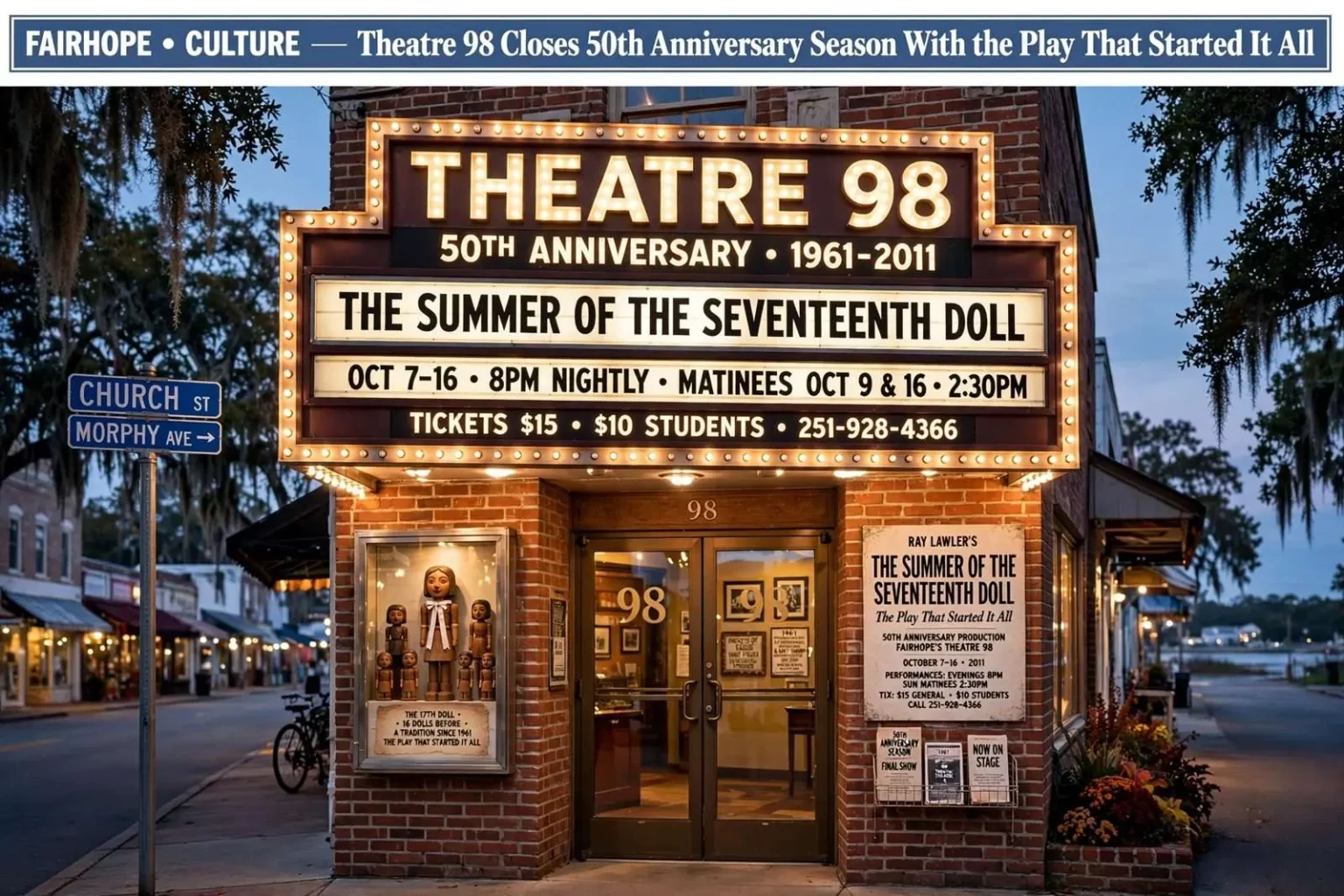
Theatre 98 in Fairhope is marking a milestone: fifty years to the season after the play first opened its stage, the community theater closes its anniversary year with a new production of Ray Lawler’s “The Summer of the Seventeenth Doll.” The company was founded in 1961 through the merger of two older Fairhope theater groups, and “The Doll” — as it’s known — was the first play ever staged there.
The 2011 revival, directed by Jonne Thornton, brings back Lawler’s landmark Australian drama set in 1950s Melbourne, where two sugarcane cutters, Roo and Barney, make their annual five-month layoff visit to Olive and her household — until the arrival of Pearl and the group’s shifting ages set their sixteen-year ritual wobbling. The seven-actor cast features Hal Knox as Roo, Graham Timbes as Barney, Susan Ames as Olive, Liz Reed as Pearl, Dianne Robbins as Bubba, Leslie Johnson as Emma and Aaron McKee as Johnnie Dowd.
Performances run October 7–16 at 8 p.m., with 2:30 p.m. matinees on October 9 and 16. Tickets are $15 for general admission and $10 for students at the intimate 94-seat theater on Church Street and Morphy Avenue. Reservations can be made by phone at 251-928-4366; because seating is limited, the theater asks that tickets be paid within 24 hours of booking, by phone with a credit card if needed.
The choice of “The Doll” for the anniversary season is a deliberate act of remembering. Lawler’s 1955 play, one of the most celebrated works in Australian theater, is itself about a tradition kept too long — sixteen years of an annual ritual repeated without change until age and changed circumstances finally crack it. Opening a fiftieth season with the first play the company ever staged lets the theater honor its own history while acknowledging, through the play’s own theme, that every tradition eventually has to face the present.
The story’s setting is 1950s Melbourne itself — a city of trams, pubs and boarding houses where the southern summer holiday season was its own institution. Lawler wrote the play after observing the seasonal migration of cane cutters down from Queensland, men who spent seven months a year cutting sugarcane in the tropical north and celebrated each finished season with a spree in the southern cities. That real-world ritual gave the playwright his structure and his tragedy: a custom built on cash, youth and repetition that could not survive contact with time.
The play’s title refers to the tradition at its center. Each season Roo carves a doll — a decorated walking cane shaped like a young woman — and presents it to Olive as the token of another layoff season together. Sixteen of those dolls sit in Olive’s home as trophies of the arrangement, and the seventeenth becomes the play’s emblem of a ritual running on fumes. Australian audiences of 1955 recognized the custom instantly; the play’s power came from watching an ordinary ritual become a mirror in which four people see how much time has passed.
Fairhope, the Baldwin County town the theater calls home, has long fostered the arts alongside its better-known reputation for parks, boutiques and Mobile Bay views. Founded in 1894 as a utopian single-tax colony, the town drew writers, artists and free-thinkers from its earliest decades, and that inheritance shows in its cultural life today: an art center, a long-running organic market, galleries and a municipal library that anchors a busy downtown. A community theater that has survived five decades in a resort town’s competitive calendar says something about how deep that audience runs.
The play that opened the doors
When the two older Fairhope groups merged in 1961 to form Theatre 98, the name itself carried the founders’ ambition — the founding group had set its sights on a 98-seat playhouse, and the number stuck. “The Summer of the Seventeenth Doll” was an audacious first choice for a young community theater: a contemporary international hit with demanding roles, rather than the safe warhorses many startup companies opened with. Fifty years later, the company’s decision to revive it gives longtime members and audiences a direct line back to the people who cleared the first stage.
Lawler’s play earned its reputation on merit. Written for the Union Theatre Repertory Company in Melbourne, it broke with the genteel drawing-room tradition of its era and put working-class Australians on stage speaking in their own idiom — cane cutters, barmaids and boarding-house keepers, with all their swagger and fear. It toured widely, was adapted into films and opera, and remains a fixture of the international repertory, studied as the moment Australian drama found its own voice. Gulf Coast audiences encountering it for the first time will find, beneath the Australian accents, a story about aging, loyalty and the illusions people build to keep love alive — themes that need no translation.
The plot turns on a ritual. Every year for sixteen years, Roo and Barney, sugarcane cutters from Queensland, have taken their five-month off-season layoff in Melbourne with Nancy and Olive, two barmaids who became their companions for each layoff season. The ritual itself is the point: the dolls — the elaborate buckcanes the cutters carve for their women — the celebration of youth and cash, the pact that the seasons must always stay the same. When Nancy marries and moves away, Pearl steps into the gap, and Roo’s unemployment and the group’s creeping middle age do the rest. What was a celebration hardens into a reckoning.
The roles ask a seasoned cast, and the one Thornton assembled draws on some of the Eastern Shore’s most experienced community performers. Hal Knox and Graham Timbes, as Roo and Barney, carry the two drifters’ fading bravado; Susan Ames takes on Olive, the play’s blazing center, whose refusal to let the ritual die gives the final act its force. Liz Reed’s Pearl, prim and practical, becomes both the catalyst and the outsider’s eye; Dianne Robbins’ Bubba, the young neighbor girl, watches the older generation’s unraveling as a warning about her own future; Leslie Johnson plays Emma, Olive’s mother, whose dry skepticism cuts through the household’s illusions; and Aaron McKee rounds out the cast as Johnnie Dowd.
An intimate room, a demanding play
The 94-seat theater on Church Street and Morphy Avenue is part of what makes a revival like this one worth catching. In a house that small, there is no distance from the actors’ faces: a line delivered at a whisper lands, and the final-act confrontations that “The Doll” builds toward play out at a range where the audience can see every tremor. Directors of revivals of this play have noted that its emotional payoff depends on that proximity — the moment when Olive’s mythology collapses plays differently in a living-room-sized house than in a grand old proscenium.
The run’s schedule spans two weekends, with evening performances October 7–16 at 8 p.m. and the two Sunday matinees at 2:30 p.m. on October 9 and 16, giving audiences on both sides of Mobile Bay a set of options. The October slot also puts the play at the front edge of Fairhope’s fall season, when the town’s cooler evenings and returning crowds make a downtown evening — dinner, then the theater — the standard way to see a show.
Ticket prices remain in the community-theater range: $15 general admission and $10 for students, with reservations taken by phone at 251-928-4366. The theater’s payment rule — tickets paid within 24 hours of booking, by phone with a credit card if needed — reflects the practical arithmetic of a small house, where even a handful of no-shows on a given night means empty seats that could have gone to someone turned away. Regulars know to book early for the shows with reputations, and an anniversary revival of the company’s first play qualifies.
The company’s five decades in Fairhope trace the town’s own growth from quiet bay town to one of Alabama’s busiest cultural destinations. Theatre 98 has staged classics, comedies and musicals for generations of Eastern Shore families, and its alumni include performers who went on to professional work in regional theater, film and television. Anniversaries are also survival stories: many community theaters founded in the early 1960s folded long ago, and the ones that endure do so through constant renewal — new directors, new faces and seasons that balance the familiar with plays like this one that ask more of a cast and an audience.
Fifty years is a long life for any community theater, sustained as they are by volunteer boards, season subscriptions and the slow turnover of actors who age out of roles the way Roo and Barney age out of cane cutting. Theatre 98’s anniversary season — closing with the play that started it all — is both a celebration and a statement that the institution intends to keep its stage lit. For Fairhope audiences, the October run offers a chance to see a landmark of world theater, performed by the Eastern Shore’s own, in the room where it all began.