
Family Mourns 23-Year-Old Irvington Mother Killed in Mobile County Crash
Roberta Lee Daman, 23, of Irvington died after a two-vehicle crash in south Mobile County. An ALEA investigation is ongoing.
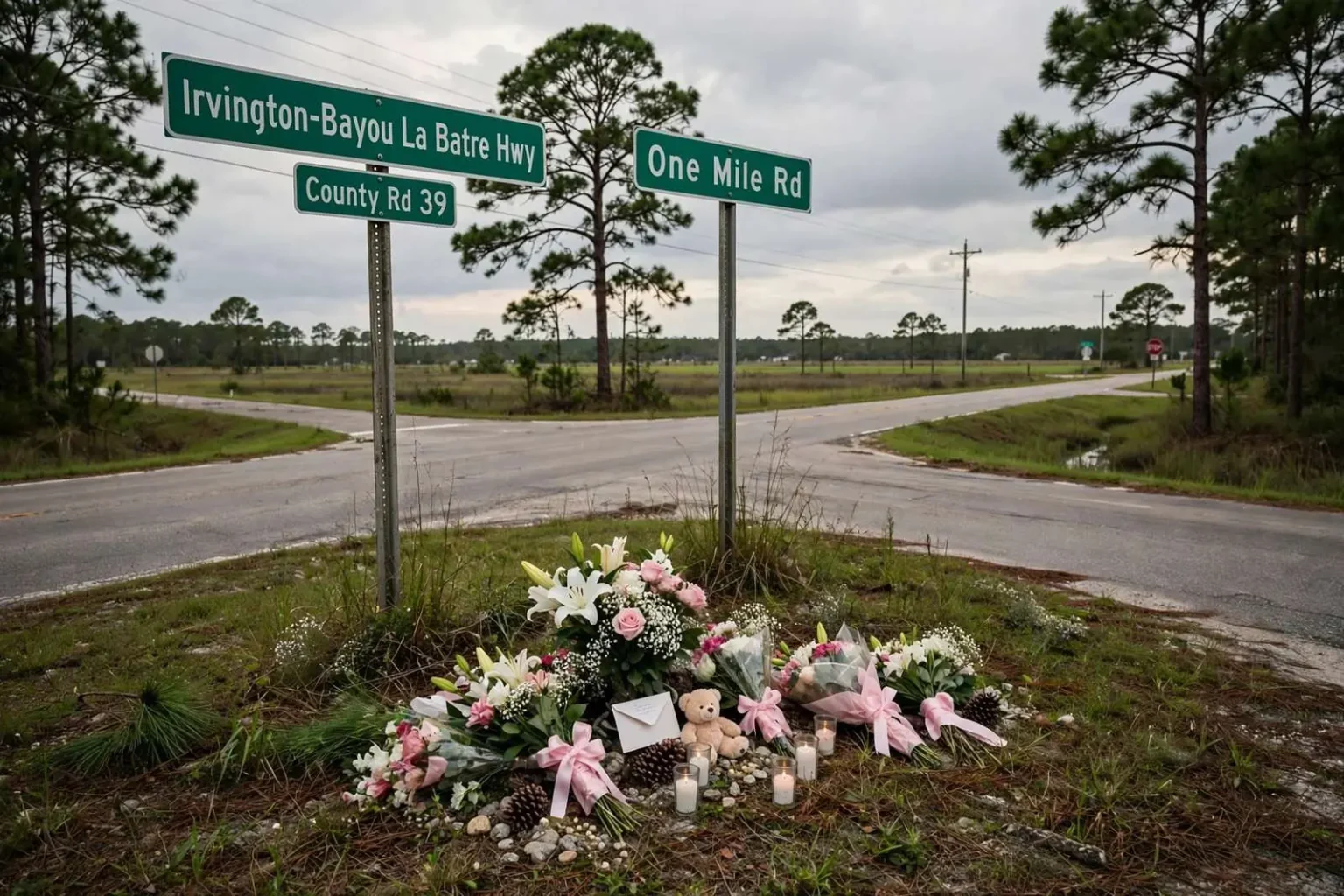
A 23-year-old Irvington mother died from injuries sustained in a two-vehicle crash in southern Mobile County, according to the Alabama Law Enforcement Agency. Roberta Lee Daman leaves behind a 3-month-old daughter and her fiance.
ALEA says an 18-year-old driver from Irvington was traveling westbound on One Mile Road when her 2009 Ford F-150 struck the 1992 Jeep Cherokee driven by Daman, who was northbound on Irvington-Bayou La Batre Highway. The other driver suffered non-life-threatening injuries, and the investigation remains ongoing.
The intersection where the crash occurred sits at the junction of two rural roads that carry a steady mix of local traffic, commercial vehicles, and fishermen’s trailers between the communities that dot southern Mobile County. Rural intersections of this kind — where a county road meets a state highway without signalization — account for a disproportionate share of serious crashes across Alabama, a pattern that safety engineers attribute to higher approach speeds, limited sight lines, and the mix of vehicles traveling at very different speeds along the same corridor.
Good Samaritan Tried to Save Her
Kody Wilcox, a nursing student, came upon the wreck moments after it happened and turned around to help. He said state troopers told him the Jeep had rolled several times before landing upright. Wilcox pulled Daman from the vehicle and began CPR while bystanders called 911.
Wilcox was on the phone with his mother, Karen Wilcox, a nurse of 11 years, who coached him through it. “I told him to keep going, I was there to coach him and if he needed support,” she said. He continued CPR for roughly 20 minutes until EMS arrived. Daman was transported to USA Medical Center, where she died.
The response chain that Kody Wilcox set in motion — bystander rescue, immediate CPR, coordinated 911 calls — represents what emergency medicine professionals call the first link in the chain of survival, and in rural areas it is often the most important. Response times for volunteer and rural EMS in southern Mobile County can stretch well beyond the urban standard of minutes, and the quality of care delivered in the first twenty minutes after a traumatic injury, before an ambulance arrives, measurably affects outcomes. That a passerby happened to be a nursing student, and that his mother happened to be on the phone at that moment, was a convergence the family and friends who later read his account would describe in the terms people reach for when chance and loss meet.
CPR sustained for twenty minutes or more is physically punishing for a single rescuer. Properly performed chest compressions require pushing hard and fast in the center of the chest — a depth of about two inches at a rate of 100 to 120 compressions per minute — and rescuers are trained to switch every two minutes because fatigue degrades compression quality quickly. Willing one’s way through twenty minutes alone, with a voice on the phone for guidance, exceeds anything taught in a standard CPR class, where students practice in two-minute rotations. The effort speaks to the determination of a young man trained in the fundamentals of care and unwilling to stop while a life was in the balance.
USA Medical Center, where Daman was taken, is the region’s only Level I trauma center, serving the Gulf Coast from Mobile as the final receiving facility for the most serious injuries from southwest Alabama and beyond. Level I designation means around-the-clock surgical specialists, trauma teams on immediate call, and the full range of imaging, blood bank, and intensive care resources that traumatic injury demands. For patients transported from as far as Bayou La Batre, Irvington, and the county’s rural south, survival often depends on reaching that level of care quickly — and on what was done in the minutes before the ambulance ever left the scene.
‘Her World Revolved Around’ Her Daughter
Daman’s family remembered her as kind and generous. “Berta was a beautiful young woman who would do anything for you,” wrote family member Ashley Daigle. “Her world revolved around her precious three-month-old daughter.”
Her fiance, Joshua Lowry, said she was “an amazing young woman, and more beautiful than life itself,” adding that keeping her memory alive for their daughter is now his focus. A friend, Hunter Green, described her as someone with “a beautiful soul” who made everyone around her smile.
The tributes that circulated in the days after the crash traced the outline of a young life rooted in the small communities of southern Mobile County. Irvington and the surrounding communities along Highway 188 — Bayou La Batre, Coden, St. Elmo, Grand Bay — form a close-knit stretch of coastal Alabama where families often go back generations, where the seafood industry and shipyards anchor the economy, and where a death like Daman’s travels quickly through church circles, school networks, and social media feeds that connect people who have known one another since childhood.
Grief counselors and pastoral caregivers in such communities often note that the loss of a young parent carries a particular weight. The family Daman left behind — a three-month-old daughter who will not remember her, a fiance, parents, and an extended network of relatives and friends — joins the thousands of American families each year who lose someone to a crash on a rural road within miles of home. Support in the weeks that followed came in the forms such communities know well: meal trains, funeral funds set up online, and memorial posts sharing photographs of a young woman holding her infant daughter.
For the Lowry family, the focus on keeping Daman’s memory alive for her daughter echoes what bereavement specialists describe as a central task for families who lose a parent in infancy: building a record of stories, photographs, and voices that the child can one day grow into. Grief resources for young widowed parents emphasize the value of that record, and of community support that persists past the funeral, in the years when a child begins asking questions the surviving parent must answer alone.
The investigation into the crash remained open in the days that followed, with ALEA troopers working to establish the sequence of events that brought the two vehicles together. Crash reconstruction in a case involving a rollover requires mapping the vehicles’ final positions, examining damage patterns to estimate speeds and angles of impact, documenting roadway evidence — tire marks, gouges, debris fields — and in many cases downloading data from the vehicles’ onboard event recorders, which modern trucks record and older vehicles like a 1992 Jeep may lack. The findings will inform whether any charges are warranted, a determination that rests with the district attorney’s office once troopers complete their report.
The crash also joined the long ledger of intersection and rollover tragedies that shape safety conversations in southern Mobile County. Rollover crashes account for a small share of total collisions but a large share of fatalities, particularly in vehicles like older SUVs and trucks with higher centers of gravity and, in many cases, limited modern stability control. Seat belts, occupant ejection prevention, and speed at rural intersections have been recurring themes in ALEA’s regional safety campaigns, which pair enforcement waves with public reminders timed to high-travel seasons along the Gulf Coast.
What remained, for the family that mourned her, was the work of remembrance that follows such a loss — a funeral in one of the small churches that dot the highway between Irvington and the bay, and a daughter who will one day learn about her mother from the people who loved her and from the words they left behind: that she was kind, that she was generous, that her world revolved around the baby she left behind.
The road geography of the crash site tells its own part of the story. Irvington-Bayou La Batre Highway runs through the heart of the communities it is named for, carrying school buses, seafood trucks, and commuter traffic along a corridor where posted speeds are higher than the residential streets that feed into it. One Mile Road is one of those feeders. Crossings like this one concentrate risk at a single point: a driver pulling out from the side road must judge gaps in traffic moving at highway speed, and a driver on the highway must watch for vehicles that may stop or turn without warning. Transportation planners call these “high-conflict” intersections, and their crash histories are among the data points counties use when prioritizing signage, lighting, and widening projects for state and federal safety funds.
The vehicles involved also reflect the fleet realities of rural southern Alabama, where older trucks and SUVs remain in service far longer than the national average. A 2009 Ford F-150 and a 1992 Jeep Cherokee bracket nearly two decades of automotive safety development. In the years between those model years, vehicle design added standard stability control, curtain airbags, stronger roof structures, and improved crash cages — features proven to improve survival in rollover events. Older vehicles without those systems, particularly those carrying occupants unrestrained, produce worse outcomes in the same crashes that newer vehicles convert into close calls. The difference is a recurring theme in ALEA’s rural safety messaging, which urges owners of older vehicles to be especially diligent about the one safety feature that never ages: a buckled seat belt.
The presence of bystanders willing to stop and help — Wilcox, the callers who reached 911, and others who directed traffic or checked on the second driver — mirrored the pattern that rural counties rely on when crashes happen far from the nearest station. Dispatchers in Mobile County’s 911 center, working from caller accounts, triage the response and route the closest ambulance and fire units, while providing pre-arrival instructions to callers performing CPR. Those instructions, standard in modern emergency dispatch, walk a caller through hand position, compression depth, and rhythm — a bridge between what an untrained bystander can do alone and what a trained responder provides. In this case, with a nursing student already working and his mother coaching by phone, the dispatcher’s guidance joined a chain of assistance that had begun before the first call was even connected.
For the EMS crews who arrived to find CPR in progress, the handoff marked the transition from bystander care to advanced life support. Paramedics continuing resuscitation en route to a trauma center work under standing protocols that cover airway management, fluids, and cardiac medications, with radio or telemedical contact to a receiving physician. The 20-minute CPR effort Wilcox sustained before their arrival mattered to that chain: resuscitation outcomes are strongly tied to the minimization of any interruption in compressions from the first moment of arrest onward, and a bystander who never stopped bought the paramedics a better starting point than they otherwise would have had.