Federal Major Disaster Declaration Unlocks Aid for Florida Counties Hit by Sally
A federal major disaster declaration brought full public assistance to Escambia County and emergency funds to 12 more Panhandle counties after Hurricane.
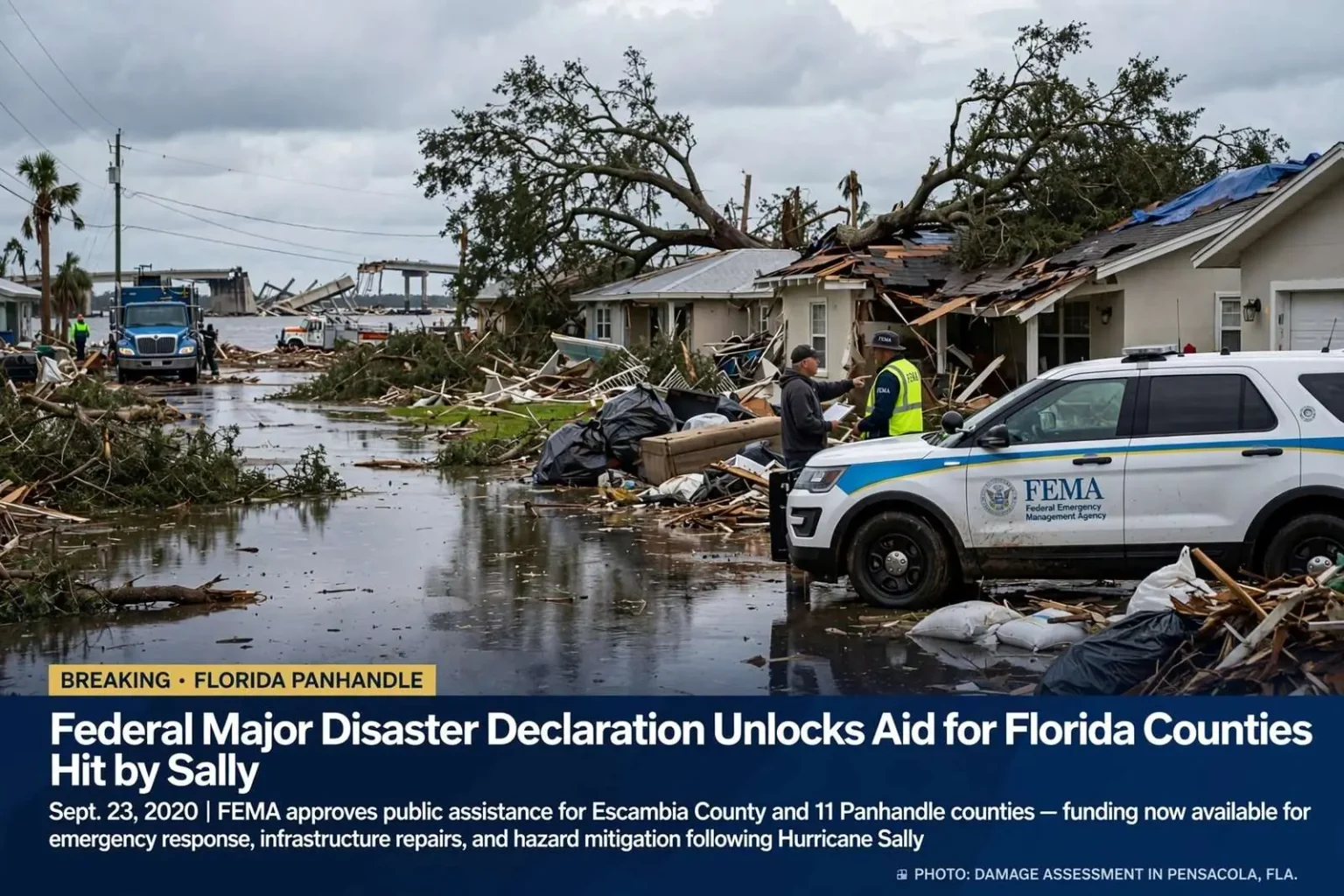
Washington opened the federal spigot for the Florida Panhandle after Hurricane Sally, with a major disaster declaration making federal funding available to state, tribal and local governments and certain private nonprofits for recovery work across the region. The declaration formalized the federal government’s role in a recovery that stretched from Pensacola’s damaged neighborhoods to flooded communities across a dozen Panhandle counties.
The declaration, issued Sept. 23, 2020, authorizes cost-sharing federal funding for emergency work and the repair or replacement of storm-damaged facilities in Escambia County — the area that took Sally’s worst — with all categories of public assistance. Emergency protective measures funding, Category B, extends to Bay, Calhoun, Franklin, Gadsden, Gulf, Holmes, Jackson, Liberty, Okaloosa, Santa Rosa, Walton and Washington counties. Hazard mitigation measures were funded statewide.
The distinction between the two tiers of public assistance matters for how money flows. All-categories coverage in Escambia County means federal cost-sharing is available not just for emergency response but for permanent restoration of roads, bridges, utilities, public buildings and other infrastructure damaged by the storm. The Category B designation in the other counties covers the emergency phase — things like search and rescue, emergency medical care, sheltering and debris-removal coordination — while assessments continued on the broader damage those communities suffered.
The Federal Machinery Behind the Declaration
FEMA Administrator Pete Gaynor named Jeffrey L. Coleman as Federal Coordinating Officer to run recovery operations in the affected areas. The Federal Coordinating Officer serves as the on-the-ground manager of the federal recovery, working alongside state counterparts to validate damage claims, set project funding and keep reimbursement moving to local governments that had already spent heavily on response.
The declaration applied to damage from Sally’s landfall beginning Sept. 14, 2020, and continuing — a period that captured both the storm’s direct assault on the coast and the extensive flooding that followed as the slow-moving system drenched the Panhandle and south Alabama.
For cash-strapped county and municipal governments, the timing of federal reimbursement is critical. Emergency response — overtime for first responders, debris contracts, emergency repairs — comes due immediately, while tax revenues in storm-damaged areas can fall at precisely the wrong moment. Public assistance programs are designed to refill those coffers, typically covering a defined share of eligible costs after documentation and inspection.
Private nonprofits, including schools, universities, hospitals and houses of worship that provide critical services, also fall within the declaration’s scope, allowing organizations that absorbed major losses while serving their communities to seek the same cost-shared help available to governments.
DeSantis: Critical Support for Rebuilding
Gov. Ron DeSantis announced that FEMA had approved his request for the declaration. “This declaration adds all categories of public assistance for Escambia County, providing critical federal support for the long-term rebuilding efforts of this area following the severe damage and flooding that Sally left in its wake,” the governor said. “Northwest Floridians are resilient, and we will continue to work with our local and federal partners to ensure a full recovery.”
The governor’s statement reflected the two-track reality of post-storm recovery in Florida. State agencies had been working the disaster from the first hours — moving resources, coordinating with county emergency managers and conducting damage assessments — while the federal declaration process moved through the documentation required to justify major federal funding.
The Florida Division of Emergency Management continued damage assessments in the dozen counties that initially received only partial public assistance, and was also evaluating individual residences and businesses as the state pressed FEMA for Individual Assistance. The addition of Individual Assistance, if approved, would open aid directly to affected households — temporary housing assistance, home repair grants and other programs — rather than routing money through governments first.
That distinction is the one most visible to storm victims. Public assistance rebuilds the community’s infrastructure; individual assistance helps families replace roofs, cover temporary lodging and make damaged homes safe again. For homeowners in the Panhandle’s hardest-hit neighborhoods, the state’s push for Individual Assistance represented the next hoped-for step in the recovery.
Sally’s Impact on the Panhandle
Hurricane Sally made its name as a slow, wet storm. Its crawl across the northern Gulf meant prolonged onshore winds and historic rainfall totals for the Pensacola area, where neighborhoods took water from both storm surge and flooding, and where wind damage stripped roofs and downed trees and power lines across Escambia and Santa Rosa counties.
The barrier islands and coastal communities bore the brunt of the surge, while inland flooding damaged homes and businesses well away from the beachfront. The Pensacola Bay Bridge — a critical link between Pensacola and Gulf Breeze — was among the region’s most visible casualties, knocked out of service by storm-driven damage and disrupting commutes for months.
Relief for Small Businesses
Separately, DeSantis activated the Florida Small Business Emergency Bridge Loan program through the Department of Economic Opportunity to give storm-affected small businesses short-term cash support while insurance and federal aid worked through their pipelines.
The bridge loan program fills a well-known gap in disaster recovery. Insurance claims can take weeks or months to settle, and federal disaster loans involve applications, inspections and processing time — but payroll, rent and supplier bills arrive immediately. A short-term, interest-free bridge loan lets a damaged business keep operating, retain employees and make emergency repairs while the slower funding sources come through.
For the Panhandle, where tourism, fishing, restaurants and small retail anchor the coastal economy, the program’s value is amplified by the calendar. Sally struck in the middle of the September-to-peak season stretch, and businesses already weathering the pandemic year faced storm losses on top of an exhausted customer base and strained finances.
State officials in past Florida hurricanes have used the bridge loan program to put money into affected businesses within days of a storm, and the Sally activation followed that template, targeting small business owners in the declared and assessed counties whose physical damage or revenue losses threatened their survival.
How Recovery Funds Reach Communities
The machinery of a major disaster declaration takes time to translate into visible recovery. After a declaration, FEMA and the state open applicant briefings for local governments, public agencies and eligible nonprofits, walk them through documentation requirements and set up project applications. Damage inventory teams scope repairs, costs are developed and reviewed, and funding obligates project by project.
Debris removal is usually the most immediate public assistance activity, and Sally generated enormous debris volumes across the Panhandle — fallen trees, storm wreckage and flooded household goods piled along streets for weeks. Category B funding supports that emergency phase, while later categories cover the permanent restoration work that unfolds over years.
Hazard mitigation funding statewide reflects a longer view. Money set aside for mitigation — drainage improvements, elevation projects, hardened public buildings, improved warning systems — aims to reduce the cost of the next storm, an approach that has become central to federal disaster policy in hurricane-prone states.
For residents of Escambia County and the surrounding Panhandle, the Sept. 23 declaration marked the point where the federal commitment became formal and financial rather than purely operational. The recovery itself — roofs replaced, roads rebuilt, the bay bridge restored — would unfold over months and years, supported at each stage by the cost-sharing structure the declaration put in place.
Regional Ripples Across State Lines
Though the declaration covered Florida counties, Sally’s damage zone ignored the state line. The same slow-motion landfall that hammered Pensacola also flooded streets in downtown Pensacola Beach communities, and across the border in Baldwin County and Mobile, Alabama, homes and roads took serious water and wind damage. South Alabama readers followed the Florida declaration closely in part because the recovery next door shaped regional dynamics — insurance markets, contractor availability and disaster resources all move across the two-state area.
Contractors, roofers and debris crews that converge on a disaster zone serve both states, and an active federal declaration on the Florida side draws capacity that Gulf Coast residents everywhere depend on. Similarly, lessons learned in one state’s recovery — on debris contracts, housing programs and mitigation priorities — inform the other’s.
The Panhandle’s experience with Sally also fit into a broader pattern for the 2020 hurricane season, one of the most active on record, which stretched emergency management resources across the Gulf and Atlantic coasts and kept state and federal agencies cycling between response and recovery operations for months.
What Affected Residents Should Know
For individuals and business owners in the affected counties, the sequence that follows a major disaster declaration follows a familiar rhythm. Governments and eligible nonprofits file for public assistance through the state; residents wait on the outcome of the state’s Individual Assistance request; and businesses can pursue the state bridge loan program and, where designated, federal disaster loans for physical damage and economic injury.
Documentation is the thread that ties all of it together. Storm victims are advised to photograph damage, keep receipts for repairs and temporary lodging, and retain records of lost income — the paperwork that determines eligibility across every program. Local emergency management offices and the state’s disaster resources serve as the front door for questions about what is available and how to apply.
The Sept. 23, 2020, declaration did not end Sally’s story; it began its longest chapter. Rebuilding public infrastructure and restoring damaged communities across the Panhandle would continue well after the floodwaters receded, funded in significant part by the cost-sharing federal commitment that the declaration formalized — and watched closely by the Northwest Florida residents the governor described as resilient.