
FEMA Distributing Tarps, Meals in Bay Minette After Hurricane Sally
FEMA is handing out free tarps and ready-to-eat meals in Bay Minette, Alabama, as Baldwin County continues its recovery from Hurricane Sally.
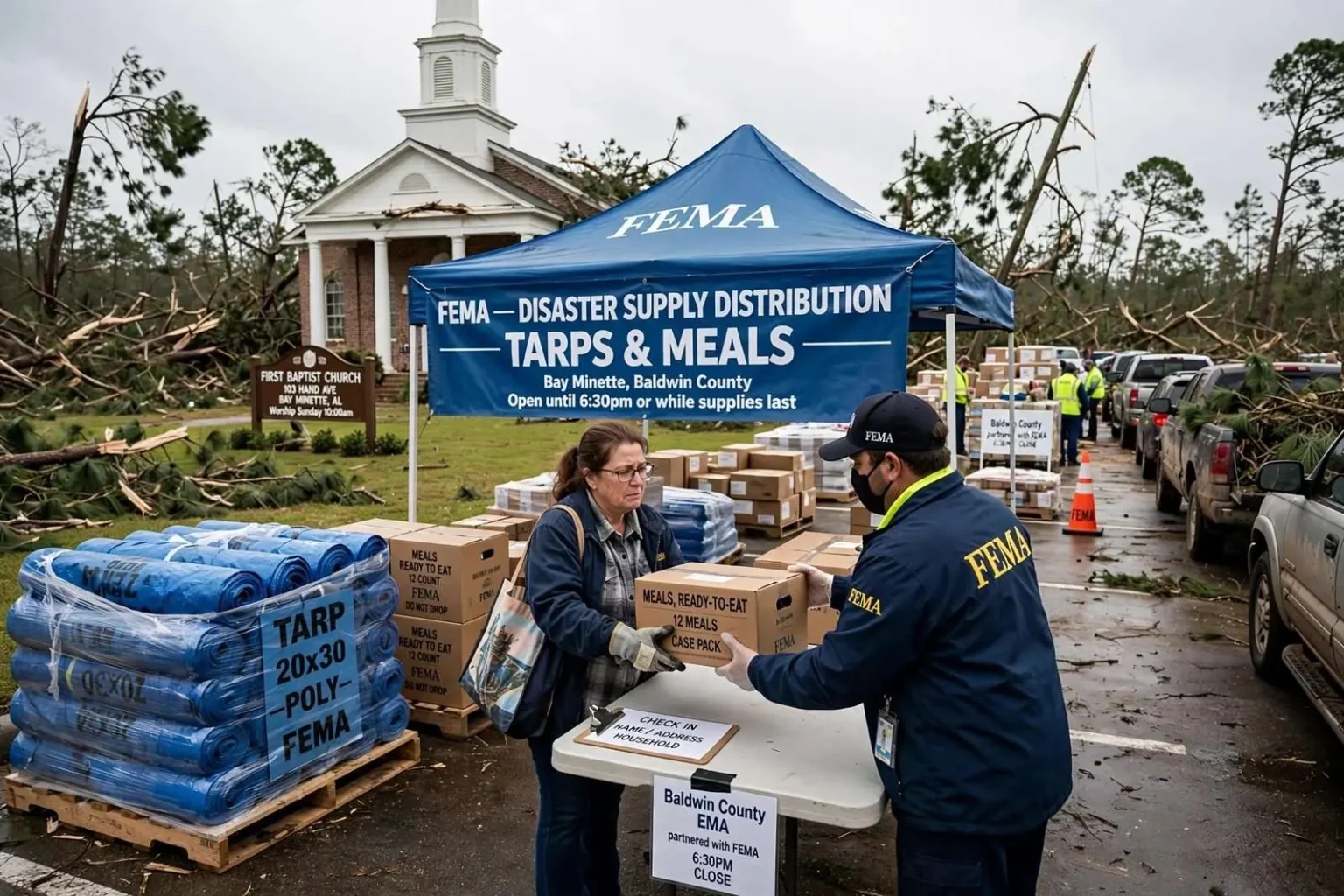
BAY MINETTE, Ala. — The Federal Emergency Management Agency began distributing tarps and ready-to-eat meals in Baldwin County on Tuesday as residents continued the long grind of recovery from Hurricane Sally, which hammered the Gulf Coast with torrential rain, destructive winds and days-long power outages. The distribution point was set up at First Baptist Church on Hand Avenue in Bay Minette, putting supplies in the heart of the county seat where residents from across northern Baldwin County could reach them. Supplies were available until 6:30 p.m. or until they ran out, according to the announcement, an arrangement typical of mobile distribution efforts that depend on truckloads arriving from staging areas elsewhere in the disaster zone.
The stop was part of a broader push to get emergency supplies into the hands of coastal Alabama households damaged by Sally, which came ashore in September 2020 as a slow-moving Category 2 storm. Unlike fast-moving hurricanes that pass in hours, Sally crawled across the region, dumping more than two feet of rain in some areas and pushing storm surge into communities along Mobile Bay and Perdido Bay. Baldwin and Mobile counties took the brunt, with downed trees blocking roads, roofs peeled back by hours of sustained winds, and hundreds of thousands of utility customers left in the dark.
Why tarps and meals come first
The supplies FEMA chose to distribute tell the story of the recovery’s first days. Blue tarps became the visual shorthand for Sally’s aftermath, thrown over roofs where shingles were stripped or trees punctured the decking, buying homeowners time to schedule permanent repairs in a region where every roofing contractor in three states was suddenly booked solid. Ready-to-eat meals filled the gap for households still without power, particularly in rural stretches of Baldwin County where restaurants and groceries were closed or unreachable. Neither item solves the underlying damage, but both determine whether a family can stay in a damaged home while the larger recovery unfolds.
Churches have long served as natural distribution points in Baldwin County disasters, and First Baptist Church’s Hand Avenue location fit the pattern. Congregations sit on established properties with parking for queues of cars, they are known landmarks that residents can find without complicated directions, and they arrive at the recovery with volunteer networks already organized. State and county emergency management agencies coordinate with FEMA on site selection, balancing population centers against road conditions, since many secondary roads remained littered with debris in the days after the storm.
Sally’s footprint across Baldwin County
Sally’s path placed Bay Minette and the rest of inland Baldwin County squarely in the damage swath. The county, Alabama’s largest by land area, spreads from the Eastern Shore communities of Daphne and Fairhope down to the beach towns of Gulf Shores and Orange Beach, and every section reported damage in the storm’s wake. Orange Beach and Gulf Shores suffered catastrophic wind damage to condominiums and homes near the coast, while the northern half of the county contended with a different mix: flooded creeks, snapped pines, and rural households that could wait days for power crews to reach them down long county roads.
The distribution effort also reflected lessons federal and state agencies carried from earlier Gulf storms. Speed matters most in the first week, when residents are deciding whether to shelter in damaged homes or leave, and simple supplies distributed close to neighborhoods reduce the traffic pressure on damaged highways. FEMA’s role in a major disaster declaration includes this kind of direct commodity distribution alongside individual assistance programs that come later, when residents begin registering for aid and scheduling inspections. The tarps and meals handed out Tuesday were the visible first layer of a bureaucracy that would spend months processing claims across the two counties.
Residents seeking help in the weeks that followed were encouraged to monitor official announcements from Baldwin County Emergency Management Agency and FEMA rather than relying on word of mouth, since distribution sites move as needs shift and supplies arrive in batches. The Tuesday event at First Baptist Church on Hand Avenue stood as one example of that rolling effort, aimed squarely at the households still coping with Sally’s wreckage: a tarp for the roof, a meal for the table, and proof that the recovery apparatus had reached even the northern end of the county.
For Bay Minette itself, hosting a FEMA distribution site marked a shift in how the storm’s aftermath was being managed. The city of roughly 8,000 people sits inland from the coast, and in most hurricane coverage it is the beach towns that dominate the pictures. Sally reversed that emphasis: the storm’s slow track and sprawling wind field meant northern Baldwin County took serious damage too, and residents there are used to watching relief flow south. Putting tarps and meals at a Hand Avenue church ensured that families in Bay Minette, Stockton, Perdido and the surrounding rural communities could resupply without driving through debris-choked corridors toward the shore.
The distribution also came as crews from outside the region poured into Alabama to help restore electricity. Sally’s damage to the power grid was among the most extensive in the state’s modern history, with lines down across thousands of locations, and utilities staged bucket trucks and line workers from across the Southeast in the counties for the repair campaign. Every additional day without power increased demand for exactly the supplies FEMA was handing out, since refrigerated food spoils, well pumps fail and families burn through whatever they stocked before landfall.
The longer recovery ahead
Commodity distribution is only the opening act of a federal disaster response. After the emergency phase, attention shifts to individual assistance, in which residents register with FEMA, document their losses and schedule inspections to determine eligibility for grants covering repairs, temporary housing and other needs. The Small Business Administration typically supplements that with low-interest disaster loans for homeowners, renters and businesses across the declared counties. For Baldwin County households, the tarps received in the first week would eventually be replaced by roof repairs funded through some combination of insurance, federal grants and contractor availability, a process that stretched on for many families well after the storm left the headlines.
Public officials used events like the Bay Minette distribution to press a consistent message: document damage, keep receipts, and register with FEMA even if the immediate need seems small, because eligibility windows and program requirements can be difficult to navigate after the fact. That guidance matters in a county where a large share of damage was tree-related and localized, the kind that can be underestimated in early assessments. A pine through a roof reads as catastrophic on any street; a roof that simply lost shingles may hide water damage that emerges weeks later.
Tuesday’s distribution at First Baptist Church on Hand Avenue captured the recovery in miniature: a federal agency, a local congregation, a truckload of tarps and meals, and a line of neighbors whose homes had been through the worst storm to strike Baldwin County in years. It was a small stop in a large operation, but for the residents who drove away with supplies for their damaged houses, it was the most tangible piece of the recovery effort to date, and a sign that the assistance flowing into coastal Alabama had finally reached their corner of it.
The experience of Baldwin County in Sally’s aftermath also fed into a wider conversation about how the Gulf Coast prepares for storms in a warming era. Sally was one of a record-breaking run of named storms in the 2020 Atlantic season, and its slow forward speed produced rainfall totals more typical of a tropical storm system that lingers for days. Emergency managers across the region have noted that rapid intensification and slow decay are the patterns that stress response systems most, because they compress preparation time while stretching the duration of the emergency itself. The demand for tarps in Baldwin County was a direct function of that combination.
Volunteer organizations supplemented the official response throughout the county in the weeks after landfall. Disaster relief groups, church associations and spontaneous neighborhood crews cleared trees off roofs, cut fallen pines out of driveways and checked on elderly residents in communities where power restoration took the longest. That volunteer layer is often invisible in official accounts, but in rural Baldwin County it was the difference between a household waiting alone and a household with a chain saw crew in the yard. FEMA’s distribution sites worked best when they intersected with those networks, as word of supply locations spread through churches and civic groups faster than through any official channel.
Getting supplies to the people who need them
The mechanics of a point-of-distribution site are simple but unforgiving. Supplies arrive on pallets, volunteers and agency staff unload and stage them, and residents drive through or walk up to receive standardized packages, in this case tarps and ready-to-eat meals, until the stock runs out or the posted closing time arrives. The 6:30 p.m. cutoff in Bay Minette reflected both the supply on hand and the staffing available, and it rewarded residents who arrived early. Sites of this kind can serve hundreds of households in an afternoon when the line moves smoothly, which is why locations with generous parking and easy access from main roads are chosen.
For the wider Gulf Coast, Sally became a case study in storm behavior and response coordination. The hurricane’s effects spanned from the Mississippi line to the Florida border, and the response drew on resources from multiple states, federal agencies and the National Guard. Every distribution point, including the one at First Baptist Church, depended on that chain: supplies sourced from federal warehouses, trucked to staging areas, allocated by county emergency managers and handed out by people who lived through the same storm as the recipients. The recovery of coastal Alabama was built from thousands of such small, local deliveries.
Residents of Bay Minette and the rest of northern Baldwin County who benefited from the Tuesday distribution were seeing the practical face of a disaster declaration that covered their county alongside Mobile County and neighboring areas of Florida. The tarps kept rain out of damaged homes, the meals bridged the days before power returned, and the event itself confirmed that the recovery had mapped the whole county rather than just its coastline. In the months that followed, the same churches, parks and government lots that hosted supplies would host insurance adjusters, inspectors and contractors, as the Gulf Coast worked its way back from a storm that spared no part of it.