
FEMA to Fund Backup Generator for Satsuma Sewer Lift Station Under Flood Mitigation Program
FEMA's Hazard Mitigation Grant Program will fund a 40-kilowatt backup generator for a Satsuma sewer lift station in a flood-prone area, keeping wastewater flowing to the treatment plant during power outages.
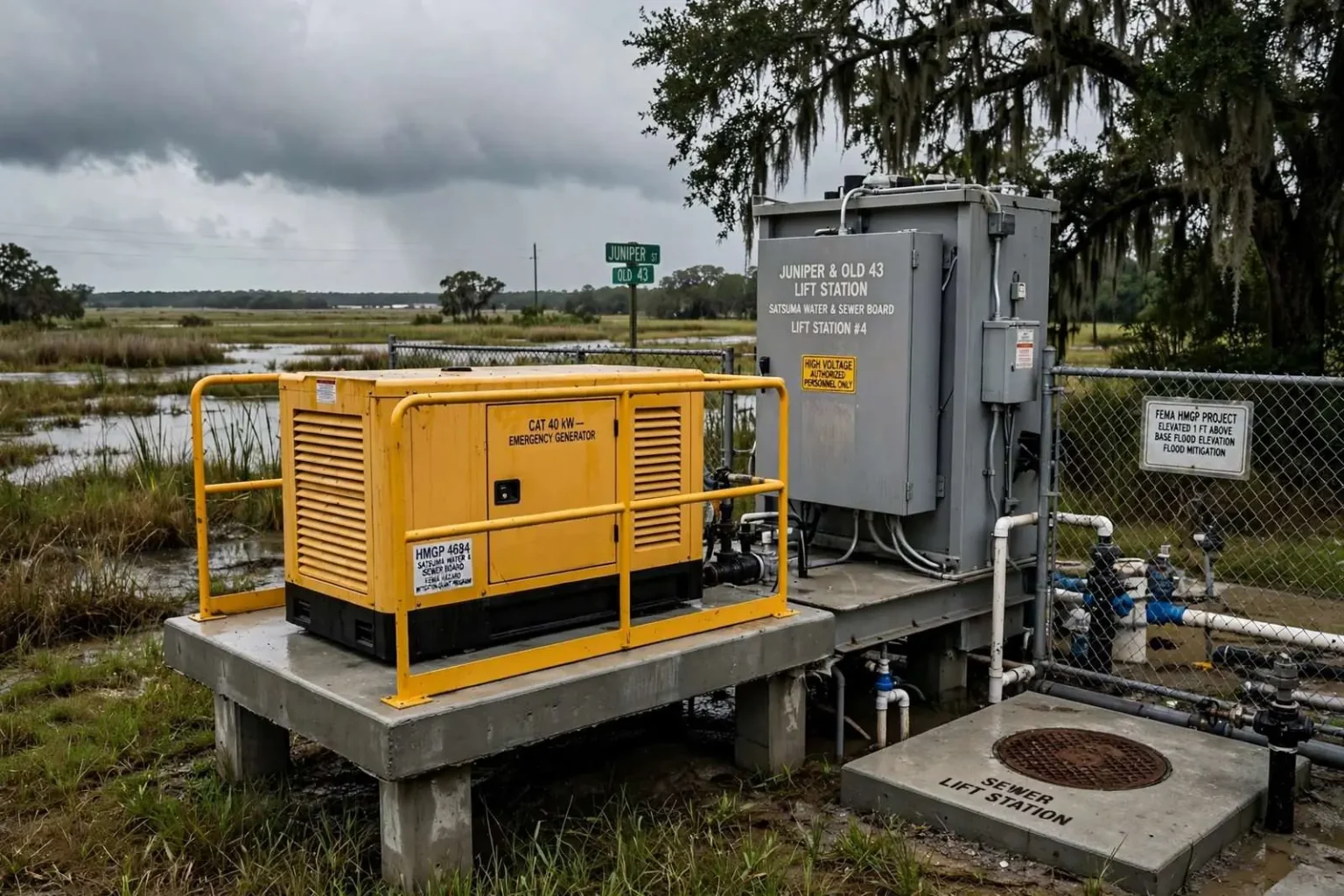
The Federal Emergency Management Agency has moved forward with plans to help the Satsuma Water and Sewer Board install a new emergency backup generator at a sewer lift station in a flood-prone part of the city, funding the project through its Hazard Mitigation Grant Program (HMGP). The project may sound modest — one generator at one lift station — but for the residents of the north Mobile County city, it addresses one of the most unpleasant and costly failures a small utility can experience: sewage that stops moving when the power goes out.
A Generator to Keep Sewage Flowing During Power Outages
The project, formally titled “HMGP 4684 Satsuma Generator,” calls for installing a 40-kilowatt emergency generator at the Juniper & Old 43 Lift Station, located within Satsuma’s city limits in Mobile County. The generator would provide backup power to the lift station during storm-related power interruptions, ensuring sewage continues to be pumped to the Satsuma Wastewater Treatment Plant even when the electrical grid goes down. Under the plan, the generator will be installed one foot above the base flood elevation, in keeping with the City of Satsuma’s floodplain ordinance.
Lift stations are the invisible workhorses of any sewer system. Gravity moves wastewater only so far; in flat coastal plain terrain like Satsuma’s, pumps must push sewage uphill through the collection network until it reaches the treatment plant. When a lift station loses power, the pumps stop, and the sewage has nowhere to go. The result can be backups into homes, overflows into yards and drainage ways, and a cleanup bill that dwarfs the cost of prevention.
South Alabama’s storm profile makes that risk more than theoretical. Hurricanes, tropical systems and ordinary severe thunderstorms routinely knock out electricity across Mobile County, sometimes for days at a stretch, and outages tend to coincide with the heaviest rainfall — precisely when the collection system is working hardest. A lift station that survives a storm structurally can still fail functionally if its power supply does not.
FEMA’s Hazard Mitigation Grant Program is designed to help communities reduce the risk of future disaster damage by funding projects like backup power systems, floodproofing and infrastructure hardening after a federally declared disaster. In this case, the funding traces back to disaster declaration DR-4684, for which an initial disaster-wide public notice was published in January 2023. The lift station site sits within a regulatory floodway and near wetlands, according to the FEMA notice, placing it squarely within the kind of vulnerable infrastructure the grant program is intended to protect.
Weighing the Alternatives
Before settling on the generator project, FEMA said it considered other options for protecting the lift station from future flood damage. One alternative would have relocated the facility outside the floodplain entirely, but the agency determined that option would require rerouting sewer main lines, could disrupt public access to nearby properties, and would likely cost more than simply repairing and hardening the existing site. A second alternative — taking no action at all — was ruled out because the lift station’s generator is considered necessary to keep sewage moving to the treatment plant during power interruptions. FEMA concluded that installing the backup generator at the current site was the only practicable alternative.
The alternatives analysis illustrates how hazard mitigation projects are actually chosen. Relocating infrastructure out of a floodplain is always the cleanest answer on paper, but utility systems are networks: moving one lift station means re-engineering the mains that feed it, and the disruption and expense can quickly outrun the benefit. Elevating and hardening equipment in place, by contrast, delivers protection at a fraction of the cost and keeps the existing system intact.
Because the project sits within a Special Flood Hazard Area, FEMA’s review process involved several layers of federal environmental and historic preservation law, including the National Environmental Policy Act, Executive Orders 11988 and 11990 governing floodplains and wetlands, and Section 106 of the National Historic Preservation Act. The agency also noted its efforts under Executive Order 12898 and more recent orders signed in 2021 to ensure environmental justice considerations — including potential impacts on minority and low-income populations — are factored into hazard mitigation projects like this one.
Funding for the generator is conditional on compliance with all applicable federal, state, tribal and local laws, floodplain standards and permitting requirements, and the project must also comply with National Flood Insurance Program requirements. Those conditions are standard attachments to every HMGP award, and they place the burden of demonstrating compliance on the grantee. For the Satsuma Water and Sewer Board, that means the generator cannot simply be dropped into place; permits must be secured, elevation requirements documented and environmental conditions honored before federal dollars flow.
The National Flood Insurance Program connection carries particular weight for a community like Satsuma, where residents and businesses hold flood policies under the program and where local floodplain ordinances are the mechanism by which the community stays eligible for it. Communities that waive or ignore floodplain standards can find their residents facing restricted access to federal flood insurance and federal disaster assistance — stakes that explain why a one-foot-above-base-flood-elevation requirement written into a generator installation is treated as a matter of course rather than a negotiation.
Part of a Broader Federal Recovery Effort
The Satsuma generator project is one of many hazard mitigation efforts FEMA has funded across Alabama in the wake of past federally declared disasters. The Hazard Mitigation Grant Program allows local governments, utility boards and other applicants to seek federal cost-sharing for projects that reduce the risk of damage from future storms, flooding and other disasters, rather than simply paying to repair damage after the fact. The program’s underlying economics are straightforward: every dollar spent on mitigation is understood to save multiples in avoided disaster costs, a calculus FEMA has documented across decades of post-disaster evaluations.
Across Alabama, HMGP dollars have gone toward generators for water systems, drainage improvements, safe rooms, elevation of flood-prone structures and similar projects — the unglamorous work that determines whether a community rides out the next hurricane or spends the following year rebuilding. Small municipalities often lack the tax base to fund such improvements on their own, which is what makes the cost-share structure of the program so consequential for places like Satsuma.
For a small municipal utility like the Satsuma Water and Sewer Board, a federally funded backup generator can mean the difference between continued sewage service and a costly, disruptive outage the next time storms knock out power in the area. The board’s customers experience the difference not in paperwork but in everyday terms: toilets that flush during a post-storm outage, yards that do not flood with wastewater, and no emergency bypass pumping bill arriving after the clouds clear.
FEMA’s notice on the project served as the agency’s final public notice regarding the Satsuma generator installation, issued under Region 4, which covers Alabama and several other Southeastern states. The notice specified that interested parties could submit comments, questions or request project maps by writing to FEMA’s regional office in Atlanta, referencing the subject line “HMGP 4684 Satsuma Water and Sewer.” With the environmental review completed and the public comment window run, the project moves from the planning column into the construction column — and Satsuma’s sewer system moves a step closer to keeping its promise the next time the lights go out.
What the Declaration Made Possible
Disaster declarations like DR-4684 are the gateway through which federal mitigation money reaches local projects. When a disaster declaration is issued, FEMA sets aside Hazard Mitigation Grant Program funds proportional to the scale of the disaster, and state emergency management agencies then administer the competition among applicants — cities, counties, utility boards, school systems and nonprofits that identify vulnerabilities and propose fixes. A project like the Satsuma generator survives that competition on the strength of its benefit-cost story: cheap relative to the damage it prevents, and easy to justify against the historical record of power outages and flooding in the area.
Satsuma itself is a small city in north Mobile County, straddling the U.S. 43 corridor between Saraland and Creola, with a residential base served by its own water and sewer utility rather than a county-wide system. That structure is common across south Alabama’s municipalities, where small utility boards own and operate the collection systems, treatment plants and water wells that larger cities run through big municipal departments. It means local boards carry direct responsibility for infrastructure decisions — and direct exposure when those systems fail during a storm.
The regulatory floodway designation at the Juniper & Old 43 site reflects the hydrology of the surrounding land. Floodways are the channels and adjacent areas that must be kept free of obstruction to carry flood flows, and building within them triggers stricter review than construction in the broader floodplain. Wetlands nearby add another layer, since federal law discourages projects that degrade wetland functions such as water storage and filtration. The generator project cleared that review in part because its footprint is small, its purpose is protective, and its design elevates the equipment above expected flood levels.
The final public notice closed out a process that began with the disaster-wide notice in January 2023, giving residents, agencies and advocacy groups a last formal opportunity to raise concerns or request the project’s environmental documentation. Such notices rarely generate controversy for projects of this scale, but they serve a structural purpose in federal law: they guarantee that the community bearing both the flood risk and the infrastructure has visibility into what is being built in its name and how federal money is being spent to protect it.
For the Sewer Board, the remaining path is the unglamorous one that follows every FEMA award — procurement, permitting and construction under the conditions attached to the grant. When the 40-kilowatt unit finally hums to life during the next extended outage, it will stand as a small but concrete piece of south Alabama’s larger effort to stop rebuilding the same damage after every storm and start preventing it before the next one arrives.

