
Foley firefighter’s 2-year-old son is cancer-free as O’Charley’s employees aid St. Jude Runners
A Foley firefighter's 2-year-old son, Easton Carraway, is cancer-free, and O'Charley's employees in Foley presented a check to St.
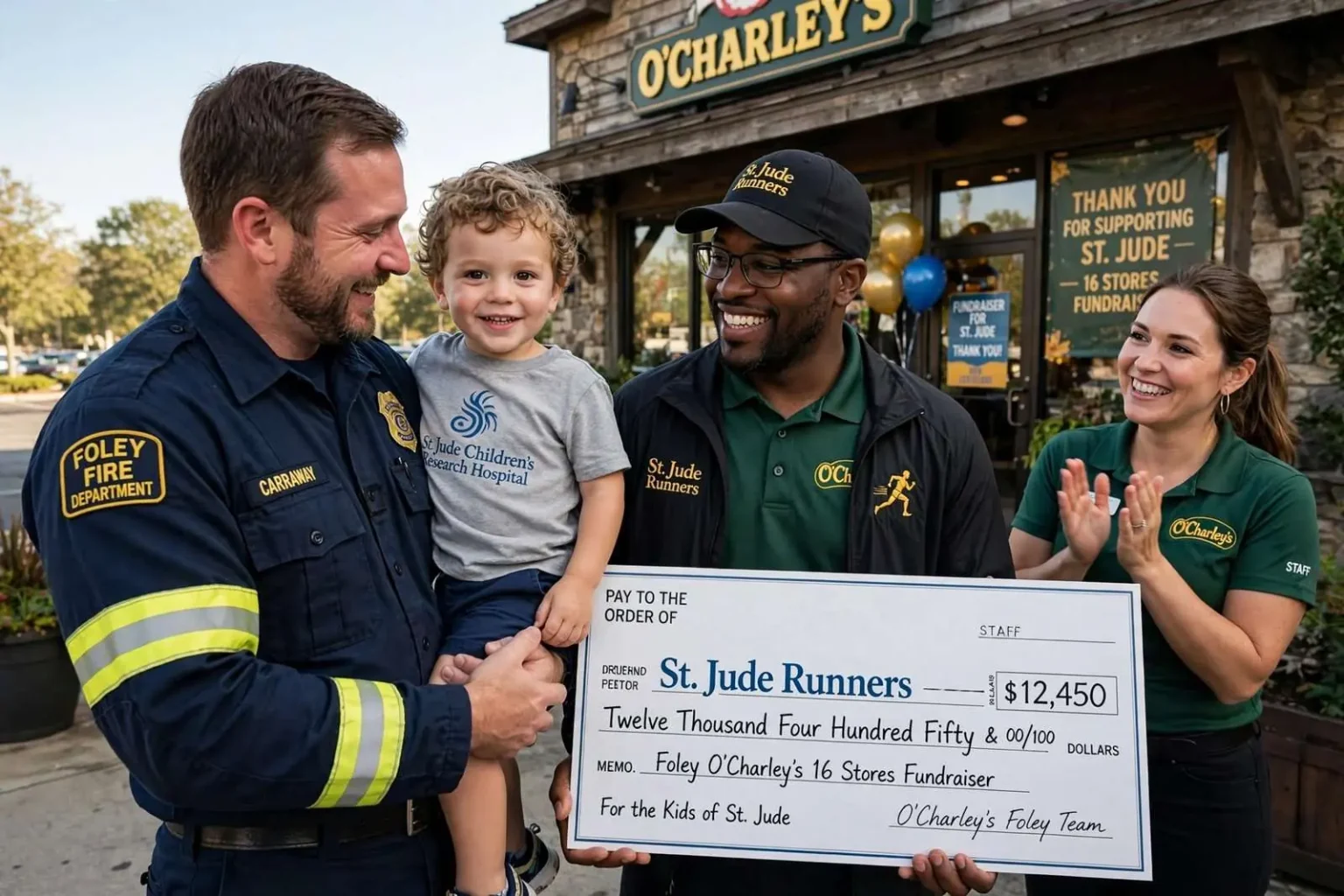
For much of his young life, 2-year-old Easton Carraway has been fighting stage 4 cancer. On Thursday, his family received news that the latest scans show the little boy — whose father is a Foley firefighter — is cancer free. The words every family facing pediatric cancer waits to hear arrived after months of treatment, tests and waiting that began when Easton was diagnosed at an age when most children are learning to string sentences together.
The same day brought a second piece of good news. Employees at the O’Charley’s restaurant in Foley presented a check to St. Jude Runners, a group of men and women who run from Memphis to Mobile to raise money for St. Jude Children’s Research Hospital, where Carraway has been receiving treatment for months. The timing, with the check presentation falling on the same day as the family’s scan results, made the occasion a double celebration for everyone involved.
“It’s just amazing. I’m shocked. I just want to thank everybody — the employees, the guests, everybody — that have helped us out to raise money for these kids,” said Rafael Pettway, an O’Charley’s employee. The fundraising effort that produced the check reached across the restaurant’s daily operations, from servers mentioning it to tables to guests adding donations, and it drew on the connection between the restaurant’s staff and the childhood cancer fight happening just a treatment cycle away.
Pettway is more than a restaurant worker who helped sell fundraising T-shirts across 16 stores. He is also a member of St. Jude Runners, the group that makes the trek from Memphis to Mobile each year to raise awareness and funds for life-saving pediatric cancer research. His dual role, fundraiser and runner, put him on both sides of the check he helped raise, a position that made the presentation day especially meaningful for him.
The fight that led to Thursday
Easton’s battle with stage 4 cancer placed his family on a path familiar to the parents treated at St. Jude Children’s Research Hospital, where care for children with the most serious diagnoses comes alongside research aimed at improving survival rates. For months, the toddler’s treatment has meant trips, procedures and scans, with his family adjusting every routine around the demands of his care. His father’s work as a Foley firefighter meant the family’s fight was known throughout the fire service community and the city he serves.
The news that the latest scans showed no cancer is the milestone families count in this fight, the point at which treatment shifts from attacking the disease to confirming it stays away. Medicine is deliberate about such announcements, and follow-up care continues for years, but for the family the scan results marked the moment they had worked toward since the diagnosis. Thursday’s news capped months of uncertainty with the best outcome the scans could show.
Fire service families often describe their departments as extended families, and Easton’s fight has been carried by that network alongside his immediate family. Foley’s firefighters and the broader community have followed the boy’s progress, and the fundraising tie-in with a local restaurant gave the wider public a way to contribute to the hospital treating him. The connection between one family’s crisis and the research mission of St. Jude is precisely what campaigns like the runners’ emphasize.
The run from Memphis to Mobile
St. Jude Runners, the group Pettway belongs to, undertakes a run from Memphis to Mobile each year, tracing a route of hundreds of miles between the hospital that anchors pediatric cancer research and the Gulf Coast city that has embraced the effort. The runners cover the distance in stages, passing the route between participants, and their journey doubles as a rolling fundraiser and awareness campaign through every town they pass through along the way.
The money raised supports St. Jude Children’s Research Hospital, the Memphis institution founded to ensure that no child is denied treatment based on a family’s ability to pay. Families treated at St. Jude never receive a bill for treatment, travel, housing or food, a policy made possible by donations that fund both the care and the research. That structure is why fundraising runs, T-shirt sales and restaurant campaigns matter so much: they are the financial engine that keeps the hospital’s doors open to every eligible child.
The hospital’s research mission reaches far beyond Memphis. Discoveries made in its labs and clinics have contributed to the dramatic rise in childhood cancer survival rates over the past half-century, and its protocols are shared freely with hospitals worldwide. For a child like Easton, treated over months in St. Jude’s care, the hospital represents both immediate treatment and the accumulated knowledge of decades of pediatric cancer research funded in part by the efforts of groups like the runners.
Sixteen stores and a community effort
The T-shirt fundraising effort Pettway helped drive extended across 16 stores, turning a single restaurant’s campaign into a regional one. Selling shirts across that many locations required coordination among staff at each store and gave customers everywhere the chance to participate in the cause. The check presented Thursday to St. Jude Runners represented the sum of that collective effort, gathered one shirt and one donation at a time.
Restaurant fundraisers succeed because they invite ordinary participation. A guest deciding between a plain meal and one that contributes to a cause does not need to organize anything; the mechanics are handled by employees like Pettway, who champion the effort on the floor. The employees at the Foley O’Charley’s made the campaign their own, and the presentation of the check to the runners gave them a moment to see the destination of their work.
The overlap between the two good-news events, the scan results and the check presentation, gave Thursday a resonance that neither event would have carried alone. The family marking their son’s cancer-free scans stood alongside the employees celebrating their fundraising total, and the runner among them, Pettway, connected the two. Occasions like that one explain why communities continue to organize for St. Jude year after year.
What comes next for Easton and his family
A cancer-free scan is a beginning rather than an ending in pediatric oncology. Easton will continue under medical supervision, with follow-up scans and appointments forming the schedule of the months ahead, as his care team monitors his progress. Children who complete treatment resume the ordinary business of being children, and for a 2-year-old that means play, growth and the normal milestones that his family can now watch without the shadow the diagnosis cast over them.
His father’s colleagues in the Foley Fire Department and the community that rallied around the family will continue to follow his progress, as will the employees whose fundraising contributed to the hospital treating him. The story that began with a diagnosis has reached its most hopeful chapter, one that families across the Gulf Coast who have faced St. Jude’s care will recognize.
For St. Jude Runners, the check presented in Foley joins the total they carry to Memphis each year, dollars that fund research and treatment for children whose families never see a bill. The group’s run from Memphis to Mobile remains ahead of them, and the support raised along the Gulf Coast, including the Foley restaurant’s contribution, will travel with them every mile of the route.
Foley’s connection to the cause
Foley, the Baldwin County city at the heart of this story, sits along the Highway 59 corridor that carries visitors toward the Gulf beaches, and its community institutions, from the fire department to its local restaurants, form the close-knit network that rallies in moments like this one. The city’s firefighters see the community at its most difficult moments as a matter of routine, which makes it all the more affecting when the crisis lands in one of their own homes. The support that flowed toward the Carraway family reflected that relationship between the department and the city it serves.
The O’Charley’s restaurant where the check was presented is part of the commercial fabric along Foley’s main corridors, a gathering place for families and travelers alike. Restaurants occupy a particular role in small-city fundraising, since their customers are neighbors as often as strangers, and a cause promoted from the floor reaches people who will encounter the family it helps at the grocery store or the ballpark. That local intimacy is what fundraising at the national level cannot replicate.
Events like Thursday’s presentation also ripple through the employees who participate. Staff members who spend weeks selling shirts and soliciting donations form their own connection to the cause, and seeing the check handed to the runners who will carry it forward gives that work a concrete face. For Pettway, who straddles both worlds as employee and runner, the moment carried the weight of the whole effort, and his reaction, surprise and gratitude in equal measure, reflected how much the total exceeded his expectations.
The work the money supports
The funds raised by campaigns like this one flow into an institution whose annual research and treatment operation depends overwhelmingly on charitable giving. St. Jude’s model, treating children regardless of ability to pay while pursuing research into the diseases that strike them, requires supporters to underwrite costs that insurance and government funding do not cover. Every dollar raised on the Gulf Coast joins a national stream of contributions that keeps that model running.
The hospital’s impact on childhood cancer treatment is measured in survival rates that have climbed from a small fraction to the majority of cases over the decades of its work, a transformation built on protocols developed and shared from Memphis. Children treated today benefit from clinical trials and discoveries that previous generations of donors funded, and the money raised this year funds the trials that will treat the children of the next. That continuity is what the runners describe when they explain why they run.
For the families receiving care, the hospital’s support extends beyond medicine to the practical needs that a childhood cancer diagnosis creates. Housing near the hospital, meals and travel are all covered, allowing parents to stay focused on their child rather than the mounting costs. Families from the Gulf Coast, like the Carraways, have made the trips to Memphis under that umbrella, and the community fundraising they benefit from is the same fundraising the runners and restaurant employees carried out.
A day the community will remember
Thursday gave the Foley community two reasons to celebrate that will be retold for years: a firefighter’s son declared cancer-free, and a restaurant’s staff handing over the fruits of weeks of fundraising to the runners who will carry it to Memphis. The two stories intertwined naturally, since the same hospital connected them, the same disease framed them and the same community powered them.
The runners’ route from Memphis to Mobile remains the visible centerpiece of the effort, a journey that turns individual endurance into dollars for research, and the check presented in Foley will join the total that journey supports. For Easton Carraway’s family, the day’s news marked the milestone they had prayed for through months of treatment. For the employees and guests who gave, the day confirmed what their contributions joined: a fight that, on this Thursday at least, was winning.