
Foley Neighborhood Leans on Neighbors in Hurricane Sally Recovery
In Foley, Alabama, residents left without power after Hurricane Sally are leaning on neighbors who share generators and check on one another during.
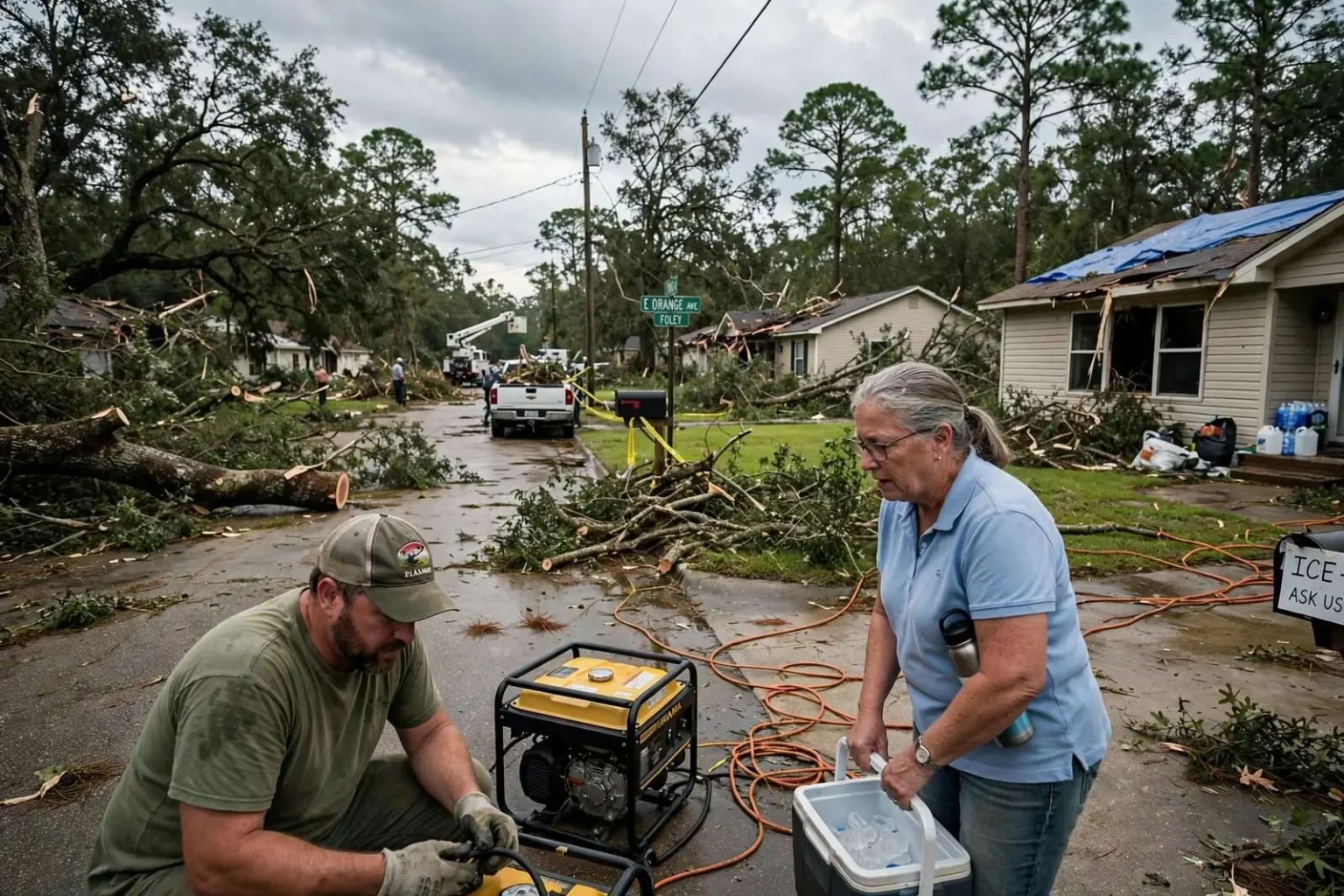
FOLEY, Ala. — Power crews, tree crews and debris trucks have begun moving through Foley neighborhoods that some residents say had been overlooked in the early days of the Hurricane Sally recovery. The Category 2 storm slammed into the Alabama coast near Gulf Shores in the early morning hours of Sept. 16, 2020, dragging torrential rain and damaging winds across Baldwin County, and in the days that followed, communities from the beaches to the northern end of the county faced the same grim inventory: downed trees, snapped power lines and weeks without electricity.
For those still without electricity, the response has come from next door. Residents described neighbors sharing generators, checking on one another and trading what they had as the community coped with a long week without power. In a city of roughly 20,000 people where many neighborhoods sit under a dense canopy of mature oaks and pines, the storm’s tree damage proved extensive — and so did the utility backlog.
“A lot of us have been trying to help each other run generators,” one Foley resident said. “It’s been a blessing in a way because people come together at a time like this.”
A slow recovery in the neighborhoods
Residents in some of the harder-hit parts of Foley said the first days after the storm felt quiet in the wrong way. While crews concentrated on main lines and critical infrastructure — a standard utility practice that restores power to the greatest number of customers first — individual streets with tangled downed lines and blocked roads waited. By the time power crews, tree crews and debris trucks began working through the residential streets, many households had already stretched a week or more on whatever they had.
That waiting period is where the neighborhood networks took over. Generator-sharing became the practical currency of the recovery: households with power ran extension cords to neighbors’ refrigerators, freezers and window units, and those with fuel checked on those without. Morning conversations on front lawns doubled as damage assessments, as neighbors compared roof damage, cleared each other’s driveways and passed along word about where to find ice, gas and supplies.
“It’s been a blessing in a way because people come together at a time like this,” the resident said — a sentiment echoed across Baldwin County as the scope of Sally’s damage became clear.
Sally’s toll on Baldwin County
Hurricane Sally made landfall near Gulf Shores on Sept. 16 with sustained winds around 105 mph, but the storm’s defining feature was rain. Exceptionally slow forward motion — just a few miles per hour as it came ashore — allowed the storm to wring enormous rainfall totals over the central Gulf Coast, with parts of the region measuring well over a foot of rain. In Foley and surrounding communities, saturated ground made it easier for winds to topple trees, and toppled trees in turn took down power lines, blocked roads and damaged homes.
The result was one of the most extensive power-outage footprints in Alabama history. Tens of thousands of customers across Baldwin County lost electricity, some for a week or longer, and rural pockets waited longer still. Communities along the Perdido and Fish River systems saw significant flooding, while the storm surge pounded the coastal towns to the south.
Foley, sitting in the southern-central part of the county a few miles north of the coast, absorbed a share of all of it: wind damage to roofs and outbuildings, tree strikes on homes and vehicles, flooded low spots and a grid that needed substantial rebuilding. City crews worked first on clearing arterial roads so utility trucks could reach the neighborhoods behind them, then turned to the debris piles that grew at every curb.
The broader pattern across Baldwin County
The scene in Foley reflects a broader pattern across Baldwin County, where downed trees and lingering outages have pushed neighbors to depend on one another while utility and cleanup crews work through the backlog left by Sally. From Orange Beach and Gulf Shores on the coast to Bay Minette in the north, the county’s recovery has run on two engines at once: the formal response of utilities, municipalities and contractors, and the informal one of neighbors, churches and civic groups filling gaps as they appeared.
Baldwin County’s geography shapes that dynamic. At well over 1,500 square miles, it is the largest county in Alabama by land area, stretching from Mobile Bay across piney woods and farm country to the Florida line. Its communities are small and spread out — Foley, Fairhope, Daphne, Spanish Fort, Robertsdale, Loxley, Summerdale, Elberta — and in a disaster of Sally’s scale, help from the county seat or the state capital can take time to reach a single blocked street. Neighbors are simply closer.
Churches and community organizations have played a familiar role in that informal network, distributing supplies, hosting chainsaw crews and coordinating volunteers. Volunteer fire departments in the county’s unincorporated communities have doubled as information centers, passing along outage updates and road closures to residents who lack power — and, with it, reliable phone service and internet.
What residents can expect from the recovery
Utility crews and their mutual-aid partners follow a predictable sequence after a storm of this scale: restore transmission lines and substations, then critical facilities such as hospitals, water systems and emergency operations, then main distribution lines that serve large numbers of customers, and finally the individual service lines and buried laterals that connect single streets and houses. The last phase is the slowest and the least visible, which is why neighborhoods that waited longest often saw the heaviest crew activity once work reached them.
Debris removal follows its own timetable. In Baldwin County after Sally, curbside collection of vegetative debris — the downed limbs, trunks and stumps that define windstorm damage — ran for weeks and, in some communities, months. Residents were asked to separate vegetative debris from construction and household debris so the piles could be hauled to different destinations: mulching facilities for trees, landfills for the rest.
For homeowners, the recovery brings decisions of its own — hiring tree removal companies, filing insurance claims, screening contractors — and, as state officials have warned, a wave of storm-chasing scammers looking to profit from the urgency. Baldwin County’s courthouse offices and municipalities have urged residents to verify licenses and insurance before signing contracts, a reminder that the aftermath of a storm carries its own hazards.
Foley’s long road back
Foley has been here before. South Baldwin County communities have weathered Hurricanes Ivan in 2004, Dennis and Katrina in 2005, and a string of smaller storms since, and each recovery has left the city better prepared for the next one. Improved building codes, undergrounding projects on selected lines and hardened critical facilities have all shortened recovery times over the years — but no measure can fully protect a leafy residential city from a slow-moving hurricane that drops a year’s worth of rain in a day.
What the weeks after Sally have shown, residents say, is the part of the recovery that no crew can schedule. Generators hummed in shared backyards. Chainsaws appeared on neighbors’ fences before any contractor’s estimate did. Check-ins on elderly neighbors became a daily routine on streets where power had yet to return.
“A lot of us have been trying to help each other run generators,” the Foley resident said, and that neighbor-to-neighbor effort has become one of the defining images of the storm’s aftermath in the city — parallel to, and often ahead of, the official recovery.
As power crews finish restoring service and debris trucks continue their circuits through Foley’s neighborhoods, the city’s focus shifts to the longer tasks: roof repairs, insurance settlements, tree replanting and the ordinary business of a growing city getting back to work. The downed limbs will be chipped and hauled, the outages resolved and the tarps eventually replaced with shingles. What tends to last longer is the lesson the storm taught — that in Baldwin County, the nearest source of help in a disaster is usually the house next door.
Residents who still need assistance with storm recovery are encouraged to contact Foley City Hall, the Baldwin County Emergency Management Agency or their local volunteer organizations, all of which continue to coordinate resources as the recovery moves from emergency response to long-term cleanup.
Checking on the neighbors who need it most
One of the quiet dangers of a week-long outage is the isolation it creates for older residents and those with medical needs. Refrigerated medications spoil, air conditioning fails in the lingering September humidity, and neighbors who live alone may go days without a visitor if their household keeps to itself. In Foley, the generator-sharing networks doubled as wellness checks: the same rounds that delivered extension cords and fuel also confirmed that every household on the street had someone looking in on it.
Local officials recommend that residents keep a similar routine in any extended outage — checking on elderly neighbors, confirming that anyone dependent on powered medical equipment has a plan, and sharing cooling stations and supply distribution points by word of mouth when cell service is spotty. In Baldwin County, those informal checks often outpace the official ones simply because neighbors see each other every day and agencies cannot knock on every door at once.
The lesson is not new to the Gulf Coast, but Sally reinforced it: the first responders in a hurricane’s aftermath are frequently the people who live on the same street. Crews from the utilities, the municipalities and the contractor fleets will get the power back and clear the roads. The week before they arrive belongs to the neighbors.