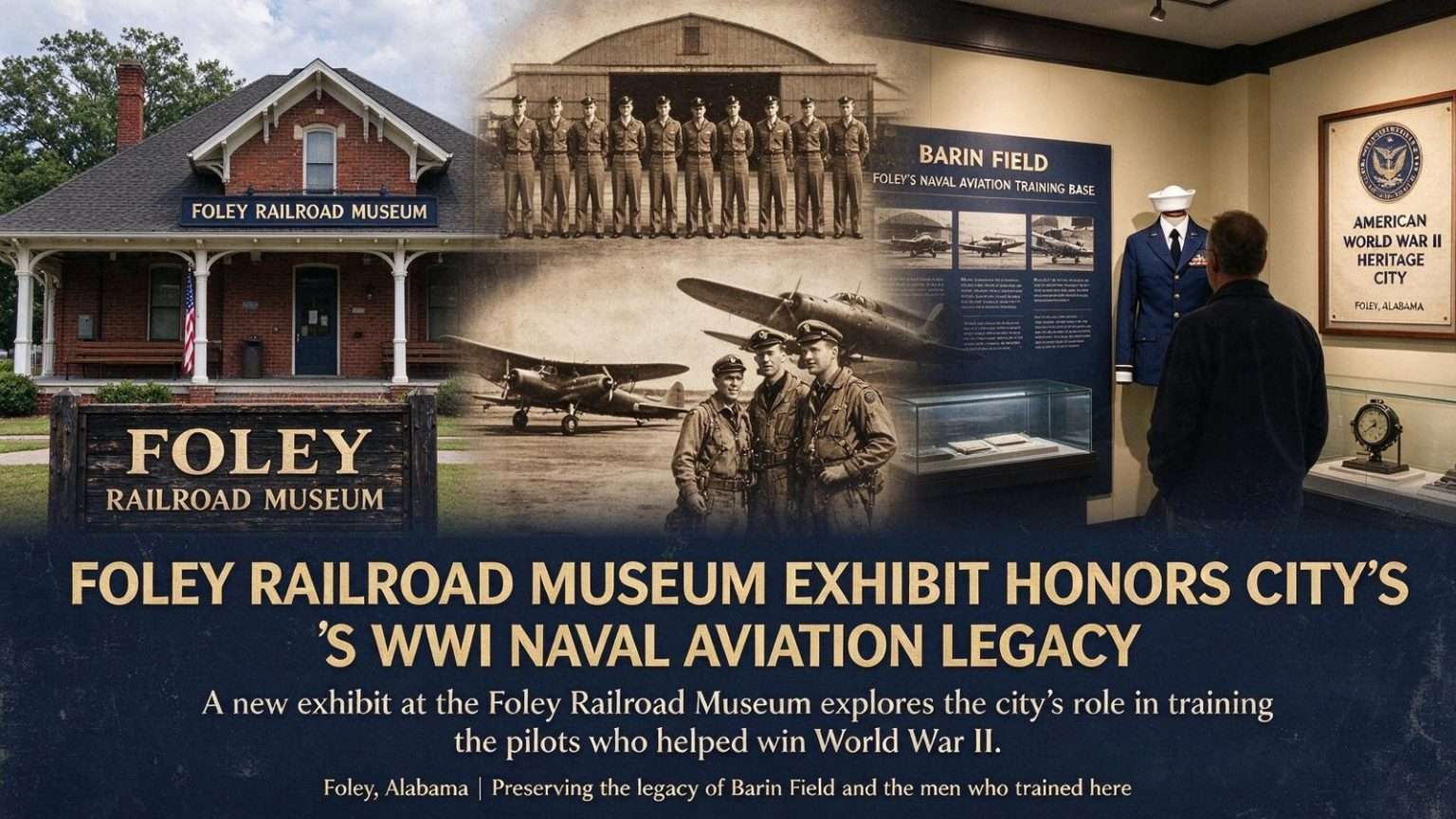
A new exhibit at the Foley Railroad Museum is inviting residents and visitors to step back in time and explore the city’s often-overlooked role in training the pilots who helped win World War II.
The exhibit, which opened on Dec. 5 to mark the 82nd anniversary of the commissioning of Barin Field in 1942, showcases rare photographs, historic uniforms and authentic equipment from the era.
The anniversary framing gave the opening a precision the museum’s volunteers clearly valued: eight decades to the year from the day the Navy put the field into service. Exhibits of this kind in small Alabama museums are typically assembled from what families have kept in trunks and attics, and the photographs, uniforms and equipment on display at Foley arrived by exactly that road — lent and donated by the descendants of the men who passed through the base.
Foley’s role in training Navy pilots
During World War II, Foley was home to Barin Field, a Naval air training base where young aviators prepared for combat before shipping out to serve their country. The base played a pivotal role in the war effort, and its presence forever shaped the history of the small Baldwin County town.
Barin Field was one node in the vast training network the Navy built across the Gulf Coast early in the war, when the military needed flat land, open skies and weather that allowed flying nearly year-round. South Alabama and the Florida panhandle supplied all three, and airfields sprang up across the region as the Navy converted the peacetime pilot pipeline into a wartime industrial operation.
For Foley, a farming town best known for its potato fields and its rail line, the base brought thousands of young servicemen, civilian jobs and a wartime economy into what had been a quiet agricultural community. Land was cleared, hangars and barracks rose, and residents who had never seen an airplane up close suddenly lived beside an airfield. The base’s legacy survives in street names, old photographs and family stories across Baldwin County.
The new exhibit tells that story through detailed panels highlighting daily life at Barin Field, the training operations conducted there, and the personal stories of the men who trained and served. Visitors walking through the exhibit can see the artifacts up close, from period photographs to the uniforms worn by the pilots and crews who called Barin Field home during the war years.
Organizers designed the display to transport guests back to a time when young aviators took to the skies from what is now a quiet corner of downtown Foley.
That contrast — a training field where hundreds of aircraft once operated, now within earshot of a museum district — is what gives the show its local force. Visitors who have driven past the old base land for years without knowing what it was leave with the full story.
A nationally recognized WWII Heritage City
The timing of the exhibit coincides with a significant honor for the city. Foley has been officially designated an American World War II Heritage City by the National Park Service, a distinction awarded to only one community in each state or U.S. territory.
Nationwide, just 38 cities hold the title, placing Foley among a small and select group recognized for its contribution to the war effort.
The Heritage City program, administered by the National Park Service, honors communities whose wartime contributions — industrial, agricultural, military — shaped the national effort, and it carries an obligation as well as an honor: designees are expected to preserve and interpret that history for the public. Foley’s museum exhibit is precisely the kind of project the designation anticipates, and the pairing of the two gives the city a documented national standing for the story it has been telling locally for years.
That designation adds extra weight to the new exhibit, which organizers hope will help residents better understand the significance of the training base that once operated in their community.
For a city of Foley’s size, the recognition also travels. Heritage City status puts the town on itineraries of travelers who follow World War II history across the country, alongside museums and battlefields far larger. A free downtown museum within reach of the Gulf Shores and Orange Beach beach traffic is positioned to catch some of those visitors on their way to the coast.
The human cost behind ‘Bloody Barin’
Part of what makes the exhibit resonate is its unflinching look at the risks aviators faced during training. Barin Field earned the nickname “Bloody Barin” because of the high number of training accidents that occurred there — 40 aviators lost their lives in just the first two years of operation.
The number deserves a moment’s context. Wartime flight training was genuinely dangerous: young men with a handful of flying hours flew powerful aircraft in tight patterns, weather was sometimes an afterthought, and the demands of producing combat pilots on schedule left little margin. The aircraft losses across America’s training fields ran into the thousands, and communities that hosted the fields buried the consequences. The nickname that Foley’s neighbors gave the field was spoken with that reality in mind.
The exhibit pays tribute to those men and the sacrifices they made, even before ever reaching the battlefield.
Glen Moore, a former Navy crash crew leader who served at Barin Field, shared his recollections of that period as part of the exhibit’s effort to preserve firsthand accounts of the base’s history.
“It was a great experience, but sometimes you’d wish you were back home and not have to face what happened,” Moore said. “But somebody has to do it, and I appreciate the chance to serve my country.”
Moore’s role placed him at the worst moments of base life — the crash crew answered every accident — and his account carries the particular weight of a man describing the part of the job nobody volunteered for. Recorded testimony of that kind has a shelf life; the museum’s effort to capture it while the Barin generation remained reflects how small museums now race the calendar.
Stories like Moore’s give the exhibit a personal dimension that goes beyond static displays of wartime artifacts, offering visitors a direct connection to the people who lived through Barin Field’s history.
Plan your visit
The exhibit is housed inside the Foley Railroad Museum, a historic setting that adds to the experience for visitors exploring the city’s wartime past. The museum is located at 125 East Laurel Ave. in downtown Foley and is open Monday through Saturday from 10 a.m. to 3 p.m. Admission is free.
The railroad setting is more than a backdrop. Foley grew up around the rail line that carried its farm goods to market, and the depot museum anchors the city’s downtown historic district — which means the Barin Field exhibit sits a few blocks from the streets the airmen walked when they had leave. Visitors can pair the exhibit with a walk through the downtown and the city’s park to see how much of the wartime landscape still reads.
The free admission and daytime hours make the museum an easy stop for two audiences the organizers have in mind. One is the South Baldwin resident, including the school groups and winter visitors who fill the city’s calendar, for whom the exhibit is the first full telling of a story most know only in fragments. The other is the coastal tourist: downtown Foley sits on the route to the beaches, and a free hour of museum time has long been part of what the city offers families waiting out a beach day.
Whether visitors are longtime Foley residents looking to reconnect with their town’s history or travelers seeking a meaningful stop along the Alabama Gulf Coast, organizers say the exhibit offers a rare and moving look at the community’s role in one of the defining chapters of American history.
Keeping the story alive
The Barin Field exhibit joins a small but growing body of local work across Baldwin County and the Gulf Coast preserving the region’s wartime record. South Alabama’s contribution to the air war — the fields, the training squadrons, the crash crews — was out of all proportion to the region’s population, and it went largely unmarked for decades after the bases closed. Museums like Foley’s are where that record now lives.
The materials themselves carry the effort. A training uniform, a flight log, a photograph of a line of trainers on a ramp: each item donated to the museum represents a family’s decision that a father’s or grandfather’s service at Barin Field should remain part of the public story rather than fading into a private memory. Museum volunteers catalog and display those pieces with the care their origin implies.
For the city, the exhibit also completes a loop that the Heritage City designation opened. A community recognized nationally for its war work now has a permanent place to explain why — in the photographs of young pilots, the panels that trace the base’s operations, the words of a crash crew leader who was there, and the forty names of the men who trained for war at Foley and never reached it.