Former Blount Star Kadarius Toney Awaits His NFL Draft Call
Former Blount High and Florida star Kadarius Toney eyed a first-round NFL Draft selection and Mobile-area draft history.
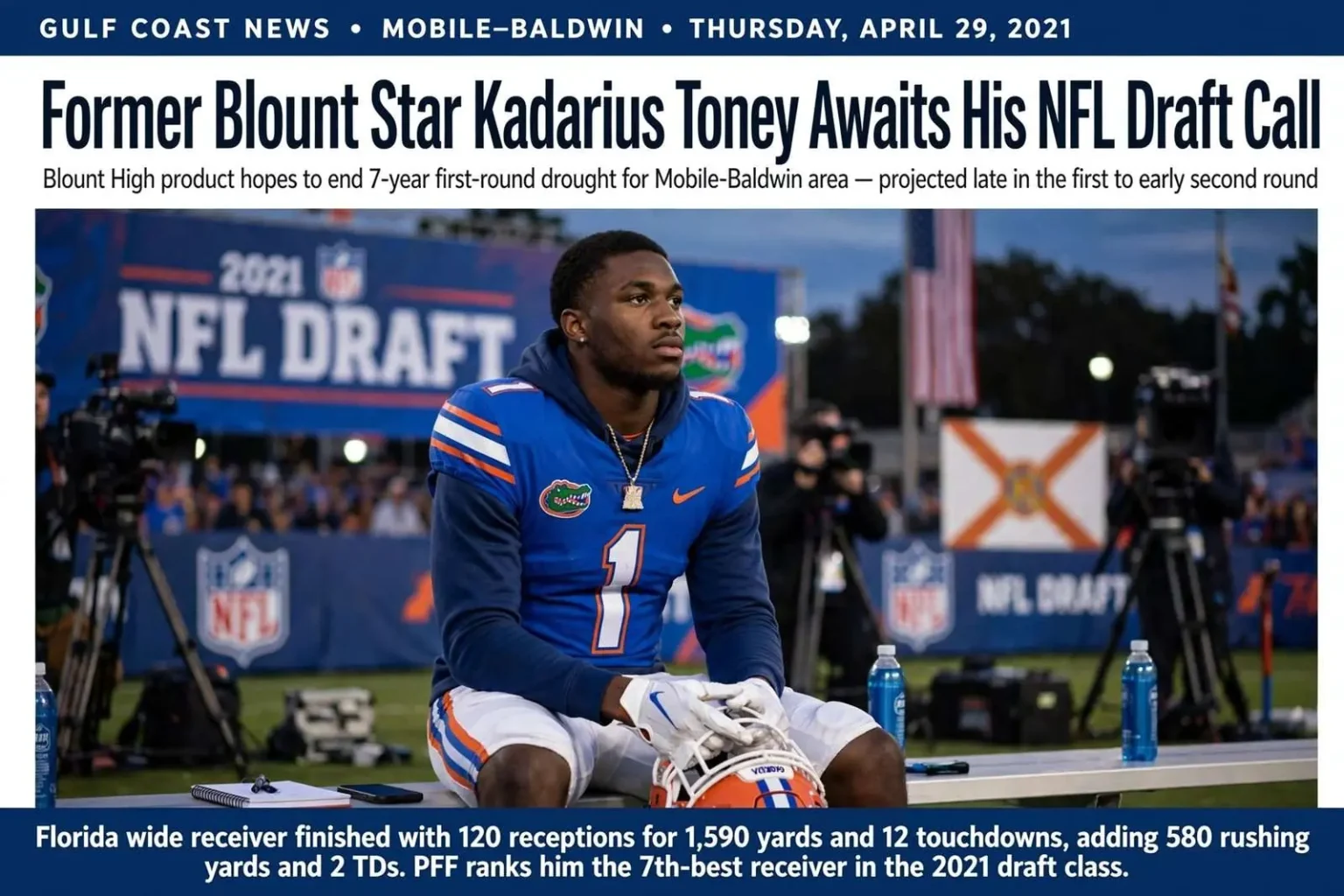
Kadarius Toney hoped to hear his name called early when the NFL Draft opened Thursday night — and to become the first first-round pick from the Mobile-Baldwin area in seven years. The former Blount High School star wrapped up his University of Florida career with 120 receptions for 1,590 yards and 12 touchdowns, adding 580 rushing yards and two scores on the ground. Draft analysts projected Toney anywhere from late in the first round to the middle of the second, and Pro Football Focus rated him the seventh-best wide receiver available.
For Toney, the wait that began Thursday night was the culmination of a football journey that started on the fields of Prichard, where he first made his name as a dual-threat playmaker at Blount High School. Whatever round his name was eventually read in, his path to the draft podium had already made him one of the most closely followed Gulf Coast products in this year’s class.
From Blount High to the Draft Board
Blount High School, located in Prichard, has long been one of the most productive football programs in the Mobile area, sending a steady stream of athletes to major college programs. Toney emerged from that pipeline as one of the most dynamic players in the region, a quarterback and athlete whose ability to make defenders miss in space drew recruiting attention from across the Southeast. When he signed with the University of Florida, he carried with him the expectations that follow any Gulf Coast star heading into Southeastern Conference competition.
The Mobile-Baldwin area has produced a long line of professional football talent over the decades, from Pro Football Hall of Famers to steady NFL contributors, reflecting the depth of high school football talent in southwest Alabama. But first-round selections have been rare in recent years, which is why Toney’s draft positioning carried significance beyond his own career. A first-round call Thursday night would have made him the first player from the Mobile-Baldwin area to hear his name in the opening round in seven years, a milestone local coaches and fans were watching closely.
High school programs across the area track their alumni on college rosters and NFL draft boards with pride, and Blount’s coaching staff had spent the week fielding questions about their famous former quarterback-turned-receiver. For younger players in the Leopards’ program, Toney’s rise served as a visible example of where the regional pipeline could lead.
A Different Kind of Playmaker
Toney’s college resume stands out because of its variety. In four seasons at Florida, he caught 120 passes for 1,590 yards and 12 touchdowns while also contributing 580 rushing yards and two touchdowns on the ground. He lined up in the backfield, in the slot and out wide, took handoffs, direct snaps and screen passes, and at times handled return duties. That versatility made him difficult to categorize for draft analysts and difficult to prepare for for opposing defensive coordinators.
His final collegiate season was his most productive, as he developed from a situational gadget player into the Gators’ most reliable target. Scouts noted his quickness in short areas, his ability to turn a short catch into a long gain and his willingness to block. Questions about consistency and ball security appeared in scouting reports, as they do for nearly every prospect, but the consensus was that his playmaking ceiling separated him from much of the class.
Pro Football Focus, the analytics outlet whose player grades have become a fixture of draft coverage, rated Toney the seventh-best wide receiver available and projected him as a second-round selection. That ranking placed him among the elite pass-catchers in a class widely regarded as unusually deep at the position.
A Deep Year for Wide Receivers
The 2021 draft class was considered especially deep at wide receiver, with as many as five pass-catchers expected off the board in the opening round. That depth created an unusual dynamic for prospects like Toney: the position’s strength meant teams filled those needs early, pushing other talented receivers down boards regardless of their individual merit. Analysts spent the weeks before the draft debating where the second tier of receivers would land, and Toney sat squarely in that conversation.
For teams picking in the late first round and early second, the depth offered opportunity. A franchise needing a playmaker could address other positions on Thursday night and still find a receiver with starting-caliber traits Friday night. That logic was part of why projections for Toney ranged so widely, from the final picks of the first round to the middle of the second, with different evaluators weighing his ceiling against the depth of the class around him.
The draft’s three-day format also shapes how these stories unfold. First-round picks are announced Thursday night in front of the largest audience, with second- and third-round selections following Friday and the remaining rounds on Saturday. Players on the border between rounds wait through a long evening knowing their phone could ring at any moment, and the spread of projections analysts publish before the draft rarely matches the order teams actually follow.
What the Scouting Reports Said
In the months leading up to the draft, Toney met with teams, participated in pre-draft workouts and went through the interview circuit that shapes the final weeks of every prospect’s calendar. Evaluators consistently highlighted his yards-after-catch ability, citing his background as a high school quarterback and his natural instincts with the ball in his hands. His route tree drew some scrutiny after a college career in which Florida used him in creative but varied roles, and teams spent time projecting how his skills would translate to a defined NFL position.
The SEC brand travels well in draft rooms, and Toney’s production against the conference’s best defenses gave evaluators plenty of quality tape to study. His performances against ranked conference opponents during his final season were among the most-watched film in the receiver group, and they did much to move him from a late-round afterthought in early preview magazines to a genuine top-100 conversation by draft week.
Wherever he was selected, Toney would join a fraternity of Gulf Coast products in the NFL and carry the flag for a Mobile-Baldwin area that follows its own with unusual intensity. Local sports talk radio and social media had tracked his every workout and mock-draft mention in the weeks leading up to Thursday night, and Blount High’s program had become a rallying point for fans hoping to see the area’s drought end.
The Waiting Game
Draft night is the rare moment when the uncertainty of professional sports is put on public display. For players projected in that late first round to early second round range, the hours between the first picks and their eventual selection can stretch agonizingly, with family gathered around and cameras running. Toney’s hope of an early call reflected both his confidence and the legitimate case his tape made for first-round consideration.
Seven years is a long gap for a region that has produced so much football talent, and the significance of ending that drought was not lost on anyone following along from the Gulf Coast. Whether the call came Thursday or Friday, Toney’s journey from the fields of Prichard to the NFL represented the latest chapter in the area’s long football story — one that younger players in Mobile and Baldwin County will now point to as proof of what is possible.
The Road From Prichard
Toney’s route to draft weekend ran through some of the most competitive football in the country. At Blount, he played in a region where every district game features athletes headed to Division I programs, and Friday nights in Prichard draw crowds that treat the games as community events. The Leopards’ program has built its identity on speed and physicality, qualities that showed up immediately in Toney’s college film and that NFL teams later cited as strengths of his game.
His transition from high school quarterback to college playmaker was itself a story area football fans followed closely. Making that switch requires more than athletic ability; it demands learning a new position, refining route technique and adjusting to the pace of SEC defenses. That Toney developed into one of the nation’s most productive receivers after arriving in Gainesville as a raw athlete speaks to the coaching investment Florida made in him and the work he put in across four seasons.
The Gators’ staff found increasingly creative ways to use him as his career progressed, and his senior-season emergence coincided with one of the most productive offensive stretches in the program’s recent history. By the time his college career ended, his highlights had become a staple of draft-season programming, replayed alongside analysis of where his unique skill set fit best at the professional level.
What a Draft Pick Means Back Home
When Mobile-Baldwin area players reach the NFL, the effect on local programs is tangible. Youth leagues see registration bumps, high school coaches gain a recruiting story they can tell every prospect who walks through the door, and communities rally around watching a hometown player on Sundays. The area’s football culture runs deep — it is a region that produces college signings every year and has sent generations of players to the Southeastern Conference and beyond.
That is why the seven-year gap between first-round picks resonated locally. Production has never been the problem; the area regularly sends talent to college rosters. But the first round carries a different weight in a community’s football identity, and players on the cusp of it carry the hopes of coaches, teammates and neighbors who watched them grow up on local fields.
For Toney, the weeks leading into the draft meant balancing the business side of the process — team visits, medical checks, agent conversations — with the emotional weight of a hometown watching. Whatever jersey he puts on this fall, the connection to Prichard and Blount High travels with him, and the young players coming up behind him in Mobile and Baldwin County now have another local path to follow from Friday night lights to the NFL draft.