
Former Mobile County Commissioner Nodine organizing Florida’s newly enfranchised voters
Former Mobile County Commissioner Stephen Nodine is helping organize Florida's 1.5 million newly enfranchised felons through Florida Second Chance Voters.
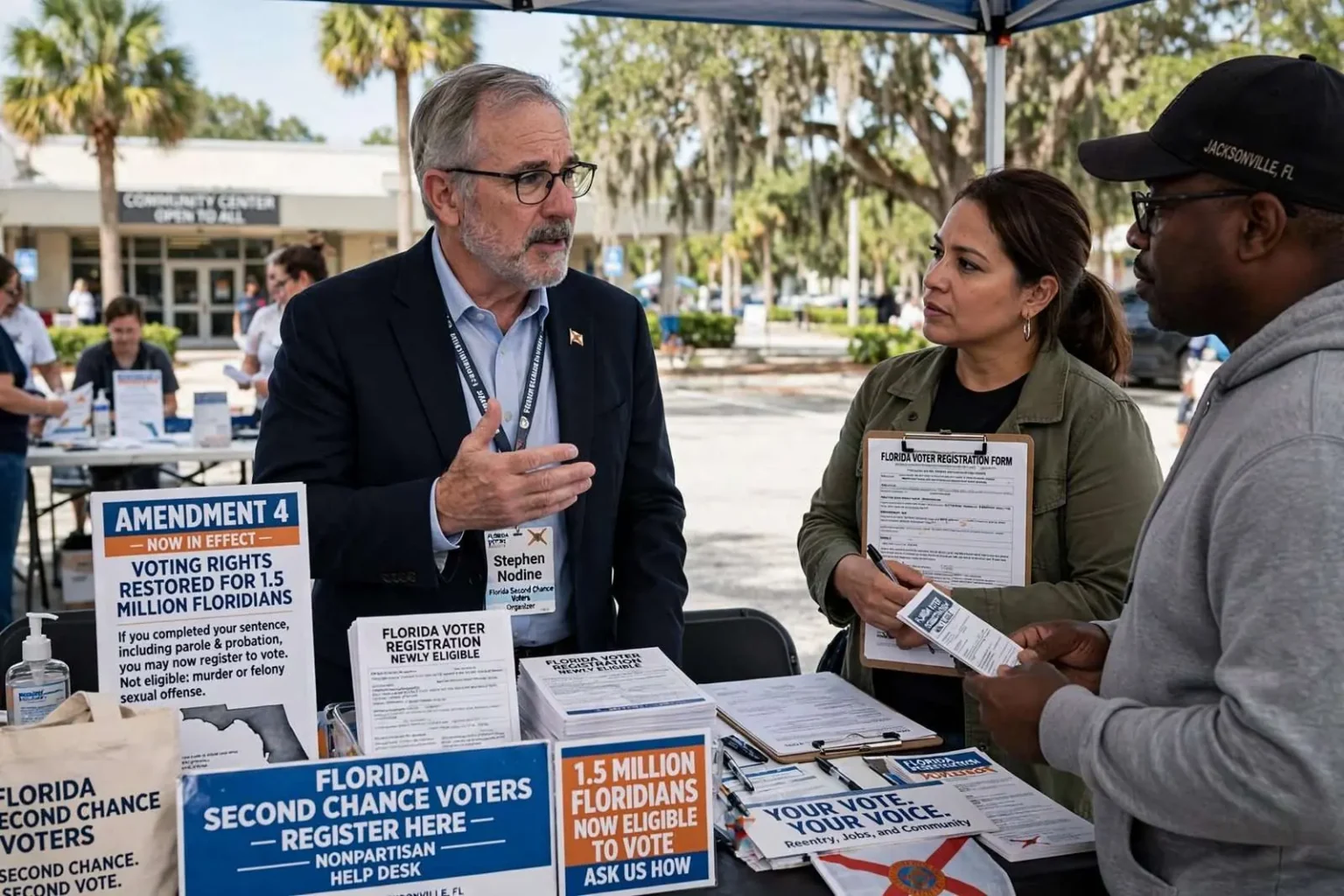
A former Mobile County elected official is now leading an effort in Florida to mobilize people who regained their voting rights under a newly approved constitutional amendment, launching the drive at a moment when the state’s electorate has just absorbed one of the largest expansions of the franchise in American history.
Stephen Nodine, who served on the Mobile City Council and later the Mobile County Commission, said he is helping organize the roughly 1.5 million Floridians with past felony convictions who became eligible to vote after voters approved Amendment 4 earlier this month by a roughly 2-to-1 margin. The amendment’s passage ended, at a single stroke, a disenfranchisement policy that had stood in Florida for generations.
“Almost six million people voted to give ex-felons a second chance,” Nodine said. The overwhelming margin, he argued, amounts to a clear instruction from Florida’s electorate that the people who served their sentences should be brought fully back into civic life.
What Amendment 4 Did
Amendment 4 amended the Florida Constitution to automatically restore voting eligibility to people with felony convictions once they complete their sentences, including any prison time, parole or probation. The measure excluded people convicted of murder or felony sexual offenses, leaving those cases subject to the state’s existing clemency process.
Before the amendment, Florida stood among the last states in the nation with a lifetime voting ban for people with felony convictions. The policy dated to the post-Civil War era, when the state’s constitution was rewritten with provisions that stripped large categories of citizens of the franchise, and it survived every subsequent reform wave that loosened similar laws elsewhere.
The practical effect was enormous: Florida held more disenfranchised citizens than any other state, a population larger than the total voting-age population of many individual states. For more than a century, a conviction — even for a nonviolent offense committed decades earlier — meant a permanent loss of the ballot unless the governor and Cabinet granted clemency through a process that varied dramatically by administration.
Previous restoration efforts under the clemency system moved slowly and unevenly. Applicants could wait years for hearings, and policy reversals between governors left thousands in limbo. Amendment 4’s automatic structure was designed to sweep that machinery aside, replacing discretion with a bright-line rule: finish your sentence, regain your vote.
The New Organization
Nodine, a former lobbyist, has formed an organization called Florida Second Chance Voters to register and mobilize the newly eligible. The group’s early mission is practical: identifying people with past convictions who are now eligible, walking them through registration, and making sure the new law translates into actual ballots rather than theoretical eligibility.
He said he plans to spend time in Tallahassee urging both parties to develop plans for criminal justice and prison reform as well as job opportunities for former convicts. The lobbying push aims to pair the restoration of voting rights with the practical supports — employment, housing and treatment — that determine whether a second chance takes hold.
“It’s up to both parties to demonstrate what they can do in prison reform, drug rehabilitation and giving these people a real second chance,” he said. In his view, the size of the new voting bloc makes responsiveness a matter of arithmetic for politicians in both parties: ignore a bloc that large, and some opponent will court it instead.
The organization enters a policy landscape where Florida’s prison system and corrections budget have been perennial subjects of legislative debate. Advocates across the ideological spectrum have found common ground in recent years on questions of reentry programming, drug treatment as an alternative to incarceration and reentry employment programs — the same areas Nodine says he will press.
A Voting Bloc of National Consequence
With Florida’s elections often decided by slim margins, Nodine argued the newly enfranchised bloc could prove decisive in local, statewide and even national races. The state’s modern political history is a ledger of razor-thin outcomes — presidential elections decided by hundreds of votes, statewide contests settled by fractions of a percentage point — and a bloc of 1.5 million potential voters dwarfs those margins many times over.
He predicted the group would play a major role in the 2020 election. Florida’s status as the nation’s most closely divided large swing state means the registration and turnout work done in the coming months will ripple through presidential, gubernatorial and legislative races alike.
The bloc is also geographically distributed in a way that magnifies its power. Returning citizens live in every county and every neighborhood, from the biggest metros to the smallest towns, meaning their votes can move city councils, county commissions, statehouse seats and congressional districts alike. Neither party can map around them.
For the newly eligible themselves, the moment is more personal. People who completed sentences years or decades ago — many of whom have never voted in their lives — are being invited into a process most Americans take for granted. Community groups across the state have begun registration drives aimed at explaining the new rules and helping people claim rights they never expected to have.
Nodine’s Unusual Vantage Point
Nodine brings to the effort a resume that includes both public office and prison time. He served on the Mobile City Council and later the Mobile County Commission, building a political career in one of Alabama’s largest counties before his resignation from the county commission in 2010.
His subsequent years included three years in federal prison on weapons and perjury convictions — an experience that placed him, by his own account, on the other side of the criminal justice system he once helped govern. He now lives in Jupiter, Florida, where the passage of Amendment 4 gave him a constituency that mirrors his own history.
That biography is central to his argument. As a former elected official who later served time in federal prison, Nodine occupies a position few advocates can claim: he understands both the politics of running for office and the reality of re-entering society after a conviction. His pitch to legislators is built on that credibility — a second-chance case argued by someone who has lived one.
A former lobbyist by trade, he is re-entering public advocacy with the same skills that profession demands: organization, persistence and an understanding of how to move an agenda through a capital. The difference this time is the constituency he is carrying with him.
The Push for Reform Beyond the Ballot
Nodine’s agenda in Tallahassee extends past the ballot box. He said the organization plans to press lawmakers on prison reform, drug rehabilitation and employment pathways for people leaving incarceration — the supports that determine whether a released person rebuilds a life or cycles back into the system.
The argument he carries to both parties is essentially fiscal as well as moral. Incarceration is expensive, recidivism is more expensive, and employment is the most reliable predictor of whether a returning citizen stays out. Frame the newly enfranchised as taxpayers and workers rather than liabilities, the argument goes, and the policy case builds itself.
Nodine’s group is part of a broader wave of activity that the amendment’s passage set in motion. Churches, civil rights organizations, advocacy groups and volunteers across Florida have mobilized to register the newly eligible, hold voting-rights workshops and staff tables outside courthouses where people complete their sentences’ final paperwork.
How large the impact becomes depends on turnout. A bloc of 1.5 million people matters only if its members register, learn the rules and actually vote — the classic organizing challenge that has decided Florida elections before. Nodine’s bet is that the desire to participate, after years of exclusion, will translate into unusually strong engagement among the state’s newest voters.
What It Means for Florida Politics
If the prediction holds, the consequences will reach every level of the ballot. Florida’s statewide races are routinely decided by points or less, its legislature is closely divided, and its 29 electoral votes have decided presidencies. A new bloc of voters participating for the first time injects uncertainty into every forecast — and both parties’ strategists know it.
Nodine, for his part, has framed the effort in deliberately nonpartisan terms, arguing that second chances are not an ideological proposition. Whether that framing holds through two parties’ competing registration drives remains to be seen, but the scale of the amendment’s passage — nearly six million votes — suggests the sentiment behind it crossed party lines.
A half-century after Florida created one of the nation’s most restrictive disenfranchisement regimes, the state’s voters chose to unwind it. The task of turning that choice into registered voters — and registered voters into ballots — now falls to organizers like Nodine, working county by county across a state that has seen few political experiments of this size.