
Former Mobile Toys R Us property sold to self-storage developer
The former Toys R Us building in Mobile sold for $2.7 million to a Savannah self-storage developer planning a climate-controlled renovation.
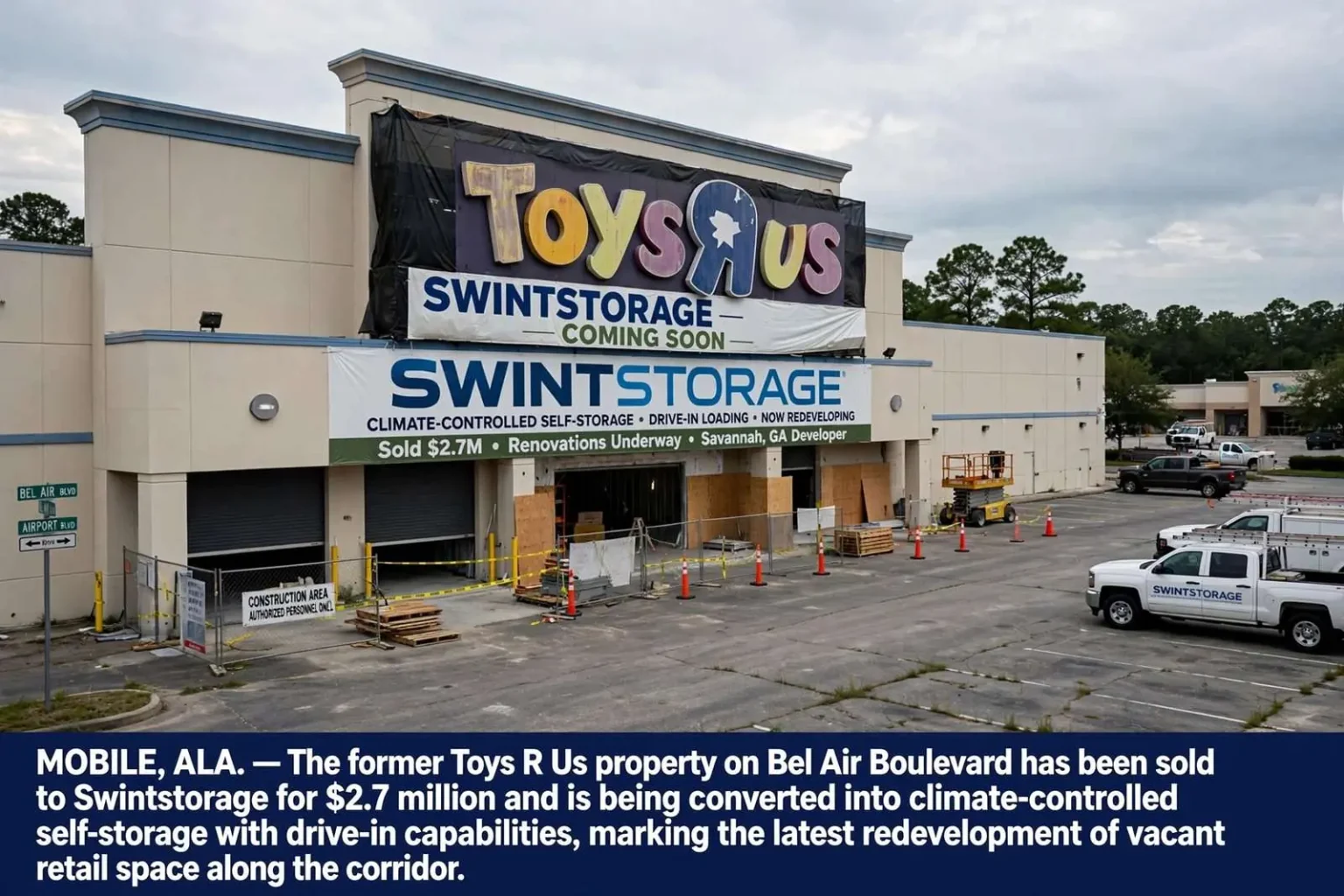
MOBILE, Ala. — The former Toys R Us property in Mobile has been sold to Swintstorage, a self-storage developer based in Savannah, Georgia, for $2.7 million. The developer plans to renovate the building into climate-controlled self-storage with drive-in capability, according to David Dexter and Niki Coker of NAI Mobile, which brokered the transaction. The sale marks the latest chapter for a big-box property that has sat in transition since the toy retailer’s collapse, and it reflects a broader reshaping of retail real estate across the Gulf Coast.
“The plans for his buildout are impressive,” Coker said. “From what it looks like, he’ll be adding large roll-up doors to the exterior of the building for moving trucks to drive in, unload in the cool and out of the elements, and exit.” The drive-in concept addresses one of the perennial complaints about self-storage — hauling boxes in and out in the summer heat and afternoon thunderstorms — by allowing customers to back a truck directly into the climate-controlled envelope of the building.
“When we landed the assignment, we had a pretty good idea the backfill user would be something other than typical retail,” Dexter said. “Big box retail has been contracting in recent years, evidence of which appears on the other side of Bel Air Blvd. and Airport Blvd. We targeted call centers, fitness enterprises, municipal and county, entertainment concepts, churches and other non-retail prospects like self-storage.”
The brokers’ targeting list reads like a catalog of the tenants filling former retail boxes across the country. As national chains have consolidated or disappeared, commercial real estate specialists have developed a playbook for what the industry calls backfill: medical clinics, gyms, call centers, government offices, churches and self-storage operations, all of which can adapt large, open floor plates that were purpose-built for merchandise displays.
Toys R Us occupied the building after it was constructed in 2005. The store closed in 2017 after the company filed for bankruptcy. The property was later put up for bid, with the Mobile store conveying to a group out of Los Angeles for $790,000, according to probate records. “While we miss the youthful nostalgia associated with Toys R Us,” Coker said, “to be able to deliver a return on investment of this magnitude on a commercial property in such a short timeframe is a true testament to the power of redevelopment and continued growth of Mobile.”
The Rise and Fall of the Toy Giant
Toys R Us was once the defining toy retailer in America, a chain whose cavernous stores and trademark giraffe became a shared childhood memory for generations of shoppers. The Mobile store opened in 2005 during the company’s later era, part of a generation of big-box construction that lined the commercial corridors ringing Mobile. For local families, the store was a fixture of birthday shopping and holiday seasons, drawing traffic from across the city and from Baldwin County shoppers who crossed Mobile Bay for the selection.
The company’s collapse came with startling speed. Burdened by billions in debt from a leveraged buyout years earlier and squeezed by online competition and shifting toy sales, Toys R Us filed for bankruptcy protection in the fall of 2017 and moved to liquidate its U.S. stores the following spring. The closure swept away roughly 700 stores nationwide, including the Mobile location, and left landlords across the country with hundreds of thousands of square feet of empty retail space to reposition.
The aftermath in Mobile followed the pattern seen in markets everywhere: the property went to auction through the bankruptcy process, and an out-of-state investment group acquired it at a steep discount, paying $790,000 according to probate records — a fraction of what a new big-box building of that size would have cost. The subsequent sale for $2.7 million delivered a substantial gain in a short holding period, a result Coker credited to the strength of the Mobile market and the redevelopment value of well-located boxes.
Why Self-Storage Keeps Winning Empty Boxes
Self-storage has been among the fastest-growing segments of American commercial real estate for years, and developers increasingly view former retail boxes as ideal conversion candidates. The buildings offer high ceilings, truck-accessible loading, generous parking fields and locations on major traffic corridors — qualities storage operators would otherwise pay to build from scratch. Converting an existing box also costs less than new construction and can often be completed faster than a ground-up facility.
The Swintstorage plan adds the drive-in feature that differentiates a growing niche within the industry. Climate-controlled storage has become the expectation for many customers, particularly in Gulf Coast climates where humidity damages paper goods, electronics, furniture and fabrics. Allowing a moving truck to enter the conditioned space directly eliminates the most dreaded part of moving day, and the concept has proven popular in hot, humid markets across the Southeast.
The Corridor Around Bel Air and Airport
The property sits in one of Mobile’s most established retail zones, near the junction of Bel Air Boulevard and Airport Boulevard, an area anchored for decades by Bel Air Mall and surrounded by a dense concentration of shopping centers, restaurants and offices. The corridor grew up alongside the postwar expansion of west Mobile and remains one of the most trafficked commercial districts in the city, making any vacancy there conspicuous — and any successful repositioning valuable to surrounding property owners.
Dexter’s comment about contraction on the “other side of Bel Air Blvd. and Airport Blvd.” pointed to visible changes in the district: vacancies left by national chains that have consolidated or exited the market, a pattern repeated in retail corridors nationwide. As consumers shifted spending online, the anchors that once drew steady traffic to these centers thinned out, and landlords have had to be creative about who fills the space. The Mobile market has seen former retail space converted to a variety of uses in recent years, mirroring national trends.
For the surrounding neighborhood, a busy self-storage facility brings steady, low-traffic operation — customers visiting in short trips rather than the sustained rush-hour surges of big-box retail — along with continued property tax contribution and maintenance of a large building that might otherwise sit vacant. Municipal officials across the country have generally welcomed such conversions when they keep corridors active, though some communities debate the trade-off of losing sales-tax-generating retail.
The transaction also illustrates the role of investment groups in the lifecycle of failed retail. The bankruptcy sale that moved the property to a Los Angeles buyer at $790,000, followed by the $2.7 million sale to a developer with a specific reuse plan, shows distressed retail real estate moving through successive owners toward its highest productive use. Brokers like NAI Mobile’s Dexter and Coker work that chain deliberately, marketing properties to the non-retail users they identified from the start.
Swintstorage, the buyer, is based in Savannah, Georgia, part of a wave of Southeast-focused storage developers expanding through secondary markets like Mobile. The company’s plans call for the renovation work to convert the former toy store into climate-controlled units with the drive-in configuration Coker described, adding a new storage option to the corridor and closing the book on one of the last visible reminders of the Toys R Us era in Mobile.
For longtime shoppers, the loss of the toy store still stings — “we miss the youthful nostalgia associated with Toys R Us,” as Coker put it. But the economics of the sale tell the more durable story: in a growing city, a well-built box on a good corner rarely stays empty for long, even when the retailer that defined it disappears.
The Bigger Picture for Big-Box Real Estate
The story of the Mobile Toys R Us property is a microcosm of a transformation reshaping American commerce. Big-box retail boomed from the 1980s through the 2000s, filling highway corridors with vast single-purpose stores, and communities like Mobile organized their commercial geography around them. When e-commerce, debt loads and changing habits undercut the chains that anchored those boxes, the real estate did not vanish — it became raw material for the next wave of uses.
Across the Southeast, brokers report steady interest in former retail sites from users who would never have appeared on a landlord’s list a generation ago. Indoor sports facilities and trampoline parks take over grocery boxes. Medical groups carve imaging centers and urgent care clinics out of former department stores. Concert venues, gyms and nonprofit organizations have all claimed vacated retail space, and storage remains one of the most reliable conversions because it requires relatively little interior work to meet the use.
Financial markets have followed the same trend. Self-storage real estate investment trusts have been among the best-performing segments of commercial property for much of the past decade, and private developers continue to enter the sector drawn by steady demand — moves, downsizing, deployments, business storage and life transitions all feed it regardless of the economic cycle. Mobile’s population growth, military presence at the area’s bases and its role as a regional hub all contribute to local storage demand.
The $2.7 million price also offers a data point for owners and brokers tracking the recovery of distressed retail assets. Buying at bankruptcy-sale prices and reselling at several times the basis within a few years was a pattern repeated in markets across the country during the years after the Toys R Us liquidation, as the storage and non-retail demand absorbed the supply of empty boxes faster than many analysts predicted.
For Mobile, the conversion adds one more data point to an encouraging commercial real estate narrative. The city’s retail market has held up better than many comparable metros, supported by the aerospace and shipbuilding jobs at Brookley and the riverfront, the port’s industrial expansion and steady population growth along the I-10 corridor. Brokers who steer obsolete retail toward productive new users — as NAI Mobile did here — are a quiet part of that engine, ensuring that even the failures of national chains end as local opportunities rather than long-term blight.