Four dead in wrong-way I-10 chase crash near Loxley, Baldwin County
Four people died in a fiery wrong-way crash on I-10 in Baldwin County after a police chase that began near Loxley and ended near the Baldwin Beach Express.
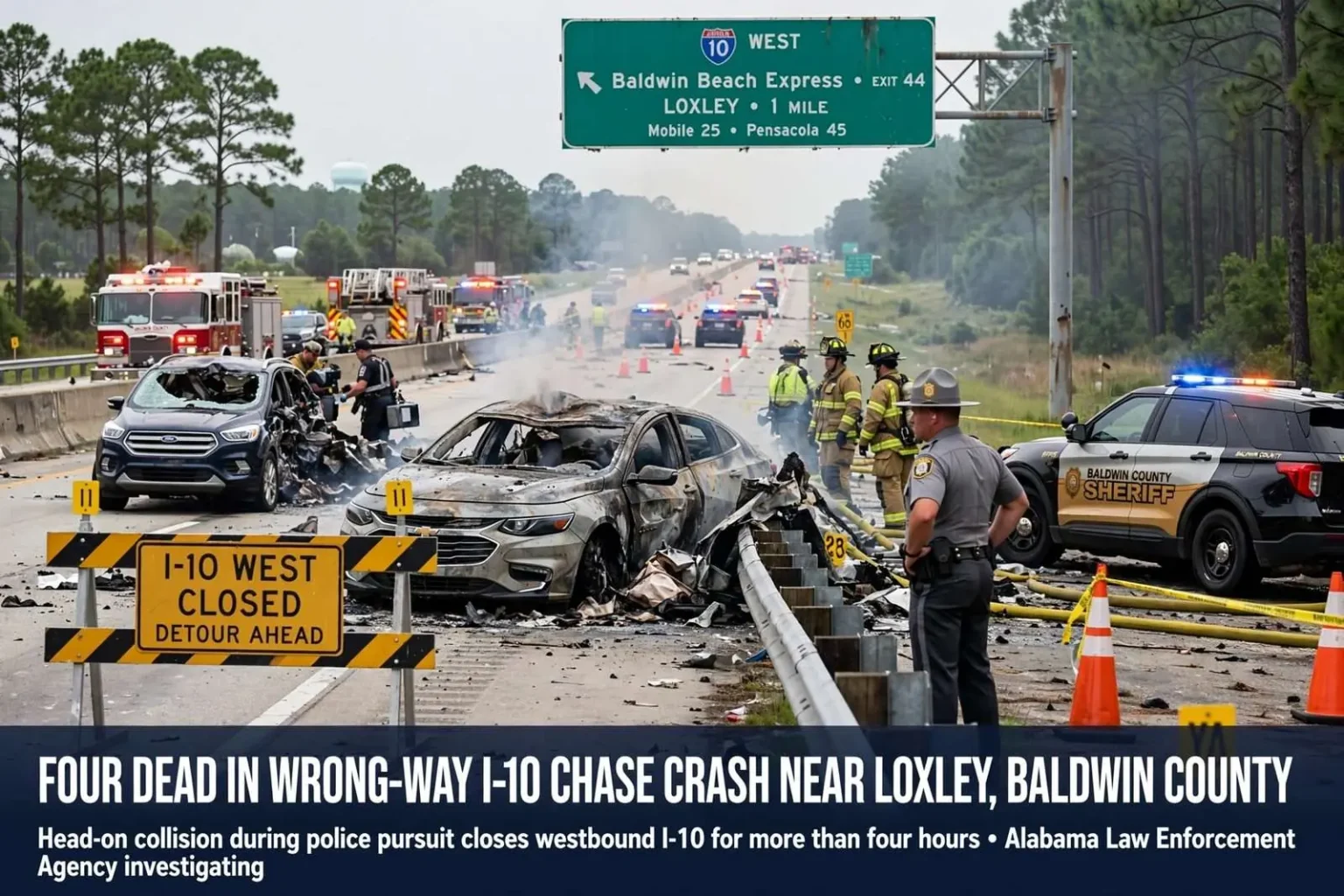
Four people died in a fiery wrong-way crash on Interstate 10 in Baldwin County, the result of a police chase that began after a traffic stop. The collision on the busy interstate corridor near Loxley killed the occupants of two vehicles and closed westbound I-10 for more than four hours while investigators worked the scene.
Alabama State Troopers identified one of the three people who died in the suspect vehicle as 34-year-old Crystal Lee Moradie of Converse, Texas. In the other vehicle, family members said 81-year-old Joseph Andrews died of his injuries; he was the driver of the innocent car struck head-on. His passenger and son, 54-year-old Kevin Andrews of Milton, Florida, was pronounced dead at the scene.
The Baldwin County Sheriff’s Office said the pursuit began after a deputy tried to make a traffic stop on eastbound I-10 near Loxley. The Chevrolet Malibu fled, turned around and traveled west in the eastbound lanes, colliding head-on with a Ford Escape near the Baldwin Beach Express. The suspect vehicle rolled over the guardrail and caught fire.
Both vehicles had out-of-state plates. The Alabama Law Enforcement Agency is leading the traffic homicide investigation into the crash, which unfolded on one of the busiest stretches of highway in south Alabama during a period of heavy summer travel.
How the pursuit unfolded
According to the sheriff’s office, the sequence began as a routine enforcement action: a deputy attempted to stop a Chevrolet Malibu for a traffic violation on eastbound I-10 near Loxley. Instead of pulling over, the driver fled. At some point during the chase, the Malibu turned around and entered the eastbound lanes traveling west — against the flow of traffic — setting up the head-on collision that followed near the Baldwin Beach Express interchange.
Wrong-way travel on a divided interstate leaves other drivers almost no time to react. Vehicles on a high-speed highway are typically separated by hundreds of feet and moving in the same direction at similar speeds, which gives drivers time to brake and maneuver. A car coming at them head-on collapses that margin to seconds, and the closing speed in a head-on collision between two highway vehicles can exceed the speed of either car alone. The Ford Escape carrying the Andrews family had nowhere to go.
The aftermath added a second scene to the emergency response. The Malibu rolled over the guardrail and caught fire, and crews had to work a burning wreck alongside the victims of the Escape. Deputies, troopers, firefighters and paramedics from agencies across south Baldwin County converged on the interstate, closing lanes and diverting traffic while they secured the wreckage and began documenting what happened.
Westbound I-10 remained closed for more than four hours, snarling traffic on a corridor that connects Mobile to the beach communities of south Baldwin County and the Florida Panhandle. Drivers were routed off the interstate as the investigation stretched into the day, a familiar disruption for Gulf Coast travelers but an unusually serious one for a single crash scene.
The victims
The crash claimed lives on both sides of the collision. In the Ford Escape, Joseph Andrews, 81, suffered injuries he did not survive, according to family members, while his son, 54-year-old Kevin Andrews of Milton, Florida, was pronounced dead at the scene. The two men, a father and son riding together, were the innocent parties in the collision — on the road for reasons that had nothing to do with the chase that ended their lives.
In the Malibu, three people died. State troopers identified one of them as Crystal Lee Moradie, 34, of Converse, Texas, a community near San Antonio. The identification of the other occupants of the suspect vehicle was part of the investigative work that followed the fire, along with the questions investigators always ask in a pursuit death: who was in the vehicle, why the driver fled, and whether the traffic violation that prompted the stop was the whole story.
The investigation ahead
The Alabama Law Enforcement Agency, the state’s umbrella law enforcement department, is leading the traffic homicide investigation. ALEA’s highway patrol division handles crash investigations across the state, and its traffic homicide units are called in for the most serious cases — crashes involving fatalities where criminal conduct or a police pursuit may have played a role. The unit’s work typically reconstructs speeds, points of impact and vehicle paths from physical evidence, downloads data from the vehicles involved and interviews the deputies who took part in the chase.
That review will have to answer hard questions. Pursuit policies across the country weigh the seriousness of the original offense against the danger a chase poses to the public, and a pursuit that ends with four deaths — three of them in the fleeing car and two of them entirely innocent victims — will draw scrutiny of how and when the deputy chose to continue. Such reviews are standard after any fatal pursuit, and their findings can shape policy for the agencies involved.
The presence of out-of-state plates on both vehicles added an investigative thread of its own. Moradie was from Converse, Texas, and the Andrews family was from Milton, Florida, just across the state line from Baldwin County. Investigators must trace the movements of everyone involved to piece together how their paths crossed on a Baldwin County interstate at the same moment.
A dangerous stretch of I-10
The crash occurred near the Baldwin Beach Express, the toll road that connects I-10 to the fast-growing coastal communities of south Baldwin County. The surrounding stretch of interstate near Loxley carries a heavy mix of local traffic, beach travelers and commercial trucks, and it has become one of the busiest segments of highway in Alabama as Baldwin County’s population has climbed. Interchanges along the corridor have been the focus of long-running state planning as officials try to keep pace with growth on the Eastern Shore and the beach corridor.
Loxley itself sits in the heart of that growth. Once a small farming community, the town along U.S. Highway 90 has become a waypoint for travelers between I-65 and the beaches, ringed by new development and interchange commerce. The interstate split near Loxley is a familiar landmark to anyone who has driven between Mobile and Gulf Shores, and it is near that junction that Sunday’s chase ended in flames.
Wrong-way crashes are rare but disproportionately deadly, and they are the subject of ongoing study by highway safety officials. Interstate interchanges are among the most common points where wrong-way travel begins, whether from confusion at ramps or, as authorities described here, from a driver deliberately turning against traffic during a pursuit. Once a vehicle is traveling the wrong way on a high-speed divided highway, the odds of a severe collision climb quickly.
The human toll
For the Andrews family, the crash turned an ordinary drive into the loss of a father and a son. Joseph Andrews, 81, had lived a long life that ended in injuries he could not survive, and his son Kevin died at the scene before he could be taken for treatment. Family members confirmed the deaths as troopers worked to identify the occupants of the burning Malibu.
News of crashes like this one travels fast through Baldwin County, where many residents drive the I-10 corridor daily. The image of a car traveling west in the eastbound lanes — the fear of every driver on a divided highway — is exactly what happened here, and it happened not to strangers fleeing something on foot but to a family in the wrong place at the wrong time.
Investigators have not released the full findings of the traffic homicide review, and questions about the pursuit, the occupants of the Malibu and the events leading up to the stop remain part of the ongoing case. What is known is the outcome: a traffic stop near Loxley became a chase, the chase became a wrong-way race down I-10, and when it ended near the Baldwin Beach Express, four people were dead, one car was burning against the guardrail, and a section of the Gulf Coast’s busiest highway sat empty for more than four hours while the state reconstructed how it all went wrong.
Emergency response on the interstate also illustrates how these scenes test rural-adjacent counties. A crash with fire, multiple fatalities and a highway closure requires coordination far beyond a single agency: sheriff’s deputies to secure the scene, state troopers to investigate, fire crews to fight the vehicle fire and extricate anyone trapped inside, paramedics to triage the injured, and wreckers to clear tons of damaged metal from the travel lanes. In Baldwin County, that coordination happens while thousands of vehicles queue behind the closure, and it is one reason simple-looking crash scenes can keep an interstate shut for half a day.