
Four New Lighted Fields Open at Mobile County Sportsplex Soccer Complex in $11.7 Million Expansion
Four new lighted fields, a second concession building, and a 300-space parking lot have opened at the Mobile County Sportsplex Soccer Complex, part of an $11.7 million Phase II expansion.
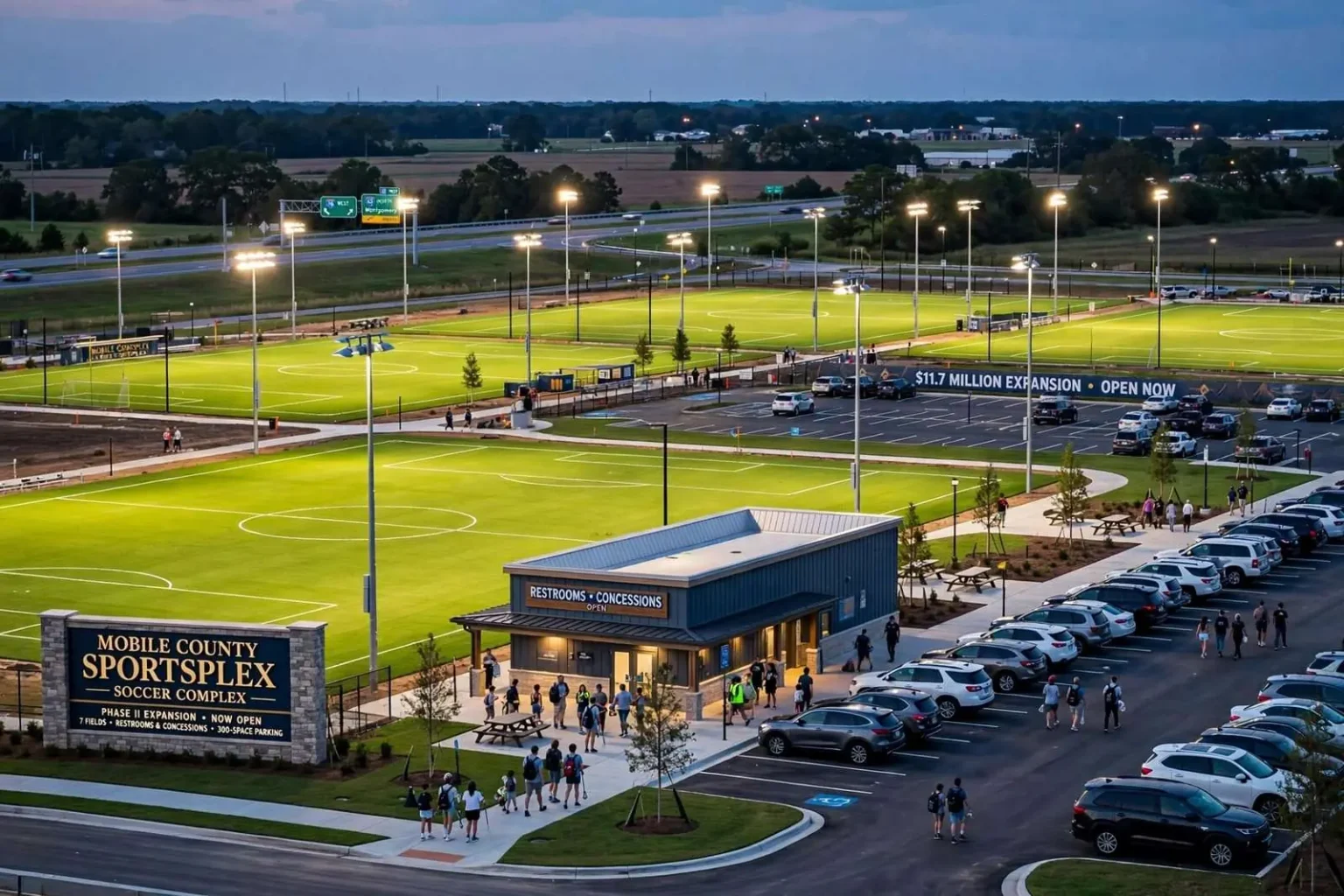
MOBILE COUNTY, Ala. — Four new lighted and sodded fields, a second restroom and concession building, and a new 300-space parking lot are now open at the Mobile County Sportsplex Soccer Complex, expanding the facility from three to seven operational fields and dramatically increasing capacity for leagues, practices, and tournament play.
The Phase II expansion represents a nearly $11.7 million investment by the Mobile County Commission, and it arrives just two years after construction began — a timeline county officials say was deliberately accelerated to put more playing space into use sooner.
Built for More Than Soccer
The Soccer Complex accommodates soccer, lacrosse, rugby, flag football, Ultimate Frisbee, and other field sports. Phase I of the complex established three LED-lighted competition fields along with support facilities and parking for more than 200 vehicles.
“These four new fields mean additional opportunities for our young athletes and families while strengthening Mobile County’s ability to host regional tournaments that bring visitors and economic activity to our community,” said Mobile County Commission President Connie Hudson, who leads the Sportsplex development. “It’s an investment that serves our residents, supports sports tourism and strengthens our local economy.”
Master Plan Reordered to Get Fields Open Faster
Construction on Phase II began in September 2024, after the Mobile County Commission adjusted the Sportsplex master plan to advance the four fields and the second restroom and concession building ahead of the planned Championship Field. The reshuffling allowed the county to add playing space sooner while continuing progress on the longer-term vision.
That long-term plan ultimately calls for 10 tournament-quality fields and a Championship Field featuring seating for 2,000 spectators, locker rooms, concessions, a press box, and an awards plaza. Design of the Championship Field is already complete, with construction expected to proceed by the end of the year once the project is bid and awarded.
Who Built It
Duplantis Design Group provided engineering and design services for the Phase II expansion. Rogers & Willard served as general contractor for the new concession and restroom building, while Mid-America Sports Construction handled the fields and parking lot.
A Regional Destination at I-10 and I-65
The Soccer Complex is the anchor of the nearly 200-acre Mobile County Sportsplex at the intersection of Interstates 10 and 65 — a location that puts the facility within easy reach of teams traveling from across the Gulf Coast region. The county is developing the Sportsplex in phases as a regional destination for community recreation, competitive athletics, and tournament play.
The complex is operated by AFC Mobile, which handles field reservations, scheduling, and facility guidelines through [email protected].
The Sportsplex is also home to the soon-to-open 40,000-square-foot Mobile County Aquatics Center. Future development plans call for additional recreational amenities as well as transportation and access improvements around the campus.
With seven fields now in operation and the Championship Field on deck, county leaders say the Sportsplex is on its way to becoming one of the Southeast’s premier amateur sports destinations — and a consistent draw for tournament traffic that fills hotels, restaurants, and shops across Mobile County.
Sports Tourism as an Economic Development Strategy
The investment behind the Sportsplex expansion reflects a strategy that local governments across the Southeast have leaned into over the past two decades: building publicly owned multi-field complexes specifically to attract tournament traffic rather than simply to serve local recreation leagues. The economics are straightforward. A single weekend youth soccer or lacrosse tournament can draw dozens of traveling teams, each bringing players, coaches, and family members who need hotel rooms, restaurant meals, gas, and retail purchases for two or three nights. Convention and visitors bureaus in tourism-driven economies often refer to this as “heads in beds” spending, and it is why counties are increasingly willing to fund large recreational infrastructure out of general capital budgets rather than leaving it entirely to school systems or private clubs. Mobile County’s approach mirrors facilities built in recent years in Foley and other fast-growing parts of coastal Alabama, where multi-field complexes anchored by interstate access have become magnets for regional and even national tournament circuits. The formula generally requires a critical mass of fields — usually six or more of similar quality and lighting — so that a single event can host enough age brackets and divisions to justify travel from out-of-state teams.
Why Lighting and Turf Quality Matter for Tournament Bids
Tournament organizers who run regional and national youth sports events typically evaluate host venues on a short list of criteria: number of adjacent, similarly sized fields; quality and consistency of lighting for evening play; adequate parking and traffic flow for simultaneous game days; and support amenities like restrooms, shade, and concessions close to the fields rather than a single central hub. LED sports lighting has become the standard for new construction because it offers more consistent, glare-reduced illumination than older metal-halide fixtures, uses substantially less electricity, and requires far less maintenance since bulbs do not need periodic replacement the way older stadium lighting does. For a complex trying to maximize field usage, lighting is not a luxury — it is what allows practices and games to run into the evening after work and school hours, effectively doubling the usable hours of a field that would otherwise sit empty after late afternoon. Sodded, well-drained natural grass fields, when properly maintained, remain the preferred surface for many youth soccer and lacrosse organizations because of lower injury rates associated with certain types of turf impact, though they require more intensive maintenance — regular mowing, aerating, overseeding, and drainage work — than synthetic alternatives.
How Multi-Sport Complexes Get Built in Phases
Large public recreation projects like the Sportsplex are almost never built in a single construction contract. Instead, counties and municipalities typically break them into phases tied to available capital — often a mix of bond proceeds, capital improvement funds, and sometimes state or federal recreation grants — so that portions of a facility can open and start generating community benefit and, in tourism-oriented builds, hotel and sales tax revenue, while later phases are designed and bid. This phased approach also lets planners adjust based on what the earlier phases reveal about demand: if the first fields fill up quickly with league play and tournament requests, that usage data helps justify accelerating construction of additional fields, as appears to have happened here when the county reordered its master plan to prioritize four new fields over the originally sequenced Championship Field. The tradeoff is that phased construction can mean years of overlapping construction and active play on the same campus, requiring careful sequencing of traffic patterns, parking, and utility work so that games can continue on completed fields while crews build out the rest of the site.
The Role of Youth Sports Growth in Facility Demand
Soccer, lacrosse, and flag football have all seen substantial participation growth among school-age children nationally over the past fifteen years, a trend youth sports researchers and governing bodies have tied to factors including the sports’ relatively lower equipment costs compared to sports like ice hockey, growing college scholarship pipelines, and the increasing popularity of club and travel team structures that compete outside the traditional school athletic calendar. That growth has strained older municipal field inventories built decades ago for a smaller slate of sports, pushing many counties to either retrofit aging complexes or build new multi-sport facilities designed from the outset to be shared by several field sports rather than dedicated to one. A complex like the Sportsplex, designed to host soccer alongside lacrosse, rugby, flag football, and Ultimate Frisbee, reflects that shift toward flexible, multi-use field design, since a single well-built rectangular turf or grass field can typically be lined and configured for several different sports with only modest adjustments between events.
What Championship-Caliber Facilities Typically Require
The Championship Field described in the county’s long-term master plan — with stadium seating, a press box, and dedicated locker rooms — represents a different tier of facility than a standard tournament field. Venues built to that specification are typically designed to host college showcase events, high-profile high school playoff games, and semi-professional or exhibition matches in addition to youth tournament finals, since the amenities (permanent seating, media facilities, and dedicated locker rooms) are what regional athletic associations and broadcasters look for when selecting a site for championship-level competition. Counties that build this kind of anchor venue alongside a broader complex are typically betting that it will serve double duty: hosting marquee events that draw larger crowds and media attention a few times a year, while the surrounding standard fields carry the bulk of weekly league and weekend tournament traffic that produces the steadier stream of hotel and restaurant spending that originally justified the public investment.
Interstate Access and the Regional Draw
The Sportsplex’s position near the interchange of Interstates 10 and 65 is not incidental to the county’s tournament strategy. Facilities located near major highway interchanges have a real advantage in the competitive market for hosting regional and multi-state tournaments, since travel time and ease of access are among the first factors tournament directors weigh when comparing candidate venues, particularly for events that draw teams from Mississippi, Florida, and Georgia as well as from across Alabama. Proximity to a metro area with an airport and a sufficient inventory of hotel rooms across multiple price points also matters, since large tournaments can require hundreds of rooms on a given weekend and organizers generally prefer host regions where that capacity already exists rather than needing to shuttle teams to lodging an hour or more away. Mobile’s existing hospitality infrastructure, built up around the port, medical, and convention business, gives the Sportsplex an advantage that newer or more remote complexes in less-developed areas often lack, and it is part of why county officials frame the facility’s growth in terms of both youth athletics and the “sports tourism and local economy” benefits cited in announcing the expansion.


