
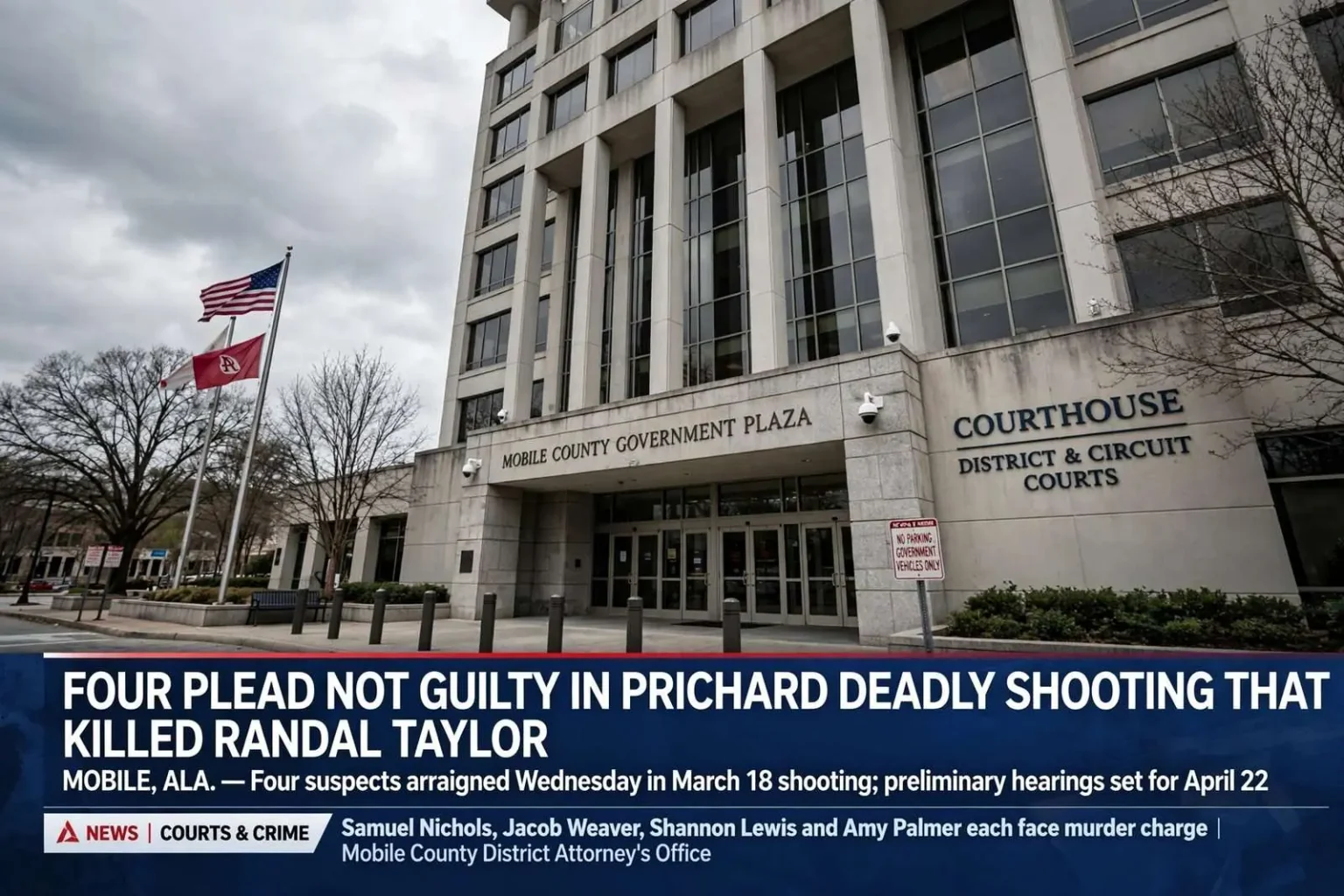
MOBILE, Ala. — Four suspects charged with murder in a deadly March shooting in Prichard have pleaded not guilty, according to the Mobile County District Attorney’s Office. The shooting occurred in Prichard on March 18 and killed Randal Taylor. The District Attorney’s Office said the four suspects were arraigned Wednesday. All four pleaded not guilty to murder, and preliminary hearings for all four suspects are set for April 22, the DA’s office said.
The arraignment is the formal step at which each defendant appears before a judge, hears the charge read aloud, and enters a plea. For the four defendants in this case — Samuel Nichols, Jacob Weaver, Shannon Lewis and Amy Palmer — the not-guilty pleas set the case on the standard track through the Mobile County court system, beginning with the preliminary hearings scheduled for late April.
Prichard, a city of roughly 19,000 residents in Mobile County, sits just north of Mobile along the U.S. Highway 43 corridor. Like many small cities in the region, Prichard operates its own police department, and major crimes investigated there typically move quickly into the Mobile County criminal justice system, where the District Attorney’s Office handles prosecution.
Because the shooting happened inside Prichard city limits, Prichard police served as the lead investigative agency, with the District Attorney’s Office reviewing the evidence and filing the murder charges. That division of labor is common in Mobile County: municipal police departments handle the initial investigation, and prosecutors decide what charges to pursue and present the case in court.
Who is charged in the case
The defendants identified by the District Attorney’s Office are Samuel Nichols, Jacob Weaver, Shannon Lewis and Amy Palmer. Each faces a murder charge in connection with the March 18 shooting that killed Randal Taylor. Prosecutors have not publicly detailed what role each suspect is alleged to have played, and it is not unusual in multi-defendant cases for the evidence against each person to differ significantly.
Under Alabama law, a person can be charged as a principal or as an accomplice when a death occurs during a crime, which is one reason multiple suspects are often charged in a single killing. The state does not have to prove that each defendant personally fired a weapon; participation in the underlying conduct can be enough to support a murder charge.
All four defendants were arraigned Wednesday, the DA’s office said. An arraignment hearing is typically brief: the clerk or judge reads the charge, defense counsel enters a plea on the defendant’s behalf, and the judge addresses scheduling and any bond conditions. A not-guilty plea at this stage is routine and preserves every defense available to the accused.
Until the case moves further along, the charges remain allegations. Defendants are presumed innocent, and the prosecution carries the burden of proving guilt beyond a reasonable doubt at trial. The preliminary hearings set for April 22 will be the first public test of the strength of the state’s evidence against each of the four.
What happens at a preliminary hearing
In Alabama, defendants charged with a felony first appear in District Court, where a preliminary hearing is held to determine whether probable cause exists to believe the defendant committed the crime. The hearing is not a trial. There is no jury, and the judge does not decide guilt or innocence. Instead, prosecutors present enough evidence — often through one or two witnesses, typically investigators — to show the case has a reasonable basis to move forward.
If the judge finds probable cause, the case is bound over to a grand jury. The grand jury, a panel of citizens, then decides whether to return an indictment. If an indictment is returned, the case moves to Mobile County Circuit Court, where felony trials are held. If the grand jury declines to indict, the case can be dismissed or resubmitted at a later time.
Defense attorneys use preliminary hearings to preview the state’s evidence. They can cross-examine the prosecution’s witnesses, which often gives the defense its first detailed look at what investigators claim happened. The testimony at these hearings is recorded and can be used later in the case, making April 22 an important date for both sides.
It is also common for cases involving multiple defendants to be scheduled for preliminary hearings on the same date, as is the case here. Coordinating the hearings helps the court manage witness availability and ensures that testimony in one hearing does not complicate proceedings in another.
Murder charges under Alabama law
Murder is among the most serious charges in the Alabama Criminal Code. A murder conviction carries a sentence of 10 to 99 years or life in prison, and the potential punishment can increase depending on the circumstances of the offense and the defendant’s prior record. Because of the stakes, these cases are handled by the felony trial division of the District Attorney’s Office and typically take many months, sometimes more than a year, to move from arraignment to trial.
The Mobile County District Attorney’s Office is one of the busiest prosecution offices in Alabama, covering the city of Mobile as well as smaller municipalities including Prichard, Saraland, Citronelle and Bayou La Batre. The office reviews cases submitted by more than a dozen law enforcement agencies across the county and presents them to the grand jury for indictment.
For defendants who cannot afford an attorney, the court appoints counsel, and felony murder cases in Alabama are almost always handled by appointed counsel or the Public Defender’s Office given the severity of the potential sentence. Bond conditions are set early in the process and can be revisited by motion if circumstances change.
Timeline of the case so far
The shooting that killed Randal Taylor occurred in Prichard on March 18. In the weeks that followed, investigators identified four suspects, and the Mobile County District Attorney’s Office charged each of them with murder. The arraignment of all four defendants on Wednesday marked the formal beginning of the court process, less than a month after the fatal shooting.
The pace of the early stages reflects how Alabama courts handle violent felonies. Defendants are typically arraigned soon after arrest, and preliminary hearings must be held within a set window to prevent extended detention without a probable-cause finding. The April 22 hearing date falls within that framework and gives both the prosecution and the defense time to prepare.
Family members of victims in Mobile County homicide cases often attend these early hearings. While victims’ relatives do not participate directly in the probable-cause proceeding, the District Attorney’s Office keeps them informed of major dates, and victim services officers are available to explain what each stage of the process means. The office’s victim services division also assists with court accompaniment and notification of hearing changes.
Any of several outcomes is possible after April 22. The judge could find probable cause and send all four cases to the grand jury. The judge could find insufficient evidence against one or more defendants and dismiss those charges, which prosecutors could refile later if more evidence emerges. Or the defense and prosecution could reach an agreement that resolves the case without trial.
The broader context of gun violence investigations
Deadly shootings in Mobile County communities are investigated by the agency with jurisdiction over where the crime occurred, and Prichard police handle a significant share of the county’s homicide investigations. Detectives in these cases gather physical evidence, canvass for witnesses, review surveillance footage where available, and work with prosecutors to determine what charges the evidence will support.
Multi-suspect murder cases present particular challenges for investigators and prosecutors. Evidence must be tied to each individual defendant, and prosecutors must decide whether to charge everyone connected to the event or only those whose conduct the law most clearly covers. The decision to charge four people in a single killing suggests investigators concluded each played a legally significant role.
For residents of Prichard and surrounding communities, the case will play out largely in public courtrooms at Mobile Government Plaza in downtown Mobile, where District and Circuit Court sessions are held. Hearing dates are subject to change, and continuances are common in felony cases as both sides gather evidence and negotiate.
The Mobile County District Attorney’s Office said preliminary hearings for all four suspects are set for April 22. Until those hearings and any subsequent grand jury action, the charges against Samuel Nichols, Jacob Weaver, Shannon Lewis and Amy Palmer remain pending allegations, and each defendant remains entitled to the full protections of the criminal justice process.
What residents should know about the court process
For Mobile County residents following the case, the next public milestone is the April 22 preliminary hearings. Members of the public can attend District Court proceedings, though courtroom access rules and security screening at Government Plaza apply. Families of the victim and the defendants typically fill the gallery in cases of this kind, and seating can be limited.
Court records in the case, including the charging documents and scheduling orders, are maintained by the Mobile County Circuit Clerk and are generally available for public inspection. Readers should be aware that early documents often contain only the minimum detail required to support the charge, and fuller accounts of the evidence typically emerge at preliminary hearings or trial.
Prichard’s place in the county’s justice system
Prichard is one of several municipalities in Mobile County with its own police department and municipal court, but felony offenses — including murder — are always referred to the county system. Prichard Municipal Court handles traffic violations, municipal ordinance cases and preliminary matters, while the Mobile County District Attorney’s Office prosecutes felonies in District and Circuit Court.
The city has worked in recent years on neighborhood revitalization and public safety initiatives, and city officials have repeatedly emphasized the importance of cooperation between residents and investigators in solving violent crimes. Cases like this one rely heavily on witnesses coming forward, and police departments across the county encourage anyone with information about a crime to contact investigators directly or use anonymous tip channels.
Next steps in the proceedings
Barring continuances, the four defendants — Samuel Nichols, Jacob Weaver, Shannon Lewis and Amy Palmer — will appear for preliminary hearings on April 22. Prosecutors will present evidence related to the March 18 shooting that killed Randal Taylor, defense attorneys will have the opportunity to cross-examine witnesses, and a District Court judge will rule on probable cause for each defendant separately.
From there, the cases will move to the grand jury if probable cause is found, and to Circuit Court for trial if indictments are returned. felony murder prosecutions in Alabama routinely take a year or more from arrest to trial, and appeals can extend the process further. The Gulf Coast Newsroom will continue to follow the case as it moves through the Mobile County court system and will report on major developments, including the outcome of the April 22 hearings.


