
Fourth Police Chase in a Week Ends Near Maitre Park as 27-Year-Old Faces Drug and Eluding Charges
A midnight chase near Maitre Park marked the fourth high-speed pursuit in the Mobile area in a week, ending with drug and eluding charges against a 27-year-old man.
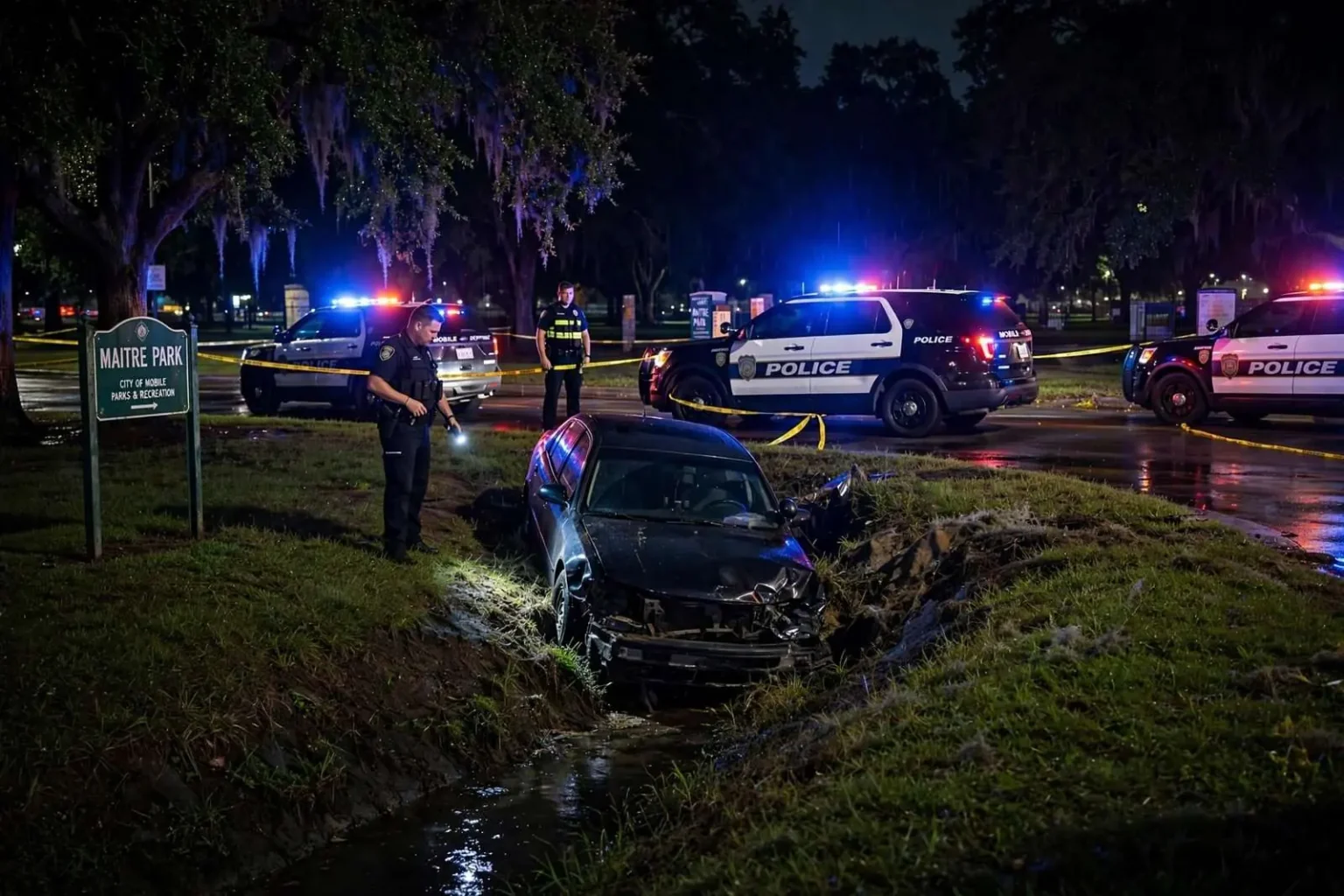
MOBILE, Ala. — A midnight pursuit that ended in a ditch near Maitre Park marked the fourth high-speed chase in the Mobile area in just one week, and it put a 27-year-old man behind bars on drug and eluding charges.
Police say officers attempted to stop Devon Partain near Broad and Government streets shortly after midnight when he sped off. The chase came to an end when Partain struck a ditch near Maitre Park and took off on foot, according to police. Officers did not have to search for long — he was arrested a short time later.
A stack of charges
Partain now faces charges of attempting to elude and possession with intent to distribute. Jail records show he was also booked on multiple outstanding warrants, including driving on a revoked license and drug possession.
Two more chases in the county
Partain’s arrest came just days after the Mobile County Sheriff’s Office dealt with two separate pursuits on the same day. Investigators say 29-year-old Dramico Bailey Jr. had been moving large amounts of drugs into Mobile from South Florida, and undercover investigators spotted him meeting one of his distributors, 28-year-old Kashunte Tate, in a Semmes parking lot.
Deputies say Tate fled in a Honda Accord, reaching speeds of more than 100 miles per hour before deputies ended that chase with a PIT maneuver on Moffett Road. A separate attempt to arrest Bailey sparked a second pursuit, during which deputies say he rammed multiple patrol cars before the chase ended on Airport Boulevard.
Deputies later seized five pounds of suspected methamphetamine, 10 guns and additional evidence, according to the sheriff’s office. Bailey and Tate now face felony charges.
Tiffany Vassel, a mother whose dashcam caught part of the chaos, said everything happened in an instant.
“Had they hit me, what would’ve happened to my baby?” Vassel said.
Earlier chase down Springhill Avenue
Last week, Mobile police say a young man led officers on a chase down Springhill Avenue that a witness captured on camera. Investigators said no officers were hurt in that incident, and the juvenile was detained at the scene.
When do chases end?
The string of pursuits has renewed attention on when — and how — area agencies decide to chase. Under Mobile police policies and procedures, officers must weigh the need for a pursuit against the danger a chase could create for everyone else on the road. The policy says that calculation includes speed, road and weather conditions, and the safety of innocent bystanders.
MPD says officers and supervisors should communicate continually during a pursuit, and if the danger becomes too great, the pursuit should be ended.
The Mobile County Sheriff’s Office declined to detail its own pursuit rules, but a spokesperson said the agency reviews pursuits in accordance with agency policy.
“The Mobile County Sheriff’s Office reviews pursuits in accordance with agency policy, and we remain committed to balancing the apprehension of dangerous or wanted individuals with the safety of our deputies and the community,” the spokesperson said.
A divided public
Reaction on social media has been split. One commenter argued that police should stop chasing people because someone is going to get hurt, while another countered that those running from the law should stop rather than endanger the public.
Safety experts generally agree the calculus is difficult: pursuits are sometimes necessary to take dangerous suspects off the street, but every second of a chase puts drivers, pedestrians and neighborhoods at risk. With four pursuits in seven days across the Mobile area, both agencies say the balance between apprehension and public safety remains at the center of every decision to pursue.
What Alabama Law Says About Eluding Police
The charge of attempting to elude police, codified in Alabama under Section 13A-10-52, applies to a driver who, after receiving a visual or audible signal from a police officer to stop, willfully fails or refuses to do so and instead tries to flee. In its basic form, the offense is a Class A misdemeanor, but Alabama law elevates it to a Class C felony if the flight creates a risk of serious physical injury or death to another person — a distinction prosecutors weigh heavily in pursuit cases that end in a crash, as this one did when the driver struck a ditch near Maitre Park. Because the felony version of the charge hinges on whether the flight endangered others, officers and prosecutors typically document speeds reached, traffic and pedestrian conditions along the route, and any collisions or near-misses when building a case, since those details are what separate a misdemeanor eluding charge from a felony one.
The additional charge of possession with intent to distribute reflects Alabama’s approach to drug offenses that involve more than an amount consistent with personal use. Under the state’s Uniform Controlled Substances Act, prosecutors can bring the more serious distribution-related charge based on factors like the quantity found, how the drugs were packaged, and whether items commonly associated with sales — scales, plastic bags, large amounts of cash — were present. Both charges here carry the possibility of state prison time, and because jail records showed outstanding warrants on top of the new charges, any sentence would ultimately need to account for multiple pending cases moving through the court system together.
How Police Departments Decide When to Chase
Vehicle pursuit policy is one of the most closely scrutinized areas of police procedure nationally, precisely because chases carry real risk to people who have nothing to do with the underlying offense. The International Association of Chiefs of Police, which develops model policies used as a reference point by many departments, recommends that officers continuously weigh the seriousness of the offense against the danger created by the pursuit itself, and that supervisors have the authority — and the obligation — to order a pursuit terminated if the risk becomes too great relative to what is being pursued. Some agencies have moved toward more restrictive policies that limit pursuits to violent felony suspects, while others, including many in Alabama, give officers broader discretion but require ongoing communication with a supervisor throughout the chase, which mirrors the standard MPD pointed to in this case.
A PIT maneuver, short for Precision Immobilization Technique, is a tactic in which a pursuing patrol car makes contact with the rear quarter panel of a fleeing vehicle to send it into a controlled spin and bring it to a stop. It is generally reserved for pursuits that have already reached a point where officers and supervisors have determined the danger of letting the chase continue outweighs the risk of intentionally initiating contact, and most departments that authorize it, including many sheriff’s offices in Alabama, restrict its use to specific speed ranges and roadway conditions to reduce the chance of a more serious crash.
Drug Trafficking Corridors Along the Gulf Coast
Law enforcement agencies across South Alabama have described Interstate 10 and the broader Gulf Coast corridor as a persistent route for methamphetamine and other narcotics moving from source markets, including Mexico by way of the Southwest border and, increasingly, distribution networks based in Florida, into smaller Alabama cities and towns. Agencies including the Mobile County Sheriff’s Office and the Drug Enforcement Administration have said that traffickers frequently rely on mid-level distributors who make relatively small, frequent deliveries rather than a single large shipment, which is part of why undercover operations like the one described in the Semmes parking lot meeting tend to focus on identifying and following individual couriers rather than intercepting one large load. Seizures involving large quantities of methamphetamine alongside firearms, as reported in the separate pursuits described here, are consistent with a pattern investigators say they see often: drug distribution operations of any size tend to also involve guns, both for the traffickers’ own protection and, at times, as a form of currency in the underlying drug trade.
Outstanding Warrants and Their Role in a Booking
When jail records show a defendant booked on outstanding warrants in addition to charges from a new arrest, it typically means the person had one or more prior cases — often for lower-level offenses like a revoked license or a previous drug possession charge — that were still working their way through the court system, or for which a bench warrant had been issued after a missed court date. Alabama court systems commonly discover these outstanding warrants automatically when a person is booked into jail, since booking includes a records check that flags any unresolved warrants tied to a person’s name and date of birth. Practically speaking, that means an arrest for one specific incident, like a chase, can end up consolidating several unrelated legal matters into a single stay in custody, since a judge setting bond on the new charges will typically also account for the outstanding warrants when deciding whether, and under what conditions, the person can be released pending trial.
How Communities Respond to a Cluster of Chases
A run of pursuits within days of each other, as described here, tends to prompt renewed public attention even when the individual incidents are unrelated to one another, simply because the visibility of multiple chases in a short window makes the underlying risk feel more immediate to residents. Criminologists who study police pursuits note that the public reaction to clustered incidents like this is a well-documented pattern: attention and scrutiny of pursuit policy tends to rise sharply after a visible cluster of chases, then fade until the next one, regardless of whether the underlying rate of pursuits has actually changed. Some Alabama municipalities have used moments like this to review or reaffirm their pursuit policies publicly, while others, like the Mobile County Sheriff’s Office in this case, decline to detail specific tactical thresholds but point to their general policy framework, a common approach among agencies that do not want to signal to potential suspects exactly what will or will not trigger a pursuit being called off.