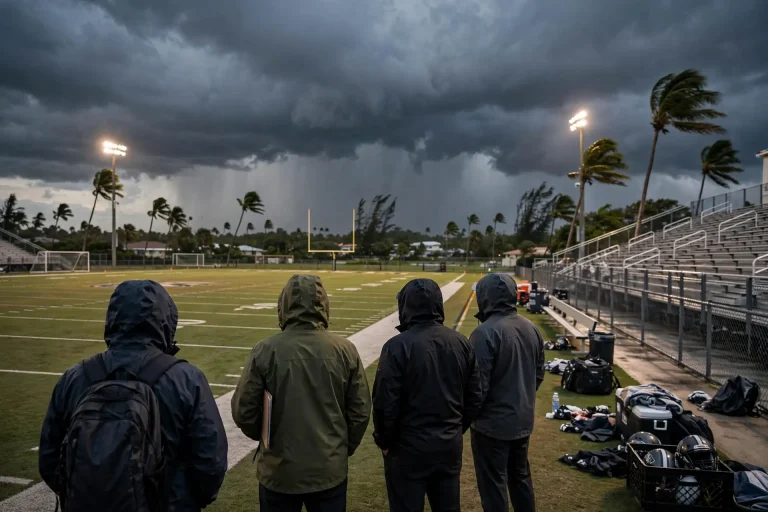
Fruitdale High School remains closed as tornado cleanup continues
Fruitdale High School stays closed while staff and volunteers clear tornado debris, with students hoped to return by Wednesday.
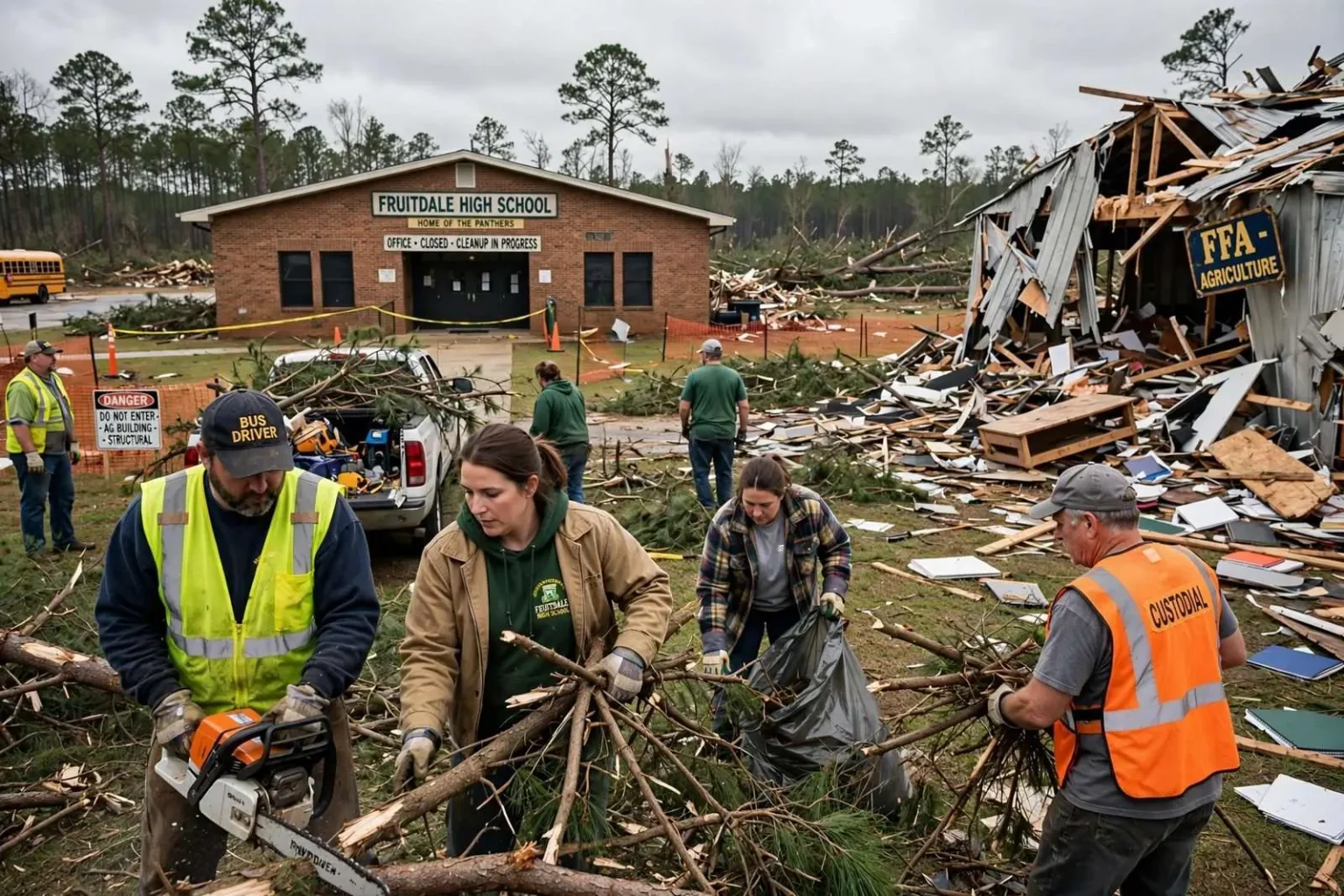
FRUITDALE, Ala. — Bus drivers had a different job Monday at Fruitdale High School: removing large limbs and debris from campus after a tornado ripped apart trees and buildings last week. The scene on the rural Washington County campus was a portrait of a small school community pulling together, with the same drivers who normally run the county’s country roads wielding chainsaws and hauling brush instead of waiting on students who are not yet allowed to return.
“We’ve got our entire staff here from teachers, to bus drivers, to custodians. There’s been people volunteering every day since the tornado hit,” said Principal Curt Stagner. In a community the size of Fruitdale, the school is more than a workplace — it is the center of civic life, and the storm that damaged it touched nearly every family in the district in one way or another.
The agricultural building was the hardest hit. Walls are gone and notebooks and paper are scattered across a classroom. Strong winds left a mess behind. For a rural school in timber country, the agriculture program is not an elective curiosity — it is the heart of the school’s identity, home to the FFA chapter and the hands-on classes that prepare students for careers in farming, forestry and the trades that keep southwest Alabama running.
“We’re blessed that it didn’t happen while we were here at school,” Stagner explained. The timing spared the school the nightmare scenario that every rural district drills for: a tornado arriving during school hours with hundreds of students and staff in buildings not built to withstand the wind. The storm instead left behind property damage and an all-hands recovery — hard weeks of work, but ones where the only casualty lists are on the insurance forms.
Campus Cleanup and a Tight Timeline
Cleanup started last Wednesday, but the campus remains closed while work continues. Power is back on, but Stagner said it’s still not safe for students to return until nails and smaller items are picked up. In tornado cleanup, the small debris is often the most persistent hazard — roofing nails, insulation fragments and splintered lumber scattered across a campus where hundreds of children will soon be running between buildings again.
The all-hands cleanup approach is characteristic of schools this size. Fruitdale’s staff — teachers, cafeteria workers, office staff, drivers — have dug in on their own time, joined by volunteers from the surrounding community, because a small rural district cannot simply call in a large outside crew and bill it to a facilities budget. Neighboring districts and county road crews have historically pitched in after storms like this one, lending equipment and manpower that a school system of a few hundred students could never maintain on its own.
The tornado’s damage pattern — heavy tree loss paired with damage to outbuildings — is typical of the storms that roll through Washington County’s pine forests. Twisters moving through dense timber often snap and uproot trees for miles, and the wood becomes projectiles that hammer roofs, walls and vehicles. That is likely how the ag building lost its walls: wind-driven trees and lumber acting as battering rams against a structure that was never designed to stop them.
School officials also want to make sure the cafeteria is up and running. Feeding students is the logistical hinge on which any reopening turns: in a small rural district, the cafeteria serves hundreds of meals a day across grade levels, and without it functioning, administrators cannot bring students back to campus no matter how clean the playgrounds are. Getting kitchen equipment inspected and the serving line certified is one of the quieter checkpoints between a storm and a reopening day.
By Wednesday they hope to allow students back on campus. That decision will be made Tuesday. The compressed timeline reflects more than optimism — in a working-class community where many parents commute out of the area for jobs, every extra day of closed school scrambles childcare arrangements and costs instructional time that rural districts guard carefully. The return of students would also mark a visible milestone in a recovery that will stretch far beyond the first morning bell.
“We’re putting up some safety fences to keep the kids out of certain areas and trying to control traffic through some dangerous places, but for the most part we should have everything secured and ready to go,” he said. The fencing plan will keep students away from the ruined ag building and the debris zones while workers and assessors finish their jobs, and temporary traffic patterns will route parent drop-off and bus traffic away from the damaged areas of campus.
A Long Road for the Ag Building
It’ll likely take weeks, if not months, before the ag building is rebuilt. The timeline puts Fruitdale in familiar company: rural schools across Alabama have weathered tornado damage over the years, and the pattern is consistent — classrooms reopen quickly, but specialized facilities take far longer because they require insurance settlement, design work, contractor availability and materials before a single nail goes back in. In the meantime, ag classes and FFA activities will have to improvise, borrowing shop space or shifting coursework while their building goes through the rebuilding process.
Donations have already started coming in, but for now the focus is getting students back to campus. In communities like Fruitdale, that support network is an everyday fact of life — churches, volunteer fire departments, neighboring schools and alumni step up when the school itself is the one that needs help — and the outpouring after the tornado has been no exception.
That support matters most for the programs the storm hit hardest. An agriculture building does not just lose walls — it loses the tools, equipment and student projects inside them, from shop machinery to supplies for livestock and land-judging teams. Replacing those items is where donated dollars will go furthest, and where the community’s help will determine how quickly the program returns to full speed once its building is rebuilt.
The school’s custodial and maintenance staff, meanwhile, face the thankless middle of the job: sweeping, sorting and hauling the storm’s leftovers until the campus passes the smell test for the people who will actually have to let their children walk back in.
“We’re going to be back and ready to go and put this thing behind us and move forward,” Stagner said. It is the kind of refrain that rural school leaders across Alabama have repeated after every storm — a promise that the calendar, the ballgames and the classes will go on, even when the buildings around them bear the scars.
Fruitdale sits in the heart of Washington County, one of Alabama’s most rural districts, where forests and small farms dominate the landscape and school campuses double as community centers, voting precincts and storm gathering points. When a tornado hits a school here, it damages more than a building; it knocks a dent in the routine of an entire community that organizes its life around the school calendar.
What Comes Next
The weeks ahead will follow the standard post-storm rhythm for a rural district. Insurance adjusters and state facilities officials will finish their assessments, contractors will be selected for the ag building’s reconstruction, and the everyday work of catching students up on missed instruction will begin in earnest. District officials will also be watching the long-term items that matter after any campus storm: replacing damaged program equipment, restocking what was lost, and documenting every expense for federal and state recovery programs that can help offset the cost.
For the students, the return will bring its own adjustment — fenced-off buildings, changed traffic patterns and an ag building to walk past on the way to class. But if the response of the past week is any indication, Fruitdale’s recovery will be measured in the same currency as its damage: volunteers in the parking lot, donations arriving from across the county, and a principal promising his community that the school will come back stronger than the storm that hit it.
The reopening plan also reflects lessons rural districts across Alabama have learned from past tornado seasons. Getting students back quickly — with hazards fenced off rather than fully cleared — keeps routines intact for children who may be processing the storm themselves, and it restores the meal service and adult supervision that many families count on. Administrators will pair the physical cleanup with the quieter work of watching how students are coping and making counselors available where needed.
For now, Fruitdale’s campus remains quiet, its halls cleaned by the same people who will fill them again as soon as the last nail is picked up. The buses are ready, the drivers are back from the tree lines, and one of Washington County’s smallest schools is preparing to show why communities like it have always rebuilt first from the inside out.