Graffiti Wars Documentary ‘Vigilante Vigilante’ Screens at the Crescent Theater
Vigilante Vigilante, a documentary about anti-graffiti vigilantes turned vandals, screens Sept. 30-Oct. 6 at the Crescent Theater in downtown Mobile.
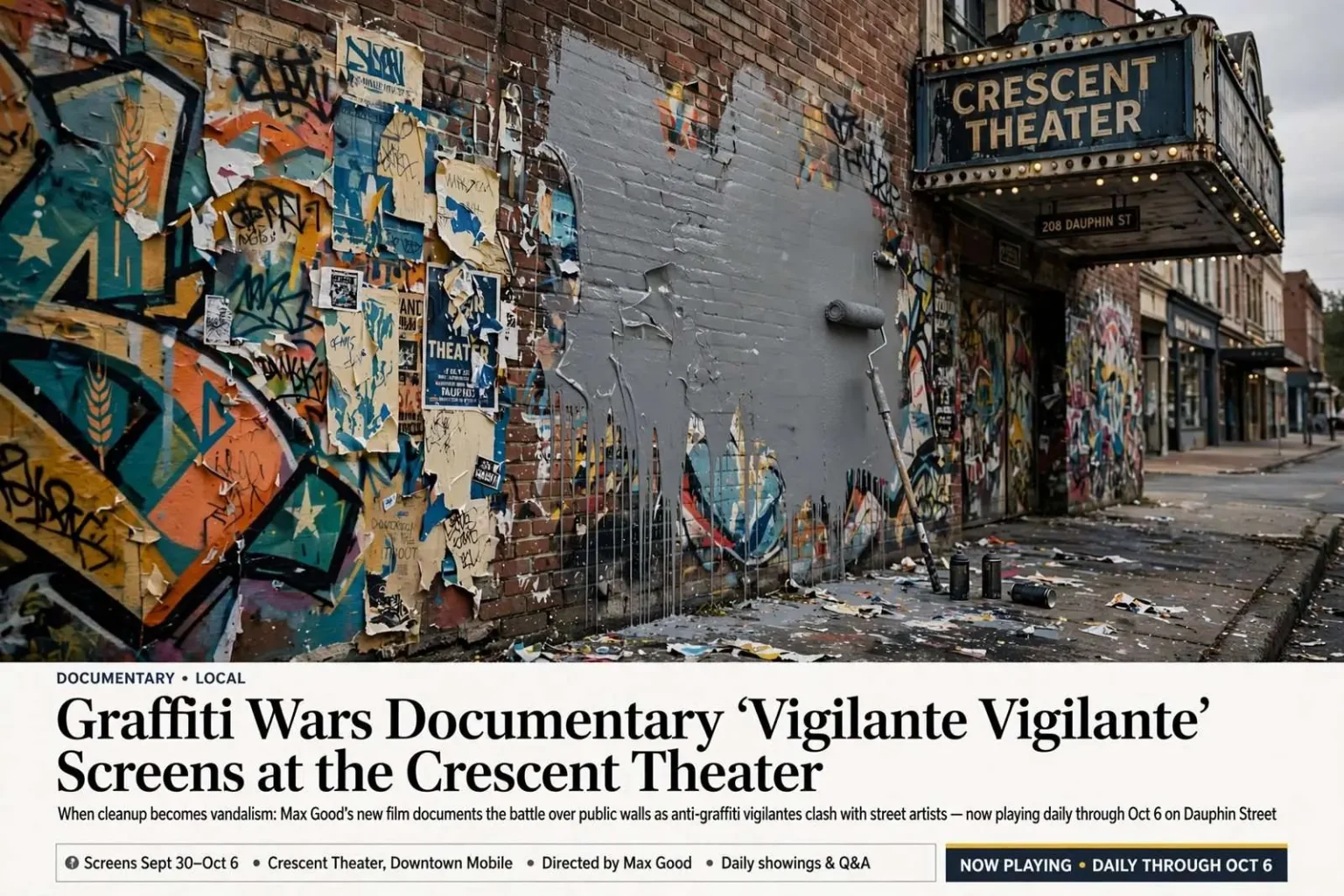
The documentary “Vigilante Vigilante” arrives at the Crescent Theater for a week-long run from September 30 through October 6, examining a strange corner of the battle over public walls: the anti-graffiti vigilantes. The film introduces a new breed of self-appointed crime-fighter — blight warriors who stop at nothing to scrub their neighborhoods of street art, stickers, tags and posters. But the documentary’s twist is that several of these crusaders have become the very menace they set out to eliminate, illegally and destructively painting over other people’s property in their zeal.
Directed by Max Good, the film follows two filmmakers who set out to expose the mysterious paint-over artists and end up discovering a battle of expression that stretches from city streets to academia, raising questions about who owns the visual landscape of a neighborhood. Along the way the documentary talks with graffiti writers, property owners, city workers, and academics who study the politics of public space, building a portrait of a conflict in which both sides claim to be defending the community. Screenings run daily at the Crescent Theater on Dauphin Street in downtown Mobile through October 6.
When Cleanup Becomes Vandalism
The paradox at the heart of the film is straightforward: in many cities, the people who paint over graffiti without permission are committing a crime themselves, defacing property they do not own. A tag on a warehouse wall is illegal; so is rolling gray paint across a commissioned mural or a neighbor’s brick facade. Yet the self-described vigilantes in the film see themselves as the last line of defense against blight, acting where they believe the city has failed. The result, the documentary argues, is an escalating war of paint in which the distinction between cleaner and vandal collapses.
That tension has real-world stakes. Municipal anti-graffiti programs across the country encourage rapid removal on the theory that visible tags invite more tagging — the so-called broken windows logic. But the same programs can blur into private vigilantism when residents take removal into their own hands, and when they do, they often destroy legal works. Murals painted with the owner’s blessing, in some cases commissioned and insured as public art, have been wiped out by paint-over crews working from the wrong assumption that all street markings are alike.
The film gives both camps their say. Graffiti writers describe the wall as the only gallery they can afford, a canvas that belongs to the street and to anyone who walks past it. The removalists answer that no one has the right to impose their mark on someone else’s property, and that accumulated tags drag down storefronts and home values. What neither side disputes is that the fight is constant, and that in neighborhoods where both are active, walls become palimpsests — layered records of the struggle itself.
The Crescent as a Home for Documentaries
The week-long booking fits the Crescent Theater’s role in downtown Mobile’s cultural life. The single-screen house on Dauphin Street has built its reputation on independent film, local productions, and programming that the multiplexes do not book, and it has become a gathering point for the city’s film community, hosting festivals, premieres, and filmmaker Q&As. A documentary like this one — small, argumentative, and rooted in urban questions that resonate in a historic district full of painted walls — is precisely the kind of booking the Crescent is known for.
Dauphin Street itself makes an apt setting for the subject matter. The corridor’s brick and stucco storefronts have carried murals, wheat-paste posters, and tags through decades of the street’s decline and revival, and Mobile’s own debates over signage, murals, and public art mirror the conflicts the film documents in bigger cities. Moviegoers stepping out of the theater onto Dauphin Street after a screening will find the film’s questions painted, literally, on the blocks around them.
Screenings run daily through October 6, giving audiences a full week to catch the film. For anyone who has wondered who keeps painting over the tags on a neighborhood wall — or who keeps putting them there — the documentary offers an uncommon look at the people on both sides of the roller and the can.
A Strange Breed of Crime-Fighter
The film’s most memorable figures are the vigilantes themselves, and they are not the residents’ association volunteers most people picture when they think of graffiti cleanup. The documentary profiles men who treat removal as a mission bordering on obsession — patrolling their neighborhoods with paint rollers and matching gray, buffing any mark that offends them, sometimes in the middle of the night. Several are candid on camera about how far they will go. The trouble, as the film documents, is that the mission has no legal authority behind it, and at least some of the crusaders cross from cleanup into destruction, painting over walls, murals, and signs that belong to other people who never asked for their help.
The filmmakers follow that thread into unexpected places. Their search for the identity of a prolific paint-over artist becomes a detective story, and their investigation widens to include the academics who study graffiti as a social movement, city officials who administer abatement budgets, and the property owners caught in between — including some who preferred the graffiti to the gray paint that replaced it. The film uses the chase as a frame for a larger argument: the question of who controls the look of a neighborhood is never really settled, and every new coat of paint is someone’s answer to it.
What emerges is a genuinely balanced film, which is part of what has made it a conversation starter at festival screenings. Viewers who arrive sympathetic to the cleanup crews tend to leave troubled by what the zealots destroy; viewers who arrive sympathetic to the writers tend to leave with an understanding of why shopkeepers see the tags as an economic threat. The documentary declines to hand down a verdict, insisting instead that audiences sit with the contradiction at its center — that the line between protecting a neighborhood and vandalizing it runs straight through the eye of the beholder.
Street Art and the Law
The legal backdrop the film explores is worth understanding for any viewer in a city with an active street scene. Graffiti, in the eyes of the law, is criminal mischief or criminal vandalism: applying paint to property without the owner’s consent, whether or not the work has artistic merit. That rule cuts in every direction. It makes the tagger a vandal; it makes the well-meaning volunteer who rolls over a neighbor’s mural a vandal too; and it gives the property owner the only vote that counts about what appears on the wall. Cities add their own ordinances on top — some requiring owners to remove graffiti within a set number of days, some offering free paint and supplies, some licensing mural programs that put legal walls in designated corridors.
Those legal walls complicate the vigilantes’ worldview. A mural painted with permission is as lawful as a tag is not, yet buff crews in the film’s account often make no distinction, either because they cannot tell the difference or because they do not care to. The destroyed mural cases are the film’s emotional core, and they are also the clearest illustration of its thesis: once removal becomes a personal crusade rather than a policy administered with records and permits, mistakes stop being mistakes and become a pattern.
The debate over murals has grown only more consequential since the film was made, as cities across the country have embraced murals as economic development, branding districts through their painted walls and drawing visitors who come to photograph them. Property values that were once dragged down by tags, the argument goes, can now be lifted by sanctioned art — which makes every illegal buff-out of a legal mural a small act of economic sabotage as well as a cultural one.
Local Echoes on Dauphin Street
For Mobile audiences, the film arrives amid the city’s own ongoing negotiation with public art. The downtown historic districts operate under design review, murals have appeared on structures across the city with varying degrees of official blessing, and local artists have pushed for more sanctioned walls while property owners weigh maintenance and liability. The questions the documentary poses in other cities — who decides, who pays, who cleans up — are the same ones Mobile confronts as its walls accumulate both art and advertising.
Dauphin Street’s own visual history gives the screening extra resonance. Through the street’s lean decades, boarded storefronts collected tags and faded posters; through the revival, new owners painted facades, commissioned murals, and instituted a different standard for what the street should look like. Both eras left their marks, and both involved someone deciding what belonged on a wall they did or did not own. The film’s argument that the visual landscape is always contested will read as lived experience to anyone who has watched the corridor change.
The week-long booking also continues the Crescent’s track record of giving documentaries that would otherwise play only in larger markets a proper theatrical run in Mobile. For a film built on the texture of city walls — the paint drips, the layered gray, the sudden flash of color under buff-out coats — the big screen matters, and the theater’s single auditorium gives the run the feel of an event rather than an option on a multiplex marquee.
The Crescent Theater’s run of “Vigilante Vigilante” begins September 30 and continues with daily screenings through October 6. For anyone who has wondered who keeps painting over the tags on a neighborhood wall — or who keeps putting them there — it offers an uncommon, even-handed look at the people on both sides of the roller and the can, and at the question underneath the whole fight: whose walls are they, really?