Grand Bay bluesman Jamell Richardson headlines Alchemy Tavern before Mardi Gras
Grand Bay blues musician and Mississippi Blues Trail marker Jamell Richardson performs at Alchemy Tavern in Mobile ahead of Mardi Gras.
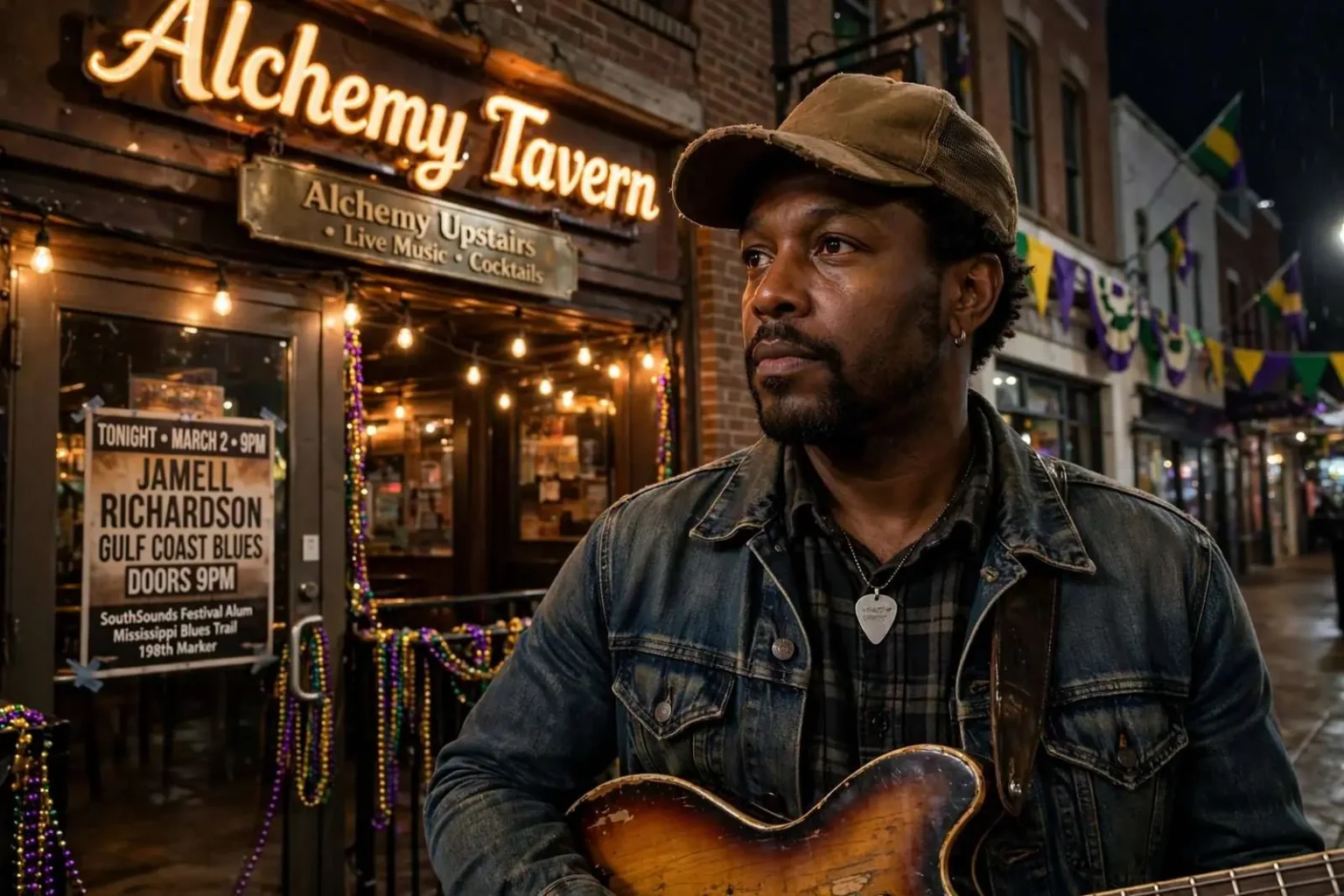
MOBILE, Ala. — With Mardi Gras weekend approaching, Grand Bay blues musician Jamell Richardson was set to bring his brand of Gulf Coast blues to Alchemy Tavern, with doors opening at 9 p.m. on March 2 for one of the late-Carnival season’s most anticipated local shows. The gig placed a south Mobile County bluesman on a downtown Mobile stage at the height of the city’s busiest stretch of the year.
Richardson, a guitarist and vocalist with deep roots in the region’s blues traditions, came to the show with credentials few local acts can claim. He is a SouthSounds Festival alum, having appeared at the Mobile festival that showcases emerging Southern artists each year, and he has been recognized with an induction as the 198th marker on the Mississippi Blues Trail — an honor that ties his name to a statewide network of historic sites commemorating the birthplace and spread of American blues music.
His style draws on Delta blues traditions, the heavy, hypnotic guitar-driven sound that took shape in the Mississippi Delta and traveled down Highway 43 and the old blues highways to the Gulf Coast. Grand Bay, sitting in the far southern reach of Mobile County just up the road from the Mississippi state line, sits squarely inside that musical geography — a community where the Delta’s influence never really left.
The Mississippi Blues Trail Connection
The Mississippi Blues Trail is one of the most ambitious music-heritage projects in the United States, a series of markers erected across Mississippi — and increasingly in neighboring states and overseas — that document the people, places and movements that built the blues. Inductees as the 198th marker are counted among artists and sites deemed significant to that ongoing story.
For a working musician based in Grand Bay, the recognition reflects the way the blues has always moved across the state line. The Gulf Coast region — spanning Mobile County, the Mississippi communities of Pascagoula, Biloxi and Hattiesburg, and the piney woods in between — has its own regional style of blues rooted in the coastal lowlands, one that blends Delta traditions with the sounds that developed around juke joints, churches and seafood and timber camps along the coast.
Richardson’s marker recognizes his contributions to that regional style. It places him in the company of the generations of Gulf Coast musicians who carried the blues from the Delta southward, adapting it to their own communities, and it gives local audiences a reason to take a second look at an artist performing a few miles from home.
Why Alchemy Tavern Matters
Alchemy Tavern has long occupied a distinctive place in Mobile’s live music landscape. Tucked into downtown Mobile, the venue and its upstairs space — known as Alchemy Upstairs — have hosted local and touring acts in an intimate setting where the distance between the performer and the audience is measured in feet, not rows. For blues in particular, a room like that matters: the music was built for small rooms, where guitar lines and vocal nuances land directly on the crowd.
Richardson’s show was booked as part of the run of local music events leading into the final weekend of Carnival, when the city’s calendar fills with balls, parades and parties and local venues compete for the crowds that flood downtown. Organizers pointed to Alchemy Upstairs as the spot to catch an established Azalea City musician live during the busy Mardi Gras stretch — a deliberate alternative to the parade route for music fans looking for a full night of entertainment.
The pairing of artist and venue also suited the moment on the calendar. The last weekend before Fat Tuesday is when Mobile’s celebration reaches its peak, and the crowds that move between parade routes and downtown clubs are the most music-hungry of the year. A doors-at-9 p.m. start allowed parade-goers to catch the night’s processions and still arrive in time for a full set, making the show a natural second stop for the evening rather than a competing event.
Mardi Gras Weekend in the Cradle of Carnival
Timing is everything in Mobile entertainment, and a March 2 show put Richardson squarely into the final weekend of the city’s Carnival season. Mobile lays claim to the oldest Mardi Gras celebration in the United States, a tradition reaching back to the early 18th century, and the modern season fills weeks of late winter with mystic society parades, marching bands and downtown crowds that swell to their largest size of the year.
For local musicians, that stretch is both opportunity and pressure. Parades command the streets and much of the public’s attention, so clubs and bars book their strongest acts to pull audiences off the route and indoors before and after the night’s floats roll. A blues show scheduled against Carnival weekend is a bet that a portion of the crowd wants a chair, a drink and live guitar as much as it wants beads — and Richardson’s local standing made him a strong card to play.
The weekend also brought out-of-towners. Mardi Gras draws visitors from across the Gulf Coast, including many who come up from the Mississippi communities where Richardson’s blues trail marker work is known, adding an audience element that a normal Saturday in Mobile would not have.
Live Performance Over the Studio
Richardson described the pre-holiday crowd as ready to party, an expectation that fit the setting perfectly. He has said that Alchemy provides an important platform for local artists and bands to be heard — a view shared widely among Mobile musicians, who point to venues like it as the proving grounds where original music survives in a market dominated by cover acts and seasonal party bands.
He also called a live performance an experience that cannot be matched by studio work, a conviction at the heart of the blues tradition itself. Delta blues was always a performer’s music, shaped in real time by the response of the room, and guitarists in that style build their reputations night by night, venue by venue. A record can capture a song, but the improvisation, the call-and-response with a crowd and the stamina of a full live set are what turn a player into a draw.
That ethos is exactly what his appearance promised: not a studio recreation but the full live treatment of a Gulf Coast blues style that has been refined across years of regional touring, festival stages and small-room headline sets.
Grand Bay to Downtown
Richardson’s road from Grand Bay to a downtown Mobile headline slot mirrors the geography of south Alabama music itself. Grand Bay, the unincorporated community along U.S. 45 near the Mississippi line, sits in a part of the county where musical traditions run deep and where many of Mobile’s working players learned their first chords in churches, family gatherings and local halls.
SouthSounds, the festival that counts Richardson among its alumni, was created to give artists from exactly those places a wider platform. Held in downtown Mobile each spring, the festival has become a regional showcase for Southern acts on the way up, and its alumni network has become a loose but real marker of credibility in the local scene. A SouthSounds alum headlining during Mardi Gras weekend is a homecoming as much as a booking.
For the audience, the March 2 show offered a chance to see a Mississippi Blues Trail-recognized musician in a room built for blues, at the one time of year when downtown Mobile is at its fullest of life. Doors at 9 p.m. meant the night ran late, in the Carnival tradition, and those who stayed past the last parade of the weekend found one of the city’s own holding the stage.
The Blues Economy of the Gulf Coast
Shows like Richardson’s are also the small infrastructure that keeps a regional music scene alive. National touring acts pass through the Gulf Coast on their own schedules, but it is the steady circuit of local venues — Alchemy Tavern among them — that gives working musicians a place to play fifty-two weeks a year and gives young players somewhere to learn the trade. Every ticket sold at a local blues show supports that circuit, from the sound engineers and bartenders to the promoters who take chances on original artists.
The region’s blues economy stretches well beyond Mobile County. The Mississippi Blues Trail has helped turn heritage into destinations, drawing travelers who follow markers from site to site across the state and into its border communities, including the Alabama communities along Highway 45 and the coastal corridor. Musicians recognized by the trail, as Richardson is, become part of that pull — one more reason for blues fans visiting the coast during Mardi Gras to cross the line for a live show.
Richardson’s March 2 headline date sat at the intersection of all of it: a heritage-honored artist, a hometown venue, a festival pedigree and the largest crowd window of the Mobile year. For the local scene, it was the kind of night that shows how much original Gulf Coast music is still being made a short drive from downtown.