Grand Bay Man, 78, Killed in Single-Vehicle Mobile County Crash
James K. Raustler, 78, of Grand Bay was killed Tuesday night when his pickup left McClinton Road, struck a tree and caught fire, ALEA reported.
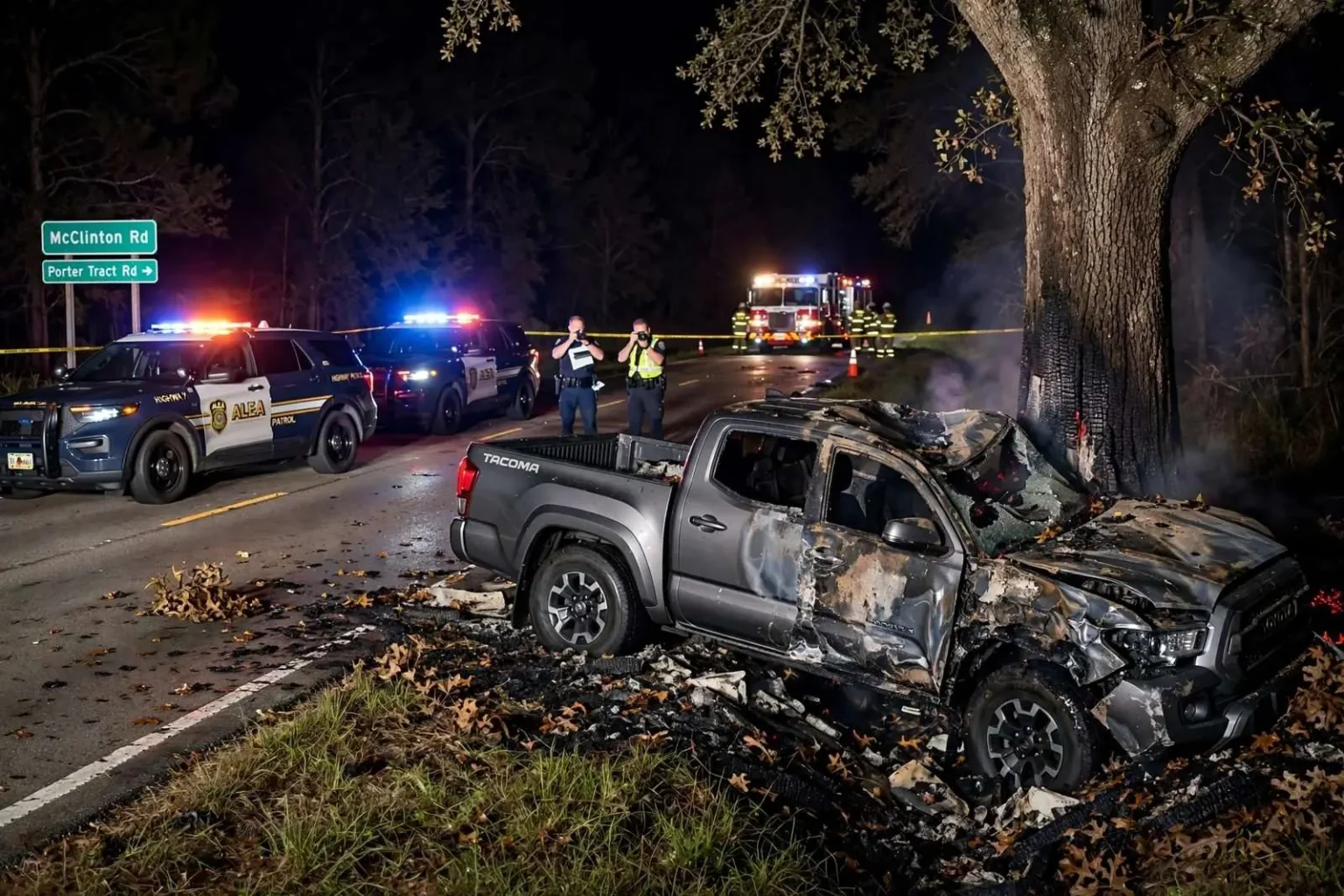
A single-vehicle crash Tuesday night has claimed the life of a 78-year-old Grand Bay man, according to the Alabama Law Enforcement Agency. James K. Raustler was fatally injured when the 2017 Toyota Tacoma he was driving left the roadway, struck a tree, and caught fire on McClinton Road in western Mobile County.
Authorities said the crash occurred at approximately 8:05 p.m. Tuesday, Aug. 18, on McClinton Road near Porter Tract Road, roughly 13 miles west of Mobile in Mobile County. Raustler was pronounced dead at the scene. The sequence investigators described — a vehicle departing the roadway, striking a fixed object, and igniting — represents one of the most dangerous crash patterns on rural roads, leaving little time for escape once fire begins.
ALEA’s Role in Fatal Crash Investigations
When a wreck involves a fatality, the Alabama Law Enforcement Agency’s Highway Patrol Division takes the lead in reconstructing what happened, a responsibility that spans unincorporated Mobile County and every other jurisdiction in the state. ALEA troopers document the scene, measure skid and gouge marks, inspect the vehicle, and interview witnesses before compiling a report that becomes the official record of the crash. In cases involving fire, investigators also work to establish whether a mechanical failure contributed, since engine compartment fires can follow engine damage in a violent impact.
The agency’s findings matter to more than the record. They determine whether any traffic citations are issued, they inform insurance determinations, and they feed the statewide crash data that highway engineers use to identify dangerous locations. A rural intersection like McClinton Road and Porter Tract Road enters that data system with every serious crash that occurs there, contributing to the long-term picture that officials use when weighing improvements such as signage, shoulder widening, or clearance of roadside hazards.
Grand Bay and the Roads of Western Mobile County
Grand Bay is a rural community along the Mississippi line in western Mobile County, an area of farms, fishing camps, and scattered subdivisions strung along U.S. 90 and the two-lane county roads that branch off it. McClinton Road, like many roads in the area, runs through a landscape where trees stand close to the pavement and shoulders are narrow — conditions that give a driver little margin for error. A vehicle that drifts off the pavement in this part of the county can strike a tree within seconds, and fixed-object collisions account for a significant share of rural traffic fatalities.
The distance from Mobile — roughly 13 miles — puts Grand Bay within the daily commute of residents who work in the city, and the area’s roads carry a steady flow of traffic at all hours, including after dark. Night driving on unfamiliar or winding rural roads demands particular caution, as reduced visibility shortens reaction time and makes it harder to judge curves, especially for drivers who travel the route routinely and may drive it from memory rather than attention.
Single-Vehicle Crashes and Their Common Causes
Single-vehicle crashes — in which one car leaves the road without contact with another vehicle — make up a substantial portion of traffic deaths in Alabama and nationally. Investigators consider a range of possible factors in every such wreck: driver health, speed, roadway conditions, mechanical failure, and distractions. Because the driver in this case was the sole occupant and did not survive, the circumstances that led the Tacoma off the road may never be fully established, which is common in fatal single-vehicle crashes where there are no surviving witnesses to the moments of impact.
What investigators can establish comes from the physical evidence: where the vehicle left the roadway, whether there were braking or steering inputs before impact, the severity and angle of the collision with the tree, and the point where the fire began. Modern pickup trucks are engineered with crumple zones and fuel system protections designed to prevent fires, but a high-energy impact with a fixed object can defeat those protections, and a fire that reaches the passenger compartment leaves occupants very little time.
Age adds another dimension that crash researchers track carefully. Drivers in their late seventies face higher fatality rates in crashes of comparable severity, both because of increased physical fragility and because of factors that can affect driving at advanced ages. ALEA’s investigation will have considered the full range of possibilities, as it does in every fatal crash, before closing its report.
Remembering the Victim
For the Grand Bay community, the death is a personal loss before it is a statistic. James K. Raustler was 78 years old — a member of a generation that built much of rural western Mobile County, where families have lived and worked the land for generations. Fatal crashes in small communities ripple outward through churches, volunteer organizations, and neighbors who have known one another for decades, and word of a wreck on a road as familiar as McClinton Road travels quickly.
Authorities did not release additional details about the crash beyond the basic sequence of events, the location, and the time. As is standard in fatal crashes, the ALEA report will stand as the formal account, and any conclusions about contributing factors will rest on the evidence gathered at the scene. What remains for the community is the loss itself — a neighbor gone on a Tuesday night on a road he had surely traveled many times, in a crash that serves as a somber reminder of how quickly a routine drive on a quiet rural road can end in tragedy.
Rural Road Safety in Focus
The crash highlights risks that safety officials have documented for years on roads like McClinton Road. Rural roads carry a disproportionate share of the nation’s traffic deaths despite carrying far less traffic than urban highways, a gap explained by higher speeds, delayed discovery of crashes, longer emergency response times, and the prevalence of fixed hazards such as trees and utility poles close to the travel lane. In neighborhoods like Grand Bay, where the road network grew up around farms rather than being engineered for modern speeds, those hazards are part of the landscape.
Countermeasures exist, and communities across Alabama have pursued them: clearing or shielding fixed objects along high-crash corridors, widening shoulders, adding rumble strips and reflective signage, and lowering speed limits on curved two-lane roads. Funding for such improvements flows through state and federal highway safety programs, and local input — including crash data from ALEA investigations like this one — plays a role in how priorities are set. For now, though, drivers on McClinton Road and the county roads around it are left with the same advice safety officials repeat after every fatal rural wreck: slow down after dark, watch for curves, stay off the shoulder’s edge, and never assume the road ahead is clear.
What Happens Next
Following a fatal crash, ALEA troopers complete their reconstruction and file the official report, which families typically request for insurance and estate purposes. The Mobile County Sheriff’s Office and volunteer fire departments that serve western Mobile County responded to the scene along with emergency medical personnel, and crews worked to clear the wreckage and any resulting fire damage from the roadway. Crash scenes involving vehicle fires require additional cleanup and sometimes reopening delays, since fuel spills and burned debris must be handled before the road returns to normal traffic.
For the family and neighbors of James K. Raustler, the days ahead will bring arrangements and remembrances rather than answers. The investigation’s findings will be contained in the ALEA report, and unless circumstances warrant further review, the case will stand as another entry in the region’s record of rural road fatalities — one more reason the residents of Grand Bay and communities like it press for safer roads, and one more reminder that the drive home on a quiet Tuesday night is never as routine as it feels.
The Night of the Crash: How the Response Unfolded
The 8:05 p.m. emergency call set in motion a response that would have involved multiple agencies typical of a rural crash scene. Volunteer fire departments serving western Mobile County, ambulance crews, and sheriff’s deputies would have converged on the narrow stretch of McClinton Road near Porter Tract Road, working in the dark to secure the scene, extinguish the vehicle fire, and begin the work that follows a fatal wreck. In rural areas, response times are longer and scenes are dimmer than in the city, and crews from neighboring communities routinely assist one another when a crash of this severity occurs.
Once the scene was secured, the investigation shifted to ALEA troopers, who document the roadway and the vehicle in detail. The distance the vehicle traveled after leaving the pavement, the point of impact with the tree, and the origin and spread of the fire all become part of the record. Troopers closed the road while they worked — a standard practice that can last several hours on a fatal crash — before reopening McClinton Road to traffic late that night or early the next morning.
The crash also demonstrates why the type of vehicle matters in these investigations. The 2017 Toyota Tacoma is a mid-size pickup, and its performance in the crash — including the fire that followed the impact — will have been documented as part of the reconstruction. Vehicle fires after fixed-object collisions are relatively uncommon but not rare, and they dramatically reduce the chance of survival for anyone trapped inside.