Grove Hill Council Weighs Fairer Employee Raises in 2027 Budget
The Grove Hill City Council discussed employee raises and the 2027 fiscal year budget, along with a new bank, hospital grass cutting and upcoming community events.
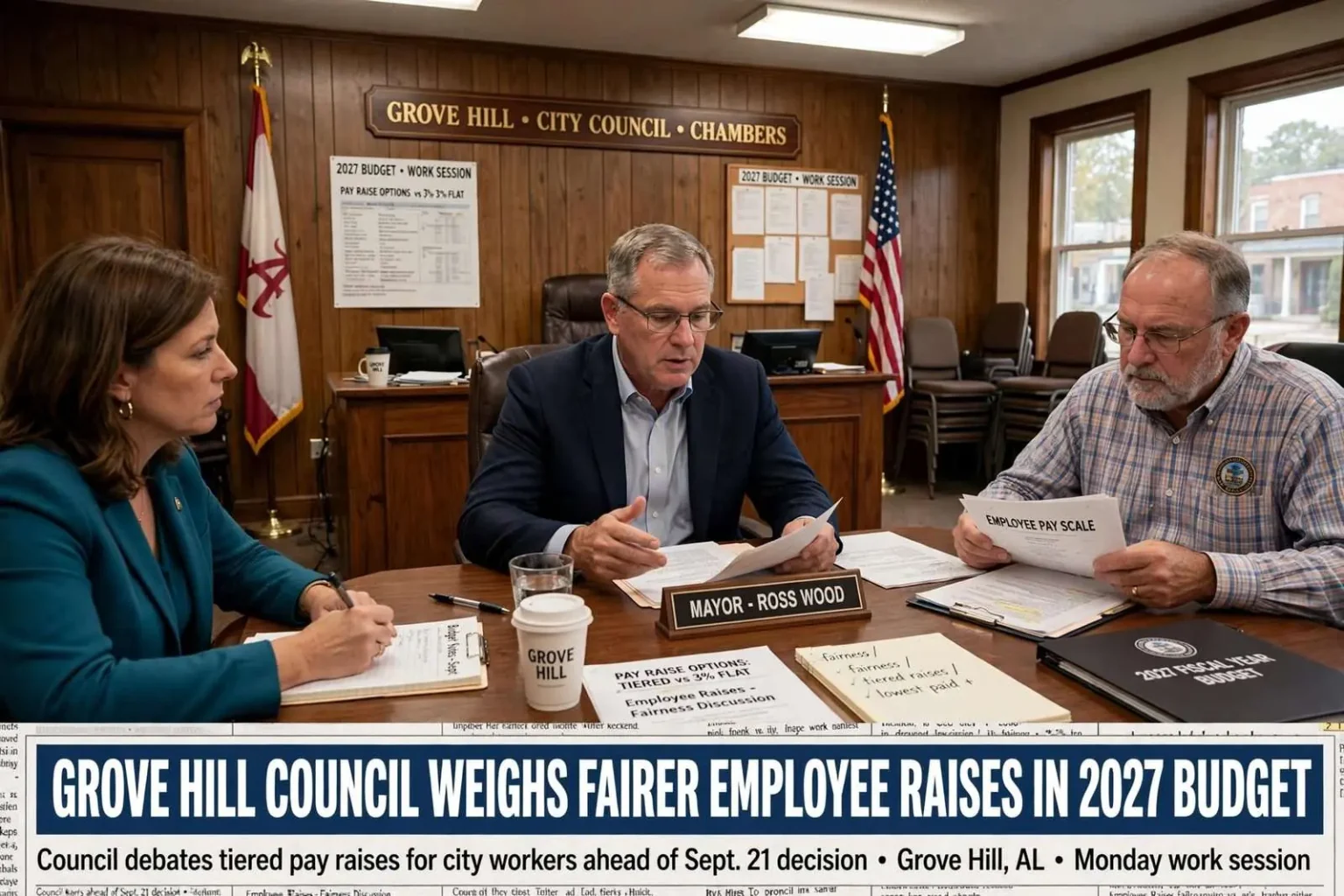
The Grove Hill City Council devoted much of its Monday work session to shaping the city’s budget for the 2027 fiscal year, which must be adopted before October. A central topic was how to structure annual pay raises for city employees.
Grove Hill typically awards a 3% increase across the board, but councilmembers raised concerns about fairness, noting that a 3% raise for a lower-paid worker does not carry the same weight as the same percentage for a higher earner. In dollar terms, the same percentage adds far more to a senior administrator’s paycheck than to a crew member’s, even though both face the same costs of living in Clarke County.
The discussion reflects a debate playing out in small cities across Alabama, where municipal budgets hinge on a handful of revenue sources and every recurring expense commits the city for years. A flat percentage raise compounds each year it is repeated, so a switch to a tiered structure — larger percentages at the bottom of the pay scale, smaller ones at the top — reshapes payroll costs differently over time than the city’s traditional approach.
Mayor Ross Wood asked councilmembers to be ready to make final budget decisions on Sept. 21, with a vote on the new budget scheduled for Oct. 5. That timeline follows the state’s requirement that Alabama municipalities adopt annual budgets by the start of the fiscal year on Oct. 1, giving the council roughly two more working sessions to settle the raise structure.
Why the Raise Formula Matters in Grove Hill
For a city the size of Grove Hill, the county seat of Clarke County, municipal employees make up a significant share of the local payroll. The city’s workforce runs its police and fire protection, water system, streets and parks, and every raise decision ripples through the town’s economy as those employees spend their wages locally.
Councilmembers weighing the fairness question must also balance it against the city’s fixed revenues. Grove Hill, like most small Alabama towns, depends heavily on sales taxes, shared state fuel taxes and utility receipts — revenue streams that move with the economy rather than with payroll needs. A raise structure that grows faster than revenue in a lean year can force cuts elsewhere in the budget.
The alternative structures under discussion would concentrate raises among the lowest-paid workers, narrowing the gap between the top and bottom of the city’s pay scale. Supporters of that approach argue it improves retention of frontline workers who can otherwise earn more with regional employers; skeptics worry it compresses the difference between entry-level and experienced staff.
No final decision had been made at the work session. The council plans to revisit the numbers with department-level figures in hand before the Sept. 21 decision deadline.
Other Council Business
In additional action during the meeting, the council agreed to switch its credit card provider from a Kansas-based bank to Huntingdon Bank, the successor to Cadence Bank, which has an office across the street from town hall. The resolution enacting the change also added protections against fraud and misuse, though the city has reported no problems with its credit card usage.
Banking relationships carry practical weight for small municipalities. A provider with a branch within walking distance of city hall lets staff resolve disputed charges and replacement cards in person rather than through call centers, and the added fraud controls bring the city’s card program in line with modern municipal practice.
The council also approved a plan to have city workers begin cutting the grass at Grove Hill Hospital. Wood said the hospital spends roughly $15,000 to $18,000 a year on grass cutting, and the arrangement will free that money for other needs.
The arrangement puts existing city crews and equipment to work on the hospital grounds, converting idle capacity between city projects into savings for one of the town’s most important institutions. Grove Hill Memorial Hospital serves as the primary health care facility for Clarke County, and officials have long treated its financial health as inseparable from the town’s — the hospital is among the community’s largest employers and its closest emergency care for miles.
Rural hospitals across Alabama have operated under chronic financial pressure, and Black Belt and south-central counties have seen facilities close when margins failed. A recurring cost of $15,000 to $18,000 redirected back into patient care is a modest line item by urban standards, but for a small rural hospital it represents supplies, equipment or staffing hours that would otherwise be spent on grounds maintenance.
The council approved a liquor license for Jay-G’s restaurant, adding to the town’s dining options. License approvals are routine items on small-city agendas, but restaurant openings carry outsized importance in county seats like Grove Hill, where eating establishments anchor the downtown commercial district.
Heard Wood praise Grove Hill Chamber of Commerce Director Laken Nix for working to recruit new members and promote local activities. A chamber luncheon is planned for Sept. 22 at the senior center, the group’s first membership meeting in some time — a signal, Wood suggested, that the organization is rebuilding its role as the town’s business voice.
Upcoming Community Events
Wood also outlined several events in the coming weeks, including the Second Chances Cancer Support Group parade on Sept. 19 at 10 a.m., the Square Cup’s annual block party on Oct. 3 from 10 a.m. until 2 p.m., and the Hope in Healing 5K run benefiting the Ronald McDonald House on Oct. 17.
The events give the town a full civic calendar through the fall. The cancer support group’s parade draws families from across Clarke County each year, the Square Cup block party fills the area around the town square with vendors and music, and the Hope in Healing run channels local fundraising toward the Ronald McDonald House in Mobile, which houses families of children receiving treatment at Gulf Coast hospitals.
The chamber is also promoting an “Eat Outside the Office Day” on Aug. 31, encouraging residents and businesspeople to buy lunch from local restaurants or food truck vendors and eat outdoors. The promotion is aimed squarely at downtown foot traffic, giving Grove Hill’s eateries a midweek boost as the chamber rebuilds its membership rolls.
Because the usual Monday meeting date falls on Labor Day, the next council meeting will be held Sept. 8. The council’s budget work continues in the meantime, with the Sept. 21 decision session and the Oct. 5 vote marking the final steps before the 2027 fiscal year begins.
Between now and then, councilmembers are expected to bring specific proposals for restructuring the employee raises — the item that consumed most of the work session and the one with the longest financial reach. How the city resolves it will set payroll policy not just for 2027 but for the raises that compound on top of it in the years ahead.
The Budget Calendar and What Comes Next
Alabama cities of Grove Hill’s size operate on lean administrative staffs, and the budget work session is where the year’s real decisions get made — long before the formal vote. The council’s Sept. 21 decision session is set for detailed numbers, and the Oct. 5 vote will come just days before the fiscal year turns.
Between now and then, councilmembers are expected to bring specific proposals for restructuring the employee raise policy, the item that dominated Monday’s discussion. Options under consideration in cities facing the same question have included flat dollar increases for the lowest brackets, percentage tiers that shrink as salaries rise, or one-time payments that reward service without permanently compounding payroll.
Whichever route the council takes will define pay policy beyond a single year. A percentage raise compounds into every future raise, which is why small cities scrutinize the structure carefully; a one-percentage-point difference across a workforce compounds into tens of thousands of dollars over a decade for a payroll the size of Grove Hill’s.
The discussion also lands against the backdrop of broader cost pressures on Alabama municipalities. Insurance premiums, fuel, utility costs and construction prices have all climbed in recent budget cycles, squeezing the same revenues that fund raises. Councilmembers must fit any new pay structure into a budget that has to absorb those increases first.
How Grove Hill’s Government Works
Grove Hill operates under the mayor-council form of government common to Alabama’s smaller cities, with the mayor and a small council setting policy and overseeing departments that include police, fire, public works and the water system. Work sessions like Monday’s allow members to debate in detail without the formality of a voting meeting, and items discussed there formally return at regular meetings for action.
The credit card provider switch illustrates how routine items move through that process. The council passed a resolution rather than a simple motion, embedding the new fraud and misuse protections into the city’s written policies — the kind of housekeeping that accumulates into better governance over time.
The grass-cutting agreement with the hospital follows a similar logic of local cooperation. Small towns with limited staffs often trade services with their anchor institutions, and the arrangement lets the hospital redirect its groundskeeping budget while giving the city a way to keep its crews productive between municipal projects.
Residents with input on the budget or the raise structure can raise it with councilmembers before the Sept. 21 session, and the council’s regular meetings remain open to the public. With the chamber luncheon on Sept. 22, the Sept. 8 regular meeting and a fall calendar full of community events, the next two months will test both the city’s finances and the civic energy Wood described — with the 2027 budget vote on Oct. 5 closing out the process.