
Gulf Coast Events Canceled or Postponed as Coronavirus Fears Spread in March 2020
From Fairhope's arts festival to Elberta Sausage Fest, Gulf Coast spring 2020 events fell to COVID-19 cancellations across South Alabama and the Panhandle.
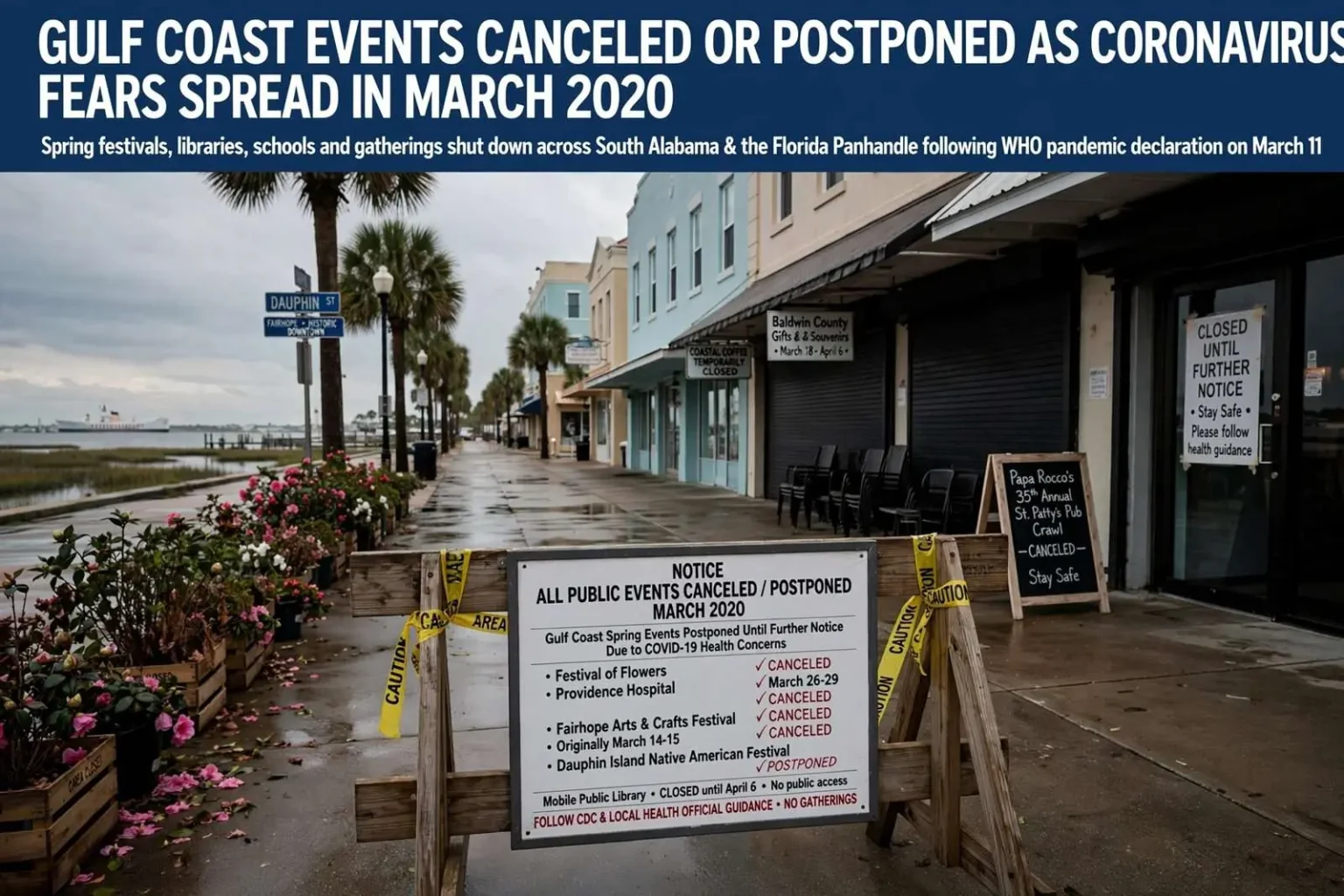
As coronavirus concerns swept the Gulf Coast in mid-March 2020, a wave of beloved spring events across South Alabama and the Panhandle was canceled or postponed — an early sign of how thoroughly COVID-19 would reshape community life. Within the span of a few days, a calendar that normally anchors the region’s spring tourism season was emptied from Mobile to Destin, as organizers weighed public safety against decades of tradition. What began as scattered precautions quickly became a regional shutdown of gatherings large and small, reaching schools, churches, museums, malls and concert halls alike.
The announcements came in a rush that followed the World Health Organization’s declaration of a global pandemic on March 11, 2020. Public health officials were urging limits on gatherings, and across the Gulf Coast each institution answered in turn — some closing their own doors, others calling off events that were days or weeks away. For a region whose identity is wrapped up in festivals and public celebrations, the speed and breadth of the cancellations had no modern precedent.
Mobile and Baldwin County
In Mobile, Battleship Memorial Park announced it would close March 20 until further notice, sending home one of the city’s most visited attractions. The park along Mobile Bay, home to the battleship USS Alabama and the submarine USS Drum, draws visitors from across the country, and its closure signaled how seriously the region’s landmark institutions were taking the spreading virus. School field trips that normally fill the park in spring evaporated along with the walk-up tourists who climb the battleship’s decks year-round.
The Mobile Public Library shut its doors effective March 18 with a tentative April 6 reopening, ending access to its branches throughout the city just as families were settling in for weeks at home. Library systems across the region faced the same calculation — books could be quarantined, but the public spaces where residents read, use computers and attend programs could not safely stay open. The April 6 date was offered as a target, not a promise, and few expected it to hold.
The region’s signature spring festivals fell in rapid succession. The Festival of Flowers — billed as the Southeast region’s largest outdoor flower show, set for March 26–29 at Providence Hospital — was canceled outright. The event, which typically transforms the hospital’s campus into elaborate landscape displays, garden exhibits and educational programs, had become a fixture of Mobile’s late-spring calendar and a major draw for gardeners across the Gulf Coast. Also canceled were the Dauphin Island Native American Festival, which celebrates the barrier island’s indigenous heritage each spring with craft demonstrations, dancing and living-history exhibits at the Dauphin Island Park and Beach grounds, and the Gulf Coast Children’s Book Festival at The Grounds, the fairground complex in west Mobile better known as home to the Greater Gulf State Fair.
Bishop State Community College postponed its lineworker graduation, holding up the ceremony that sends new utility workers into the field while the college evaluated how to conduct commencement safely. The program trains students for work with electrical utilities, and its graduates were entering an industry that would prove essential in the difficult months ahead. Across Mobile Bay in Baldwin County, the cancellations hit just as hard. The Fairhope Arts and Crafts Festival, scheduled for March 14–15, was canceled — a blow to one of the Southeast’s most popular juried art shows, which draws tens of thousands of visitors to the streets of downtown Fairhope each spring and fills the city’s restaurants and shops for a weekend. The Baldwin Art for Heart gala, a benefit supporting the American Heart Association, was canceled along with it.
Elberta’s Sausage Festival, a decades-long tradition at the end of March that fills the small south Baldwin County town with vendors and visitors each year, was “canceled for now.” The volunteer-run event raises money for community organizations and typically draws crowds well beyond the town’s size. Eastern Shore flag football activities were suspended immediately, pausing youth sports leagues in Daphne, Spanish Fort and Fairhope, and the Wharf Boat and Yacht Show was postponed while organizers sought new dates, delaying one of the region’s biggest in-water boat exhibitions at The Wharf in Orange Beach at the start of the boating season.
In Gulf Shores, Papa Rocco’s called off its 35th annual Saint Patty’s Day Pub Crawl — a tradition dating back 35 years that drew visitors from around the country to the beach town’s entertainment district. Owner Bill McGinness said public safety had to come first, a sentiment echoed by organizers across the coast as St. Patrick’s Day celebrations gave way to warnings about large gatherings. Gulf Shores public schools closed classes until April 6, offering free meals in the meantime to students who depended on school breakfast and lunch programs, and the First Baptist Church in Leroy, in north Clarke County, canceled all on-campus activities from March 18.
Panhandle Closures Follow
Across the state line, the same pattern played out in Northwest Florida. Cordova Mall in Pensacola and Silver Sands Outlet Mall in Destin closed, emptying two of the Panhandle’s busiest retail destinations at the height of the spring shopping and spring break season. The closures rippled through communities that depend heavily on tourism dollars, with visitors finding attractions dark and shopkeepers unsure when doors would reopen. Silver Sands, one of the largest outlet centers in the country, had been preparing for one of its busiest stretches of the year.
The shutdown also reached deep into the spring sports calendar beyond Baldwin County. High school athletic associations across both states suspended play, and youth leagues that had just begun practices sent families home. Recreational tournaments that fill beachside soccer fields and ballparks each March — bringing out-of-town teams and their families to hotels along the coast — disappeared from schedules, compounding the tourism losses week by week.
Pensacola Christian Academy shut down for two weeks, joining school systems across the region in suspending in-person classes and scrambling to arrange distance learning. Gallery Night Pensacola called off its March 20 event, ending the monthly downtown art walk that fills Palafox Street with vendors, live music and gallery crowds. Smokin’ in the Square, the barbecue competition and festival held in Pensacola’s Maritime Park, was scrapped as well, removing another staple of the Panhandle’s spring festival lineup and the charity fundraising that comes with it.
The cancellations reached into entertainment bookings as well. Cher’s Pensacola Bay Center concert was pushed to September, one of the first major arena reschedules in the region as tours nationwide began postponing dates. Even the KISS members’ Rock n’ Brews Casino ribbon-cutting in Biloxi was shelved, and the Mississippi Coast Coliseum’s Spring Jam was also canceled, extending the wave of closures across state lines to the west and emptying casino and concert calendars along the entire northern Gulf.
An Empty Spring Calendar
Together the cancellations emptied a calendar that normally anchors the region’s spring tourism season. March and April along the Gulf Coast are typically packed with festivals, art shows, boat exhibitions and school field trips, drawing visitors whose spending supports restaurants, hotels and shops from Mobile to Panama City Beach. With those events called off one after another, organizers and local officials began bracing for a season of lost revenue while hoping many gatherings could be rescheduled later in the year.
The economic stakes were especially high in communities that live on tourism. Gulf Shores and Orange Beach were heading into their busy season with beaches open but events vanished; Fairhope’s downtown merchants had just lost their biggest weekend of the spring; and Mobile’s convention and visitor business stalled alongside the festivals. For nonprofits and volunteer organizations, canceled galas and festivals meant fundraising gaps that would take months to fill.
For residents, the announcements changed daily life almost overnight. Weekend plans built around festivals and pub crawls gave way to school closures, library doors locked mid-morning and parking lots empty at attractions that are usually crowded this time of year. Community institutions — churches, colleges, youth leagues — each made their own calls, but the direction was the same everywhere: keep people apart until the danger passes, and accept the cost of an empty calendar in exchange.
Organizers expressed hope that postponed events could find new dates on the calendar and that canceled traditions would return the following year. The Festival of Flowers, the Fairhope Arts and Crafts Festival, Elberta’s Sausage Festival and the rest had survived hurricanes and recessions before. The question in March 2020 was how long the pandemic would keep the Gulf Coast’s tradition of gathering together on hold — and what the region’s festival season would look like when the crowds finally came back.
In the days that followed, residents learned a vocabulary that would define the year ahead: social distancing, flattening the curve, essential businesses. The empty festival calendar became the most visible symbol of the pandemic’s arrival on the Gulf Coast, a region built on coming together. Every closed gate and canceled parade route stood as a reminder that the fastest way through the crisis was for the crowds that normally define spring to stay home.