
Gulf Shores City Schools to reopen Sept. 28 after Hurricane Sally
Gulf Shores City Schools will welcome students back Sept. 28, about a week after Hurricane Sally hit, with free meal pickup available this week.
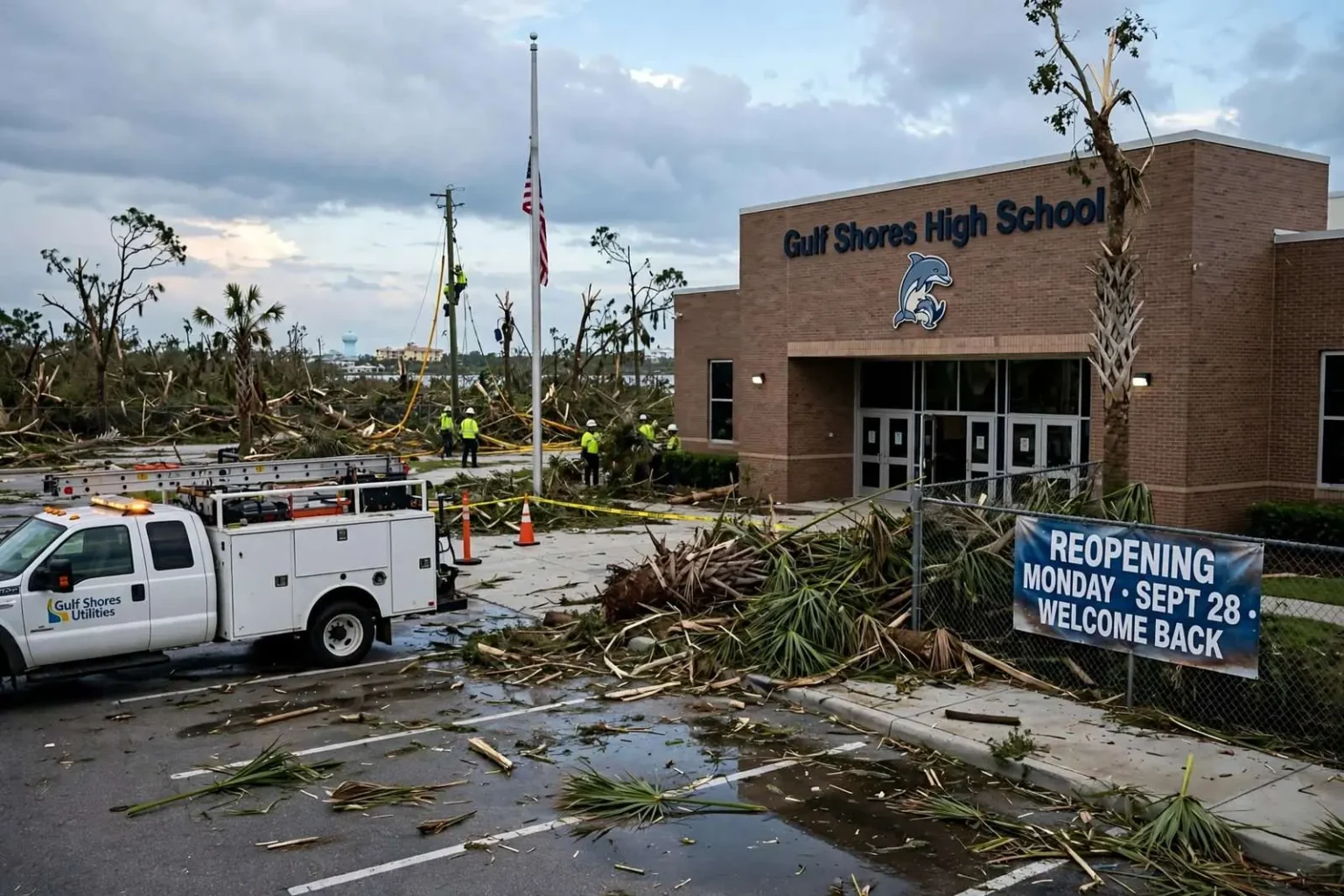
Gulf Shores City Schools will welcome students and teachers back to the classroom Monday, Sept. 28, about a week after Hurricane Sally made landfall near the city. The return date was set after days of clearing debris, restoring power and inspecting every campus in a beachfront community that took a direct hit from the storm.
In a message to families, Superintendent Dr. Matt Akin said school officials have coordinated with city leaders, Gulf Shores Utilities, Baldwin EMC and the Baldwin County Emergency Management Agency since the storm, tracking utility restoration and street conditions before committing to a reopening day.
Power has been restored to the elementary campus and was expected soon at the high school and middle school, according to Akin’s message, leaving final cleanup and safety checks as the last hurdle between the district and its students.
“Although a lot has been accomplished in the last few days, the work in our area has just begun,” Akin wrote. “In coordinating with city officials, I have determined that our students and teachers can safely return to school on Monday, Sept. 28.”
A young school system in a battered coastal city
The reopening marks another early test for one of Alabama’s newest city school systems. Gulf Shores City Schools broke away from the Baldwin County Public Schools system in recent years to form its own independent district, operating an elementary school, a middle school and Gulf Shores High School under local control for just its second full year when Sally struck.
Running a standalone system is a considerable undertaking for a city of Gulf Shores’ size, and the hurricane pressed on every part of the operation at once — building maintenance, transportation routes, food service, staffing and communication with hundreds of families scattered between their homes, hotels and relatives’ houses while repairs continued.
Sally came ashore near Gulf Shores on Sept. 16 as a Category 2 hurricane, and its slow crawl inland proved as damaging as its landfall. Hours of persistent onshore winds toppled trees onto homes and power lines, blocked roads with debris and left much of Baldwin County without electricity, making the days after the storm nearly as disruptive as the storm itself.
Racing the clock on utilities
The school system’s reopening hinged on two utilities with very different jobs. Gulf Shores Utilities, the city’s own provider, handles electric, water and sewer service inside the city limits, while Baldwin EMC, a member-owned electric cooperative headquartered in Summerdale, serves thousands of members across Baldwin County and parts of neighboring counties.
Both spent the week after landfall replacing downed lines, mending damaged substations and working street by street through debris-choked neighborhoods, coordinating with tree-removal crews so lines could be restrung safely. The Baldwin County Emergency Management Agency, meanwhile, served as the countywide clearinghouse for the response, feeding situation reports to cities, school systems and state agencies as conditions improved.
Restoring the elementary campus first reflected the pattern of repairs across the city rather than any special priority; crews reached some neighborhoods and feeder lines before others. With the high school and middle school expected to follow shortly, the district aimed to have all three campuses live before students reported.
Employees return first
Before students come back, all administrators and 10- to 12-month employees have been asked to report on Sept. 23. That early return gives staff nearly a week to prepare classrooms, confirm that technology and air conditioning are functioning, walk through emergency procedures and handle the countless small repairs and cleanups that decide whether a first day back runs smoothly.
Those five days also give the district a buffer. If a campus loses power again or a problem surfaces during the employee return, officials still have room to adjust before the full student body arrives, rather than scrambling on reopening morning itself.
Transportation figures to be one of the watch points. School buses returning to their routes will share streets with utility trucks, debris haulers and contractors working across the city, and some intersections may still be operating without functioning signals. Families were advised to build in extra time and keep an eye on district messages as conditions evolve.
Free meals “to go” in the meantime
The system’s child nutrition program will serve free breakfast and lunch “to go” this week, bridging the gap for families still without full kitchens or grocery access before classes resume. Pickup is at Gulf Shores High School at 8:30 a.m. and at GSHS and Pelican Place at 11 a.m., spreading the distribution across the city and across the day so no single site becomes a bottleneck.
Grab-and-go meal service became a familiar lifeline along the Gulf Coast during school closures and storm recoveries, letting families collect meals by car without gathering indoors. For a coastal community where many residents were still without power a week after landfall, the free meals doubled as practical relief during the recovery’s most inconvenient stretch.
Pelican Place, the shopping center at Craft Farms on the city’s northern side, gave families who lived farther from the school campuses a convenient pickup point, an acknowledgment that even in a compact beach city, post-storm conditions vary block to block.
What parents should know before Monday
With the reopening set, families face a short list of practical preparations. Damaged roads, lingering debris piles and crews still working in rights-of-way mean morning commutes could take longer than usual, and drivers should treat any dark traffic signal as a four-way stop. Students who spent the week displaced or without internet access may need help reconnecting school accounts and finding materials.
Families whose homes or neighborhoods were hit hard were encouraged to communicate with teachers and administrators, since schools often serve as the connective tissue that helps a community spot families who need extra help after a storm.
The wider recovery continues
The school system’s return is one piece of a much larger recovery that city leaders describe as just beginning. Gulf Shores’ economy leans heavily on tourism, and the storm struck at the tail end of the beach season, leaving hotels, restaurants and rental properties assessing damage while crews cleared sand and debris from the highways that funnel visitors to and from the coast.
Restoring electricity, water and sewer service remained the top priority for the city’s recovery in the days after landfall, followed by debris removal on residential streets. State and federal assistance programs were expected to play a role as damage assessments moved forward across Baldwin County, one of the state’s fastest-growing counties and one that has absorbed repeated Gulf storms over the decades.
For the schools, reopening carries a significance beyond instruction. In communities recovering from a hurricane, the first day back in class is often treated as a milestone of normalcy — a visible sign that the city is functioning again, and a structured, familiar place for children whose routines the storm upended.
Akin’s message struck a balance between reassurance and realism, crediting the utility crews, city workers and school employees who pushed the district toward a Monday reopening while cautioning families that recovery work across the area would continue for weeks to come.
The district said it will continue updating families through its normal communication channels as the reopening approaches, and officials thanked parents for their patience during a week in which the question of when students would return remained open until the final determination was made in coordination with city officials.
As of the announcement, all three Gulf Shores City Schools campuses were scheduled to be open for a regular school day on Monday, Sept. 28, with employees reporting the previous Wednesday and free to-go meals available at pickup sites through the end of the week.
How Baldwin County school systems weather the Gulf
Coastal Baldwin County school leaders keep a standing playbook for hurricane season that most inland districts never need. Storm tracks are watched from the moment a system enters the Gulf, generators are fueled and tested, food service warehouses are stocked ahead of projected landfalls, and communication plans are prepared for the near-certainty that cell service and internet access will be unreliable in the days after a strike.
The decision to reopen, however, cannot be made from a checklist alone. Superintendents along the coast coordinate with county emergency management, municipal leaders and utility providers because a school day depends on far more than the condition of school buildings — it depends on whether bus routes are passable, whether traffic signals work, whether students have safe roads to walk and whether families still sheltering elsewhere can realistically get back.
Gulf Shores’ ability to set a reopening date within roughly a week of landfall reflected both the pace of utility restoration and the city’s experience with Gulf storms. Communities along the Alabama coast have rebuilt repeatedly after hurricanes over the past several decades, and each recovery leaves behind lessons about preparation, communication and the order in which services come back online.
For now, the district’s attention shifts from recovery logistics to the school year itself. Athletics schedules, field trips and after-school programs that were paused during the closure will resume as conditions allow, and teachers will spend the first days back assessing where students stand after an unplanned week away from instruction in the middle of the first marking period of the fall semester.