
Gulf Shores Council Sets Joint Work Session and Rescheduled Regular Meeting for Dec. 5
Gulf Shores holds a joint work session and rescheduled council meeting Dec. 5 at 4 p.m. Public attendance welcome; comments in person only.
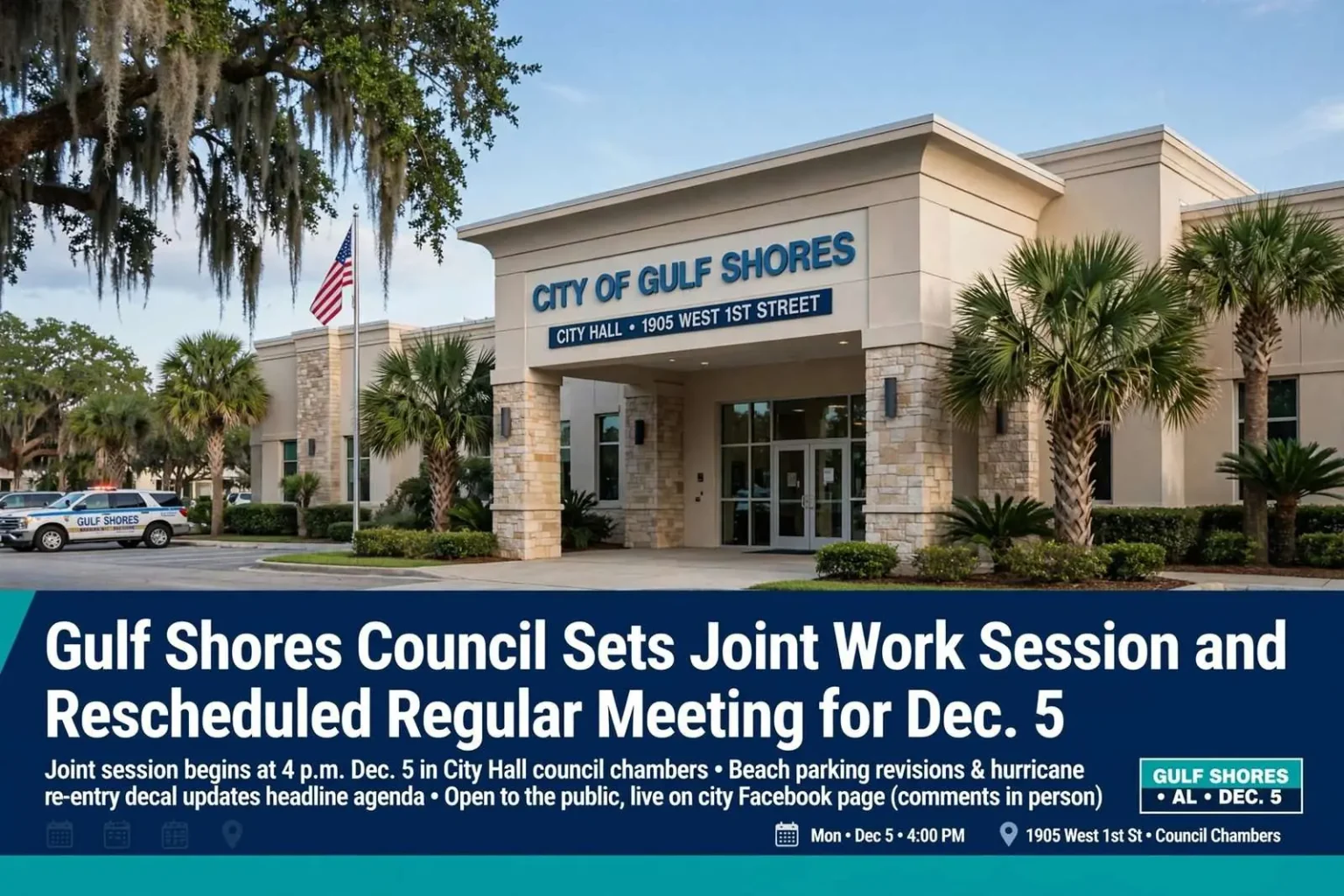
The City of Gulf Shores will hold a joint council work session and rescheduled regular council meeting on Monday, December 5, beginning at 4 p.m. in the City Hall council chambers at 1905 West 1st Street. The session is open to the public, and questions and comments will be taken in person at the meeting, giving residents and property owners a direct chance to weigh in on an agenda that includes some of the most consequential policy changes the council has considered this year.
The proceedings will also be streamed live on the city’s Facebook page for viewing only — all public comments must be delivered in person. City officials have used the hybrid format in recent years to let remote viewers follow council business while preserving the in-person participation that Alabama’s open-meetings framework is built around. A full agenda item summary is available through the city’s agenda center, where residents can review each item before the meeting begins.
Beach Parking and Traffic Changes Headline the Agenda
The most consequential item is a proposed ordinance amending Chapter 21 (Traffic) of the city code. City staff determined that growing demand for parking near the city’s Gulf-front beaches requires further regulation, and the package of amendments would update conflicting hurricane re-entry decal ordinances and resolutions, redefine controlled beach parking hours, expand the controlled beach parking area, and modify controlled beach parking fees.
A companion resolution would define and update policies and rates for controlled beach parking, permit fees and annual hurricane re-entry decals. Together, the two measures would rewrite the practical rules governing how residents, property owners and visitors access the beachfront — the single most valuable and most contested public asset in a city whose economy rises and falls with coastal tourism. Controlled beach parking programs in Gulf Shores have historically combined paid or permitted spaces near the sand with resident protections, and the proposed changes would adjust where the program applies, when the rules take effect each day, and what permits cost.
The hurricane re-entry decal component carries weight beyond parking policy. The decals are the credentials that allow residents and property owners to return to the beachfront after an evacuation, and the ordinance updates are aimed at resolving conflicts that have accumulated between older ordinances and resolutions as the program evolved over successive storm seasons. Officials have said a cleaner, consistent set of rules matters most in the hours after a hurricane, when re-entry control points depend on clear standards for who is allowed across the bridges and onto the peninsula.
Why Beach Parking Is a Persistent Flash Point
Gulf Shores occupies a narrow barrier island on Alabama’s Gulf Coast, and its Gulf-front parking supply is finite while visitation keeps climbing. Summer weekends and holiday periods routinely fill public lots and street parking near the sand, pushing overflow into residential neighborhoods along West Beach and the lagoon side of the island. The controlled parking program is the city’s principal tool for balancing that pressure — protecting access for residents and registered property owners while still welcoming the tourist traffic that funds a large share of the city budget through lodging and sales taxes.
Adjusting the hours of enforcement, the geographic footprint of the controlled zone and the fee schedule touches nearly every constituency in the city, from full-time residents to condominium associations to vacation rental operators. That is why city staff routed the changes through both an ordinance amendment and a companion resolution: the ordinance carries the legal force, while the resolution sets the administrative policies and rates that staff will apply. Residents who want to comment on either will need to do so in person at the December 5 meeting.
Event Permits, Airport Leases and Board Appointments
The recreation and cultural affairs agenda includes public assembly permit applications from the Gulf Shores Kiwanis Club for the 2023 Polar Bear Dip, for the 2023 Waterway Village Zydeco & Crawfish Festival, and for the COGS Zydeco Crawfish Festival 5K & Fun Run. The events are fixtures of the city’s winter and early-year calendar: the Polar Bear Dip draws hundreds of hardy participants to the Gulf on New Year’s Day, while the Waterway Village festivals anchor the working-waterfront district along the Intracoastal Waterway with music, food and family activities that bring visitors to a side of the city away from the beachfront.
Council will also consider ratifying two land leases at the city airport: an agreement with Gulf Shores Power Sports, LLC (Kitchens Brothers) for construction of an 11,500-square-foot aircraft storage hangar in the southwest aircraft storage complex, and a lease with Megalop Holdings, LLC (Donnie Elmore) for a 4,400-square-foot hangar unit in the same complex. The leases continue the steady buildout of hangar capacity at the city’s airfield, where demand for covered aircraft storage has consistently exceeded supply as the coastal aviation community grows. New hangars generate ground-lease revenue for the airport and expand the based-aircraft base that supports its operations.
Other items include appointing John Eslick to the Beautification Board to replace Marlene Johnt, renewing the city’s annual state lobbying contract, and routine consent-agenda business ranging from meeting minutes to invoices. The Beautification Board — the volunteer body that oversees landscaping standards, litter programs and the city’s appearance along its major corridors — fills occasional vacancies as terms expire or members step down, and appointments of this kind are among the council’s regular personnel responsibilities.
How the Meeting Will Run
The joint format means the council will convene in work session to discuss agenda items with staff before transitioning into the regular meeting where formal votes occur. Work sessions give council members room to ask questions and refine proposals — including the beach parking package — before the public vote, and residents who attend get to see the deliberation that shapes the final versions of the measures. The 4 p.m. start is earlier than the city’s typical evening meeting time, a scheduling note for residents planning to attend or comment in person.
Anyone unable to attend can follow the Facebook stream for viewing, review the agenda item summary through the city’s agenda center, or contact City Hall at 1905 West 1st Street with questions before the meeting. Because public comments will only be taken in person, residents with strong feelings about the beach parking ordinance, the hurricane re-entry decal changes or the airport leases are encouraged to arrive early to sign in and speak when the mayor opens the floor.
What to Watch
The beach parking and re-entry decal package is the item most likely to draw discussion, and any changes the council makes in response to public comment would be reflected in the ordinance and resolution as adopted. The airport hangar leases and festival permits are expected to move quickly, and the board appointment completes the evening’s routine business. Together the agenda offers a snapshot of a resort city managing the collision between tourism growth and residential life — from the parking lots along the dunes to the hangars at the airfield and the festivals that fill the calendar between them.
The People and Groups Behind the Agenda
The items before the council connect to a web of civic organizations and businesses that shape daily life in Gulf Shores. The Kiwanis Club’s Polar Bear Dip has raised money for local charities for years while giving the city a signature New Year’s Day tradition, and the Zydeco & Crawfish festivals give the Waterway Village district — the cluster of docks, restaurants and shops along the Intracoastal Waterway — its biggest attendance days outside of shrimp season. Public assembly permits for each event spell out the security, sanitation and traffic arrangements the city requires before approving them, and council ratification is the final step in that process.
The airport leases reflect the same entrepreneurial energy on the aviation side. Gulf Shores Power Sports, operating as Kitchens Brothers, plans an 11,500-square-foot hangar for aircraft storage in the southwest complex of the city airfield, while Megalop Holdings, the company of longtime local figure Donnie Elmore, would take a 4,400-square-foot hangar unit nearby. Each new hangar adds to the airfield’s role as an economic asset, serving the business aviation traffic that accompanies the city’s resort economy and the private pilots who keep the based-aircraft roster growing year after year.
The Bigger Picture for a Resort City
The December 5 agenda illustrates the balancing act that defines government in Baldwin County’s beach cities. The same council that regulates beach parking to protect residential quality of life also approves the festivals, hangars, board appointments and contracts that sustain the visitor economy those residents depend on. Gulf Shores’ budget leans heavily on lodging taxes and sales taxes generated by tourism, which means the city’s ability to fund public safety, drainage and beach renourishment is tied directly to keeping visitors coming — even as the controlled parking program works to keep their cars out of the neighborhoods.
The hurricane re-entry decal overhaul is the quiet but essential piece of that balance. Gulf Shores sits on a barrier island with limited evacuation routes, and after every storm threat the city must decide quickly who may return and in what order, using the decal program as the credential system at its control points. Cleaning up the conflicting ordinances that have accumulated over the years is unglamorous work, but it is the kind of preparation that determines how smoothly the city reopens after the next hurricane, and residents who have been through past evacuations tend to watch these changes closely.
With the work session and meeting combined into a single afternoon, the council has packed a full range of policy, permitting and administrative business into one December agenda — and given residents one clear opportunity to speak on all of it, in person, before the votes are taken.