
Gulf Shores Eco-Center Event Spotlights Coastal Marine Life
The Alabama Coastal Foundation and Healthy Gulf host a free marine life event Aug. 27 in Gulf Shores, featuring films, displays and a sea turtle nesting update.
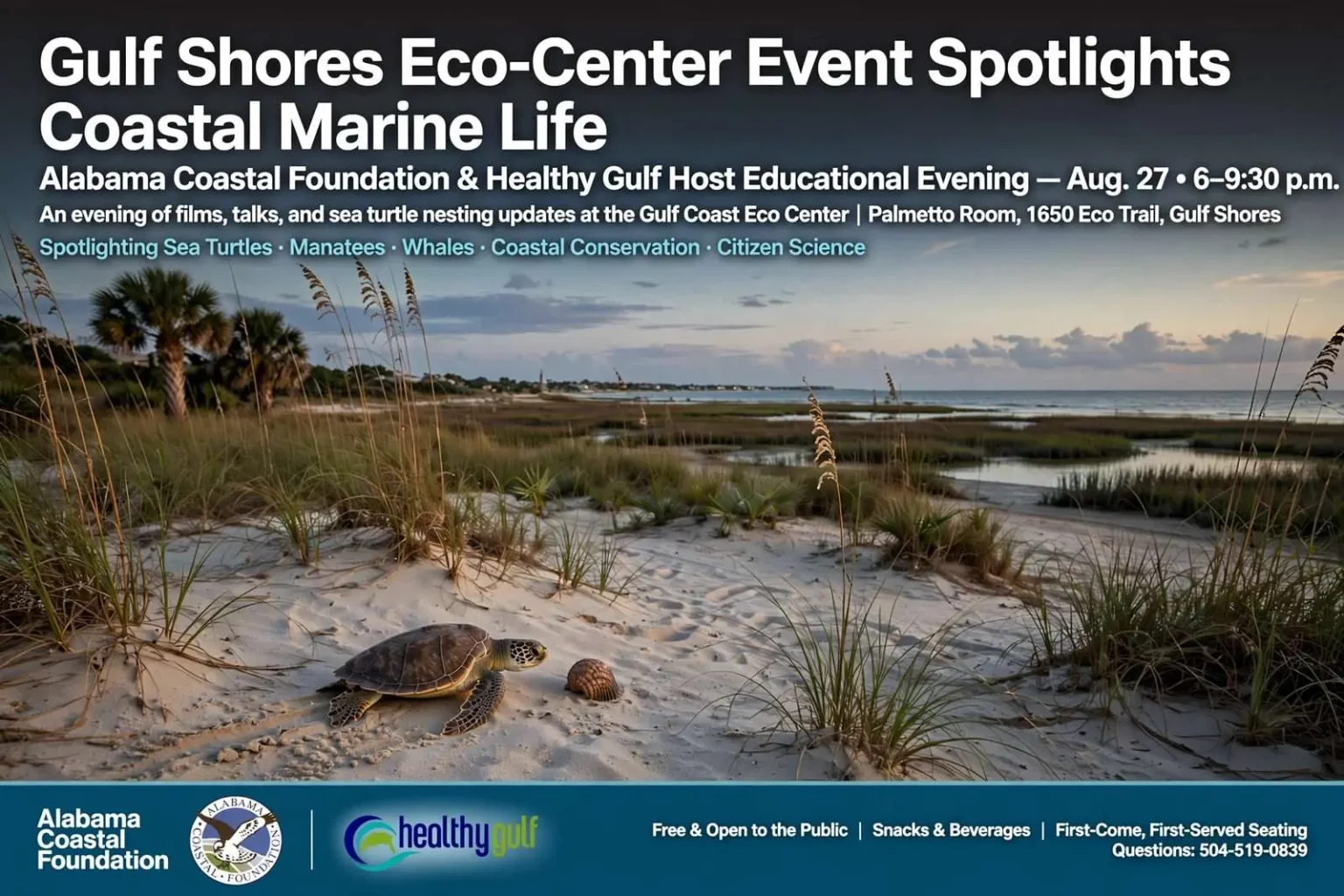
The Alabama Coastal Foundation and Healthy Gulf will host an educational celebration of the rich marine life found along the Alabama Gulf Coast during an event running from 6 to 9:30 p.m. on Aug. 27 at the Gulf Coast Eco Center Palmetto Room, 1650 Eco Trail, in Gulf Shores. Organizers are inviting the public to learn how they can get involved in protecting the animals that share the region’s beaches and waterways.
The evening will feature short films, educational displays and presentations by local advocates working on behalf of sea turtles, whales, manatees and other marine life. Attendees will also receive an update on sea turtle nesting along Alabama beaches, a topic of steady interest during the summer months when female turtles haul out at night to lay eggs in the sand and volunteers patrol the beaches at dawn to mark and monitor the nests.
Snacks and beverages will be served. Seating is general admission on a first-come, first-served basis, with bleacher seating available. For more information, contact Christian Wagley or call 504-519-0839.
Two organizations, one mission
The Alabama Coastal Foundation, headquartered in Mobile, has spent decades working to improve and protect Alabama’s coastal resources through a combination of citizen engagement, environmental education and hands-on restoration projects. Its programs reach schoolchildren, volunteers and coastal decision-makers alike, and its annual events — from oyster recycling initiatives to coastal cleanups — have made it one of the most recognizable conservation groups on the Alabama Gulf Coast. Its partnership with Healthy Gulf on an evening like this one pairs a homegrown Alabama organization with a Gulf-wide advocate.
Healthy Gulf, based in New Orleans, is a nonprofit organization devoted to protecting and restoring the natural resources of the entire Gulf of Mexico, with long-standing attention to the waters, wetlands and communities of the northern Gulf coast. The organization’s staff and advocates work on water quality, fisheries, coastal habitat and the cumulative pressures that come with development along one of the nation’s most productive coastlines. Bringing that Gulf-wide perspective to a Gulf Shores audience gives local residents a bigger-picture view of how Alabama’s beaches fit into the health of the entire Gulf.
The two organizations share a belief that protection of marine life starts with an informed public. Rather than lecturing from a distance, both groups specialize in connecting coastal residents directly to the wildlife around them — the turtles nesting in front of beach houses, the manatees that wander into Alabama’s bays and rivers in warm months, and the open Gulf waters beyond the sandbars where larger marine animals travel.
The marine life at the center of it all
Sea turtles are the headliners of Alabama’s coastal wildlife story, and for good reason. Each summer, loggerhead and other sea turtle females return to the same stretch of coastline where they hatched decades earlier, crawling ashore after dark to lay clutches of eggs above the high-tide line. The nests incubate for roughly two months before hundreds of tiny hatchlings emerge and make their desperate scramble to the Gulf, guided largely by the reflection of light on the water. Artificial lighting from beachfront development is one of the greatest hazards they face, which is why coastal communities along the Alabama shoreline promote lights-out practices during nesting season.
The volunteer effort behind that work is one of the most successful citizen-science programs on the coast. Trained volunteers walk the beaches each morning of nesting season, locate the telltale tracks left by nesting females, stake off the nests, and watch over them until hatchlings emerge. The public update planned for the Aug. 27 event gives attendees a ground-level view of how the season is unfolding — how many nests have been laid along Alabama’s beaches, how hatchings are going, and what beachgoers can do differently to keep the next season just as productive.
Manatees add a subtropical note to Alabama’s marine menagerie. The gentle herbivores, most famous for their winter gatherings in Florida’s springs, wander westward into the warm waters of Mobile Bay and its rivers and along the Intracoastal Waterway during the warmer months, delighting boaters and fishermen who spot them. Their presence in Alabama waters has become more regularly documented over the years, and advocates emphasize that boaters who slow down and keep a lookout are the manatees’ best protection in local waters.
Whales, though rarely seen close to Alabama’s beaches, are part of the larger Gulf ecosystem the event celebrates. The Gulf of Mexico is home to marine mammal populations that spend their lives far from shore, and the health of those open-water populations is tied to the same Gulf that sends fish, shrimp and blue crabs into Alabama’s bays. Presentations at the event are expected to connect those offshore stories to the onshore choices residents make every day.
Why the venue matters
The Gulf Coast Eco Center on Eco Trail in Gulf Shores is a fitting host for the evening. The center’s Palmetto Room gives the event a natural gathering place with room for films, displays and audience seating, and the setting itself — tucked into the coastal landscape just inland of the beach highway — puts attendees within sight of the habitats the presentations describe. Bleacher seating means families can settle in comfortably for a program that runs nearly three and a half hours, with refreshments keeping the atmosphere informal rather than academic.
Gulf Shores makes sense as the venue for another reason as well. The city’s economy is built directly on the health of its beaches and waters, and its residents and workforce see the connections between environmental quality and daily life more vividly than most communities. When a nesting sea turtle crawls up onto the sand in front of a beachfront condominium, or a manatee surfaces beside a fishing pier, it is not an abstraction — it is the reason visitors come back year after year.
Events like this one also serve the practical purpose of recruiting. Both host organizations depend on volunteers for everything from nest monitoring and coastal cleanups to citizen reporting of stranded or injured marine animals. An evening of short films and good conversation is a low-stakes way for curious residents to take a first step — to sign up for a newsletter, meet a program coordinator, or put a phone number in their wallet for the next time they spot something unusual on the beach.
The timing of the event, in late August, lands near the heart of sea turtle hatchling season, when nests laid in early summer are producing waves of hatchlings along the Alabama coast. It also falls within hurricane season, a reminder that the Gulf’s marine life and its human communities share the same vulnerability to storms and the same interest in healthy dunes, marshes and oyster reefs that buffer the shoreline. Conservation advocates often note that what protects sea turtles and manatees — clean water, functioning habitats, careful development — protects beach towns too.
What attendees can expect
Doors open for the 6 p.m. start, and organizers have structured the evening to move. Short films keep each segment digestible, displays give attendees something to examine up close between presentations, and local advocates speak from direct experience rather than theory. The sea turtle nesting update is scheduled as part of the program, giving everyone in the room the same current picture of the season along Alabama’s beaches. Snacks and beverages are provided, and the general admission format means anyone who arrives early can settle in; with bleacher seating available, the Palmetto Room can accommodate a comfortable crowd.
Anyone with questions before the event can reach out in advance — organizers point attendees to Christian Wagley, who can be reached at 504-519-0839. People planning to attend are encouraged to arrive with questions, since the advocates presenting are the same people who field calls about stranded turtles, unusual sightings and habitat concerns throughout the year.
For residents of Gulf Shores, Orange Beach, Foley and the surrounding communities, the evening offers something more than a lecture: a direct connection to the people doing the work of protecting the Gulf Coast’s marine life, and a clear menu of ways to join in. Whether the takeaway is a new volunteer commitment, a changed habit with beach lighting, or simply a deeper appreciation for what swims and nests along Alabama’s shores, the organizers’ goal is the same — to turn admiration for coastal wildlife into active protection of it.
The collaboration between the Alabama Coastal Foundation and Healthy Gulf reflects a broader truth about conservation on the northern Gulf coast: the issues cross state lines, but the solutions start with local people who know their beaches and bays firsthand. An August evening in a Palmetto Room in Gulf Shores, with films on the screen and sea turtle nesting maps on display, is where that local knowledge and Gulf-wide effort meet.