
Gulf Shores Natives Sell Shirts to Raise Money for Hurricane Sally Relief
Two Gulf Shores natives designed and sold T-shirts, raising nearly $6,000 for Feeding the Gulf Coast to aid Hurricane Sally recovery along the Alabama.
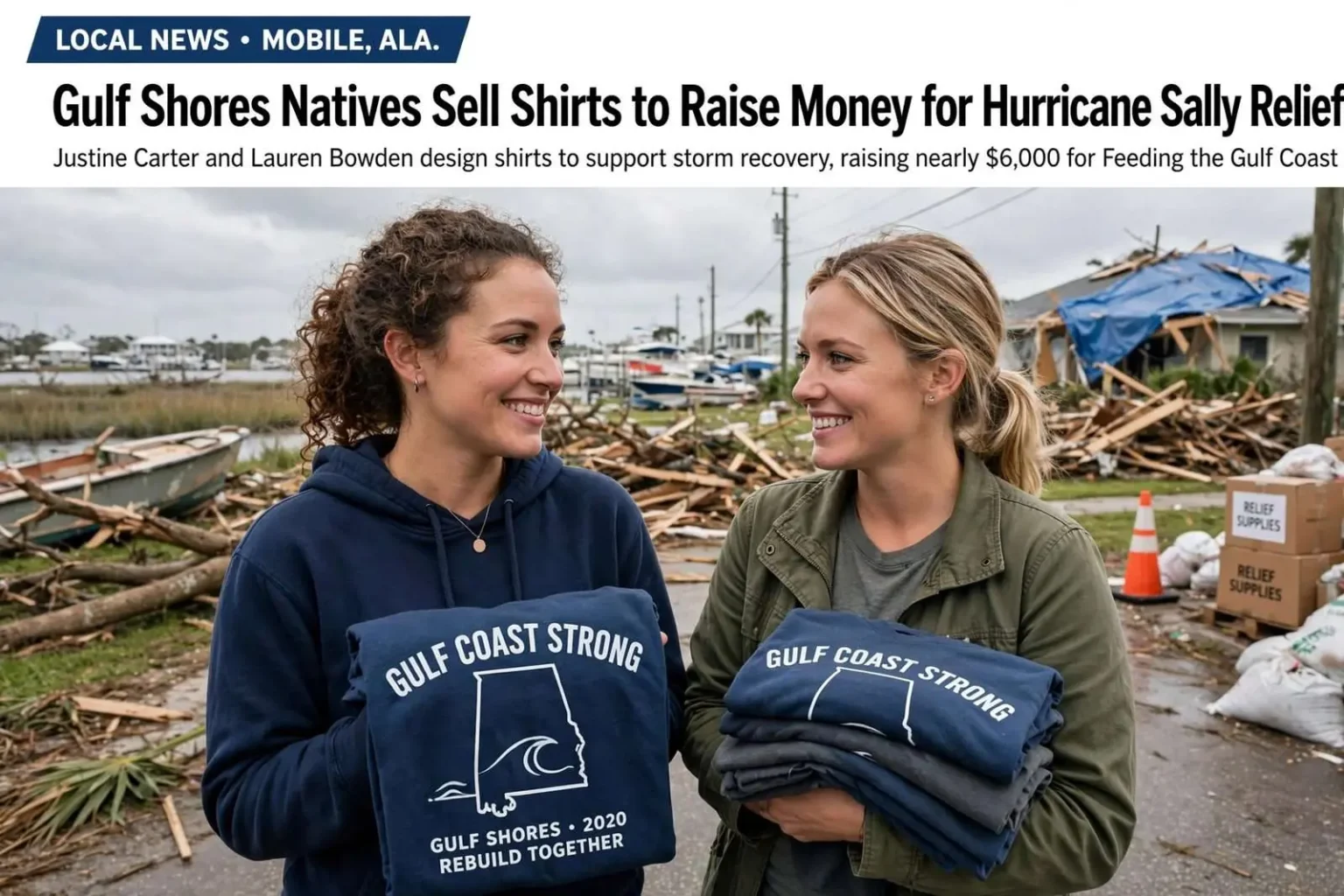
MOBILE, Ala. — Just days after Hurricane Sally tore through the Alabama Gulf Coast, two women with ties to Gulf Shores turned heartbreak into action, designing and selling T-shirts to support storm recovery. What began as a way to channel the shock of watching their hometown battered from afar grew into a fundraiser that reached hundreds of buyers within days.
Justine Carter and Lauren Bowden, both originally from Gulf Shores, said seeing boats scattered across yards and neighborhoods they grew up in left them determined to help. Sally, which came ashore on the Alabama coast in September 2020, pushed storm surge and relentless rain inland, and the images that emerged in its aftermath showed a coastal community transformed overnight: fishing boats deposited far from the water, roads littered with debris, neighborhoods darkened by widespread power outages that would last for days and, in some spots, weeks.
For people with deep roots in Gulf Shores, the storm’s aftermath was personal. The barrier-island city built its identity around the water that draws millions of visitors a year — the same water that, during Sally, hurled boats, docks and piers into the streets. Carter and Bowden’s response was fast and practical: design a shirt that Gulf Coast people would want to wear, sell it online, and send every dollar of profit to relief work on the ground.
The fundraiser takes off
Together they have sold more than 500 shirts and raised nearly $6,000. The pace of the sales reflected both the reach of social media among Gulf Coast transplants and the region’s long tradition of organizing relief from the neighborhood level up. Shirt fundraisers have become a familiar tool for small-scale disaster fundraising: no overhead beyond printing, immediate online ordering, and a wearable symbol that keeps the cause visible long after the delivery trucks have gone.
All proceeds go to Feeding the Gulf Coast, an organization that provides food and water to people in need across the region. The group operates as the regional food bank serving the central Gulf Coast, coordinating donations, warehouses and distribution partners across the affected area, and after a hurricane its logistics network becomes one of the fastest ways to move food and water into hard-hit communities.
Bowden noted the group focuses on the entire affected area rather than a single community. That mattered to the two organizers, whose hometown was only one piece of a disaster zone that stretched along the coast and inland — from the barrier islands through south Mobile County and into communities hundreds of miles from the landfall point, all coping with their own version of the same wreckage.
A storm unlike recent memory
Sally’s slow crawl toward and across the coast made it a particularly punishing storm. Rather than a quick strike, the hurricane sat and spun, dumping extraordinary rainfall totals on the panhandle and south Alabama and dropping feet of storm surge along the barrier islands. Boats broke loose or were carried wholesale off their lifts and trailers, and the region’s marinas — among the busiest between New Orleans and Tampa — were left scenes of stacked and sunken vessels.
Weeks after landfall, the cleanup was still underway: blue tarps on rooftops, debris lines along the highways, and business owners assessing whether the summer season’s losses could be recovered at all. It was into that landscape that the shirt fundraiser’s proceeds flowed — into food distributions and water supplies for families whose kitchens had no power, whose groceries had spoiled, and whose paychecks had stopped because their workplaces were damaged or closed.
The message behind the shirts
The friends also wanted to send a broader message: that the Gulf Coast is a strong, resilient place that will rebuild together. That sentiment is a refrain after every storm on the coast, but in the weeks after Sally it took on a practical meaning — neighbors cutting trees off neighbors’ roofs, lines of trucks hauling debris, church groups cooking meals in parking lots, and small fundraisers like this one feeding money into the organizations doing the day-to-day work.
Coastal residents measure resilience not in slogans but in recovery seasons. Gulf Shores and its neighboring beach communities have rebuilt from hurricanes before, each time restoring the tourist economy on which the town runs while absorbing the lessons of the last storm into building codes, evacuation plans and the habits of residents who know that the next one is always a matter of when, not if.
The fundraiser also benefited from timing. In the days right after landfall, attention on the Gulf Coast was at its peak, and every share of the ordering page reached people already looking for a way to help. Campaigns launched within that first week consistently outpace ones that wait for the cleanup phase, when the urgency in the public mind has begun to fade even as the need on the ground remains.
The shirt fundraiser was open for orders through Oct. 10, a deadline that gave the effort a focused window rather than an open-ended campaign. Organizers of efforts like this one often set cutoff dates for a practical reason: printing orders in one batch maximizes the share of each sale that reaches the charity, and a deadline creates urgency that spreads orders by word of mouth.
Why food banks carry the load after landfall
When a hurricane hits the Gulf Coast, the first images are of wind and water, but the longest-lasting emergency is usually hunger. Power outages spoil everything in household refrigerators within days. Grocery stores that lost roofs or coolers cannot restock. Workers whose restaurants, hotels and shops were damaged lose the paychecks they use to buy food in the first place. Feeding the Gulf Coast and organizations like it exist for exactly this cascade, and a hurricane turns their ordinary distribution network into a lifeline within hours.
Food banks are built for the job in a way that ad hoc relief drives are not. They have warehouse space, refrigerated trucks, relationships with national donors and a distribution map of partner pantries that already reaches into every county and parish they serve. Money donated to them after a storm converts quickly into boxed and canned goods, bottled water, fresh produce when it can be moved, and the fuel and staffing that get those items onto tables.
That is why fundraisers like Carter and Bowden’s funnel their proceeds to an established organization rather than distributing supplies themselves. The women handled what they could do fastest — design, promotion and sales — and let the food bank’s logistics do what it does best. The result was nearly $6,000 moving into the regional response without a single pallet having to be loaded by the organizers.
The Gulf Coast’s mutual aid tradition
The shirt campaign fits into a long Gulf Coast tradition of neighbors funding neighbors. After storms, the region’s recovery runs on layers: federal and state assistance for the biggest losses, insurance for those who had it, and an enormous amount of local effort — bake sales, benefit concerts, fish fries and merchandise drives — that covers the gaps in between. Small fundraisers rarely make headlines beyond their own communities, but together they form a significant share of how the coast actually gets back on its feet.
The diaspora matters too. People who grew up on the coast and moved away — to Mobile, to Atlanta, to Texas and beyond — watch storm coverage from a distance and feel the particular helplessness of seeing their hometown damaged while they are out of reach. Merchandise campaigns give that scattered community something concrete to do: buy the shirt, post the link, and know the money lands where it is needed.
Recovery after the cameras leave
The weeks and months after landfall are when recovery becomes a grind. Insurance claims stretch out, contractor schedules back up across an entire region of damaged homes, and families continue living in repairs-in-progress long after the news coverage has moved on. Relief organizations warn donors that the need does not end when the last debris truck rolls — food distributions in particular continue for months in the hardest-hit zip codes.
For Gulf Shores, a city whose economy pulses with the seasons, a September landfall carried a double blow: the immediate destruction and the loss of the fall season’s visitors, whose spending sustains the restaurants and shops that employ so many residents year-round. Donations to regional food security thus reached not only the families who lost their homes but also the workers whose livelihoods blinked out with the storm.
Carter and Bowden’s effort joined hundreds of similar ones across the region in the weeks after Sally came ashore — proof of the message printed on the shirts they sold: that the Gulf Coast is strong and resilient, that it rebuilds together, and that the people who left it for other cities keep a hand out toward home when the water rises.