Hard Freeze Forces Gulf Coast Cities to Close Park Restrooms Ahead of Record Cold
Mobile, Fairhope and Baldwin County close park restrooms and trails ahead of a dangerous December 2022 freeze, plus plumber tips to keep pipes from.
One of the coldest air masses in years began bearing down on the Gulf Coast this week, with temperatures expected to plunge into the teens and single digits across parts of the region — and cities from Mobile Bay to the beach are scrambling to keep freezing weather from wrecking public plumbing. A wind chill advisory was in effect through Saturday morning as the arctic front arrived. For a region where a sub-freezing night is rare enough to make headlines on its own, the forecast carried an added urgency: pipes across South Alabama routinely run through attics, crawl spaces and uninsulated exterior walls, and public parks are dotted with water fountains and restroom fixtures that were never designed to sit through a hard freeze.
The response unfolded on a tight schedule, with each community announcing closures before the first hard freeze could arrive rather than waiting for damage reports. Parks and public works crews spent the days leading up to the front shutting off supply lines, draining fixtures and covering exposed plumbing — the same playbook Gulf Coast cities have refined over past cold snaps, when a single night in the teens proved capable of cracking porcelain and splitting copper lines that then stayed out of service for weeks.
Mobile closes restrooms at passive parks
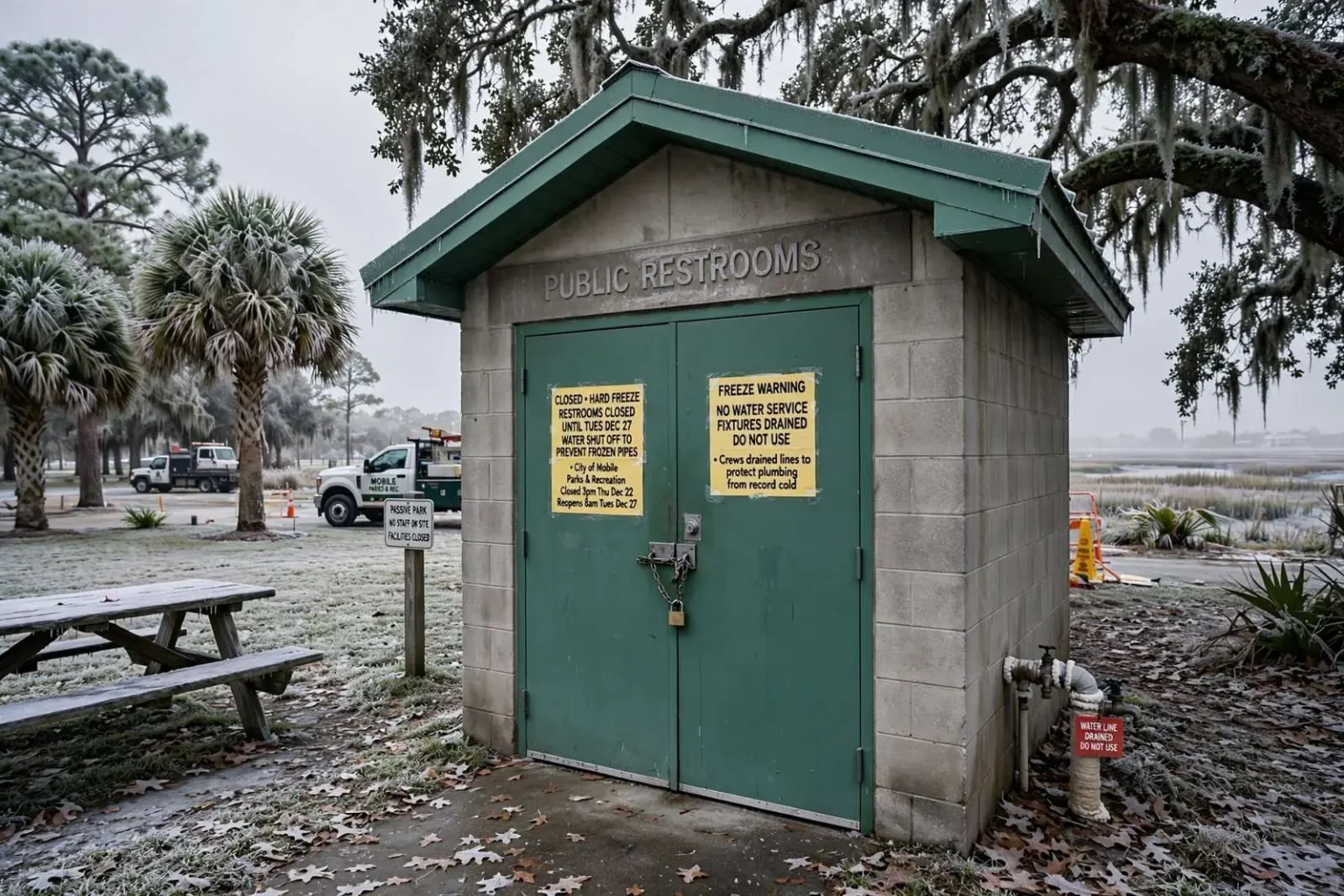
In Mobile, restrooms at all passive parks closed at 3 p.m. Thursday, Dec. 22 so crews could protect plumbing fixtures, with the facilities scheduled to reopen at 8 a.m. Tuesday, Dec. 27. The closure covered the city’s quieter neighborhood parks — the green spaces that offer picnic shelters, walking paths and playgrounds but generally lack staffed facilities — leaving the fixtures dry through the coldest stretch of the holiday weekend. City crews used the window to shut off water at the source and drain the lines, a low-cost precaution compared with the expense of repairing dozens of burst pipes after a freeze.
Across Mobile Bay in Fairhope, the city took a similar step, closing public restrooms at city parks and at the Fairhope Municipal Pier on Friday, Dec. 23 while workers cut water service to the fixtures. Restrooms were expected back online Monday, Dec. 26 once temperatures climbed above freezing. The Municipal Pier, one of the most visited public landmarks on the eastern shore of Mobile Bay, draws joggers, anglers and tourists year-round, and its restroom facilities see steady traffic even in winter — making them a priority for winterization crews working ahead of the front.
Baldwin County parks go dark
In unincorporated Baldwin County, restrooms at Meyer Park, Mo’s Landing and along the beach closed Thursday morning, Dec. 21, with officials promising to reopen them “as soon as weather conditions allow.” The wording left the timeline deliberately flexible, an acknowledgment that the duration of a deep freeze — and how quickly pipes can be safely recharged afterward — depends on how long temperatures stay below freezing and how quickly daytime readings recover. Meyer Park, a popular stop for sports teams and travelers along the Highway 181 corridor, and Mo’s Landing, a boat launch on Weeks Bay, both serve steady winter traffic from anglers and families.
At Gulf State Park, one of Alabama’s most heavily visited outdoor destinations, restrooms and water fountains at Alabama Point and Cotton Bayou went offline, and a stretch of the Hugh S. Branyon Backcountry Trail closed Thursday through Tuesday during the freeze. The affected areas sit at the park’s western end near Orange Beach and Gulf Shores, where the beach pavilions, dune crossings and trailheads draw visitors even in the off-season. The Backcountry Trail, which winds more than 25 miles through six distinct ecosystems between Gulf Shores and Orange Beach, remained open along most of its length, with only the vulnerable segment closed while the freeze passed.
Why Gulf Coast plumbing is so vulnerable
The scramble reflects a simple fact of Gulf Coast construction: homes and public buildings here are built for heat, humidity and hurricanes, not arctic air. Water lines in South Alabama frequently run through attics or along exterior walls, far less protected than the interior, basement-fed plumbing standard in colder parts of the country. Builders rarely specify the insulation depths or pipe burial depths required up north because, in a typical year, the region sees only a handful of nights below freezing. When an air mass this cold arrives, that economy of construction becomes a liability.
Local plumbers spent the week urging homeowners to take a handful of inexpensive steps that can mean the difference between a cold morning and a burst-pipe disaster. Their advice: drip faucets connected to vulnerable lines, open the cabinet doors under sinks so warm household air can reach the plumbing, insulate any exposed pipes, and know where the water shutoff valve is before an emergency begins. Each step targets a different failure mode. A slow drip keeps water moving through the line, which makes freezing far less likely; open cabinets expose under-sink plumbing to heated air; pipe insulation adds a buffer on lines in garages, attics and crawl spaces; and a shutoff valve found in advance can stop a burst pipe from flooding a house for the hours it takes a plumber to arrive.
The stakes are higher than the inconvenience of a dry faucet. A pipe that splits inside a wall or attic can release hundreds of gallons of water into drywall, flooring and insulation before anyone notices, and repairs during a region-wide freeze can stretch for weeks because every plumbing company in town is answering the same round of emergency calls. Insurers along the Gulf Coast routinely see a spike in water-damage claims after hard freezes, and contractors often warn that the damage bills from a single arctic outbreak can rival those of a modest hurricane in some neighborhoods.
A region built for hurricanes, not blizzards
The cold snap also tested systems beyond household plumbing. Municipal water departments monitored pressure across their networks, since a surge of breaks can drop pressure and force boil-water notices. Fire hydrants and backflow preventers, both exposed to the elements, needed attention. And parks departments — the ones closing restrooms this week — were working from hard experience: past Gulf Coast freezes have left cities replacing fixtures and rebuilding restroom buildings that were simply not rated for the temperatures that arrived.
The wind chill advisory in effect through Saturday morning underscored how dangerous the event was beyond property concerns. With actual temperatures in the teens and single digits and wind driving the feels-like readings even lower, exposure times that would be an annoyance in a typical Gulf Coast winter became genuinely hazardous. Emergency management officials across the region opened or publicized warming options for residents without reliable heat, and animal services groups reminded owners to bring pets indoors as the front moved in.
For longtime residents, the event joined a short list of memorable arctic outbreaks that have reached the Gulf Coast over the decades — events remembered not for snow accumulation, which is rare here, but for the days afterward, when plumbers’ phones ring nonstop and hardware stores sell out of pipe wrap, faucet covers and heat tape. Each outbreak tends to produce the same advice from the same people: this is the moment to prepare, because the next one may not come with a week’s notice.
What happens when the thaw arrives
Just as important as the freeze itself, officials say, is what happens when temperatures climb back above freezing. Pipes that cracked under ice often show no damage until water service is restored and pressure returns, which is why the reopening schedules announced this week were staggered into the following week rather than timed to the first morning above 32 degrees. Mobile planned to have its passive-park restrooms back in service by 8 a.m. Tuesday, Dec. 27, Fairhope expected its parks and pier facilities online by Monday, Dec. 26, and Baldwin County and Gulf State Park officials tied their timelines to weather conditions rather than a fixed date.
Crews restoring service follow a familiar sequence: recharge the lines slowly, check for leaks at every fixture, and pull any broken components before putting a restroom back into public use. A fixture that survived the freeze but lost a supply line can flood a restroom building in minutes, so the reactivation process is often slower than the shutdown. For park visitors, that means the disruption lingers a day or two beyond the cold itself, even after afternoons turn mild again.
What residents can still do
Even after the worst of the cold passed, plumbers and emergency managers continued to press the same checklist on homeowners. Outdoor hoses should be disconnected and spigots drained; irrigation systems should be shut down at the controller and drained; pool equipment and well pumps need covers or heat where they sit exposed; and garage doors should stay closed if water lines run through the garage. Anyone leaving town during a freeze is advised to keep the heat on and consider shutting off the main water valve, since an undetected break in an empty house is the costliest scenario of all.
The episode served as a reminder that on the Gulf Coast, cold weather preparedness is a different discipline from hurricane preparedness, but it rewards the same instinct: act early, protect the systems that keep a household running, and don’t wait for the warning to become an emergency. The cities that shut their park restrooms before the first hard freeze may have disappointed a few joggers and pier walkers, but the alternative — weeks of closed facilities and five-figure repair bills — was a trade most municipal officials were glad to make.
As the arctic air retreated and forecasters watched temperatures recover, the region returned to its usual rhythm: beaches reopened to walkers bundled against the lingering wind, boat ramps at Mo’s Landing filled with anglers resuming their winter routines, and parks crews made their rounds, turning water back on fixture by fixture and confirming that, this time, the plumbing had held. The next hard freeze will come eventually. When it does, the closures at Mobile’s passive parks, Fairhope’s pier, the Baldwin County parks and Gulf State Park’s western trailheads will likely look just like this week’s — announced a day early, executed without drama, and forgotten by the weekend.