
Harper Lee Documentary “Hey, Boo” Heads to Mobile’s Crescent Theater With Director Q&A
The Harper Lee documentary Hey, Boo screens at Mobile Crescent Theater June 10-16, 2011, with director Mary Murphy hosting Q&A sessions after select shows.
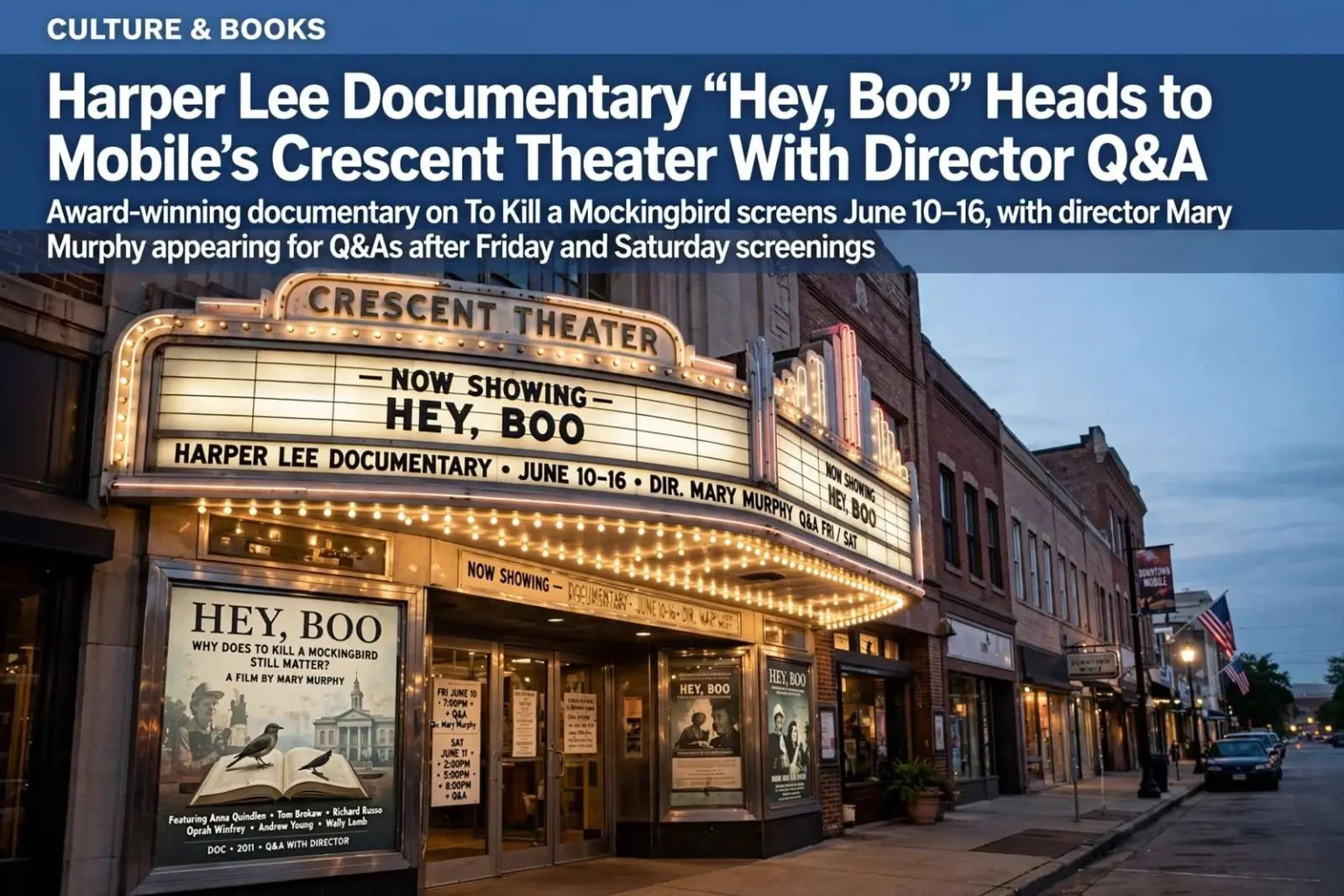
The Crescent Theater in downtown Mobile will devote a full week to one of the most talked-about literary documentaries in recent memory, screening Hey, Boo from June 10 through June 16, 2011. The film examines the lasting cultural footprint of Harper Lee’s To Kill a Mockingbird, and its Mobile run comes with a bonus that local moviegoers rarely get: director Mary Murphy will be on hand for audience question-and-answer sessions following both screenings on Friday and all three shows on Saturday. For a venue that has built its reputation on bringing independent and character-driven films to the Gulf Coast, the booking pairs a subject with deep Alabama roots and a filmmaker who knows the material from the ground up.
Hey, Boo arrives at a moment when interest in Lee and her single landmark novel shows no sign of fading. The documentary asks a deceptively simple question — why does To Kill a Mockingbird still matter? — and answers it through the voices of some of the most recognizable figures in American letters and broadcast journalism, interwoven with the history of the small Alabama town that inspired the fictional Maycomb. The Mobile engagement gives audiences a chance to consider both the book and the place that shaped it on the big screen, then put questions directly to the person who spent years pulling that story together.
A Deep Dive Into a Literary Phenomenon
At its core, Hey, Boo examines why To Kill a Mockingbird remains one of the most widely read and beloved American novels more than half a century after its publication. The film traces the history and cultural context of the book’s Deep South setting, the social changes the novel helped inspire, and the enduring mystery of why Harper Lee — a Monroeville, Alabama, native — never published a second novel during her lifetime. That question has shadowed Lee’s legacy for generations, and the documentary treats it not as gossip but as a genuine window into the relationship between a writer, her masterpiece, and the world that expected more.
The film’s roster of contributors reads like a roundup of American cultural life. It features reflections from prominent figures including author and columnist Anna Quindlen, longtime network anchor Tom Brokaw, novelist Wally Lamb, Pulitzer Prize-winning writer Richard Russo, media mogul Oprah Winfrey, and civil rights leader Andrew Young. Each shares how the novel shaped their personal and professional lives, and the accumulation of those testimonies builds the documentary’s central argument: that a book published in 1960 still shapes how Americans talk to each other about race, justice, and childhood.
That argument lands with particular force in Alabama, where the novel’s geography is not abstract. Monroeville, the Monroe County seat that served as the real-life model for Maycomb, has spent decades welcoming readers who make the pilgrimage to see the courthouse and streets Lee reimagined in fiction. The town’s connection to the book has made it a fixture of Southern literary tourism, and Murphy’s film draws heavily on that sense of place. Watching Hey, Boo an hour or so down the road from Monroeville, Mobile audiences will recognize the landscape on screen as their own.
Director Mary Murphy’s Alabama Connection
Murphy, a New England native, developed her connection to South Alabama through repeated research trips to Monroeville — the small Monroe County town that served as the real-life model for the fictional Maycomb. Those visits put her in the middle of the community that raised Lee, and they gave the documentary an authenticity that would have been impossible to recreate from a distance. Along the way, Murphy also collaborated with Emmy-winning cinematographer Lynn Rabren, who is based in Orange Beach, giving the production a visual sensibility rooted firmly on the Gulf Coast.
Murphy described her motivation for making the film as stemming from a powerful adult rereading of Lee’s novel. “I was literally blown away by it and was determined to learn more about the novel and the novelist,” she said. That experience — returning to a book many people first meet as teenagers and discovering how much more it holds — became the engine of the project, and it is a familiar one to the readers the documentary interviews. The film suggests that To Kill a Mockingbird is one of the rare American novels that changes shape as its readers do, offering children a story about growing up and adults a story about conscience.
The director’s decision to anchor the film in Monroeville also connects the Mobile screenings to a broader corridor of Alabama literary heritage. Murphy’s repeated trips to the region turned up the texture that statisticians and film crews flying in for a week never capture: the courthouse square, the rhythms of small-town life, and the way a single book can define a community’s identity without exhausting it. That grounding is part of what separates Hey, Boo from a standard talking-heads retrospective, and part of what makes its weeklong run at the Crescent feel like a homecoming rather than a tour stop.
An Award-Winning Filmmaker
Murphy brings extensive credentials to the project. A six-time Emmy Award winner, she spent two decades at CBS News, where she produced segments for 60 Minutes, 48 Hours, and CBS Sunday Morning. That background shows in the documentary’s construction: the film moves with the pace of a well-produced magazine segment, letting its interview subjects carry the emotional weight while archival material and scenes from Monroeville fill in the historical frame.
Her other documentary work includes Cry For Help, which aired on PBS, and Digital Days, a Tom Brokaw-narrated examination of the internet age. The range is telling — Murphy’s career has moved between hard news, social-issue documentaries, and cultural history, and Hey, Boo sits comfortably at the intersection of all three. Producers who spend that long in network news tend to develop an instinct for which details an audience will actually retain, and the film’s critical reception suggests that instinct was working.
What the Q&A Sessions Add
The question-and-answer sessions are the centerpiece of the Mobile engagement. Murphy will appear after both Friday screenings and all three Saturday shows, giving audiences six chances over the weekend to hear directly from the person behind the film. Directors’ appearances at the Crescent have historically drawn some of the theater’s most engaged crowds, and a subject as emotionally charged as To Kill a Mockingbird is likely to produce wide-ranging conversations — from questions about Lee’s silence to stories from the Monroeville research trips.
For teachers, book clubs, and readers who have long carried the novel with them, the sessions offer something a printed interview cannot: the ability to ask what the film left out. Murphy spent years collecting interviews and archival material about a novel that has been analyzed from every conceivable angle, and the outtakes of that process are exactly the kind of thing audiences at a director appearance tend to probe. Moviegoers planning to attend a Q&A screening should expect the post-film conversation to run as long as the feature itself.
A Theater That Fits the Subject
The Crescent Theater occupies a distinctive niche in Mobile’s cultural landscape. Tucked into the city’s downtown entertainment district, the single-screen cinema has made its name showing independent, documentary, and foreign-language films that rarely reach the multiplexes out along the interstate corridors. Its programming choices have made it a gathering place for the city’s film community, and runs like this one — a documentary with a literary theme and a director in attendance — are precisely the bookings the venue is known for.
The pairing of venue and subject works on another level as well. Mobile sits at the western edge of the same Alabama terrain that produced To Kill a Mockingbird, and the city’s audiences bring their own history to the film’s questions about race, justice, and the American South. A documentary about how a novel changed the way the country talks about those subjects, screened in a downtown Mobile theater and followed by a conversation with its director, is the kind of cultural event that ends up being remembered locally long after the week is over.
Planning a Visit
The film runs at the Crescent from June 10 through June 16, 2011, with Murphy’s appearances concentrated on Friday and Saturday. Moviegoers who want to catch a Q&A session should plan for the Friday and Saturday shows specifically, since the director will not be present for the remainder of the weeklong run. As with any limited engagement at the small downtown venue, early-week audiences tend to be lighter, giving late-run attendees a quieter room — though they will miss the conversations.
For anyone in the region who has ever taught the novel, argued about it, or made the drive up to Monroeville to stand in the courthouse where Lee’s father practiced law, Hey, Boo offers a rare opportunity to engage with the legacy of one of Alabama’s most celebrated literary figures and the novel that helped reshape American attitudes about race and justice in the South. The film’s weeklong stay puts that conversation within easy reach of the Gulf Coast, and the director’s presence makes the opening weekend the time to be in the room.