Hauled Car Catches Fire on Lott Road Near Semmes
A Mazda6 being hauled on a flatbed truck caught fire on Lott Road near Semmes. Semmes Fire and Rescue extinguished the blaze; the car was a total loss.
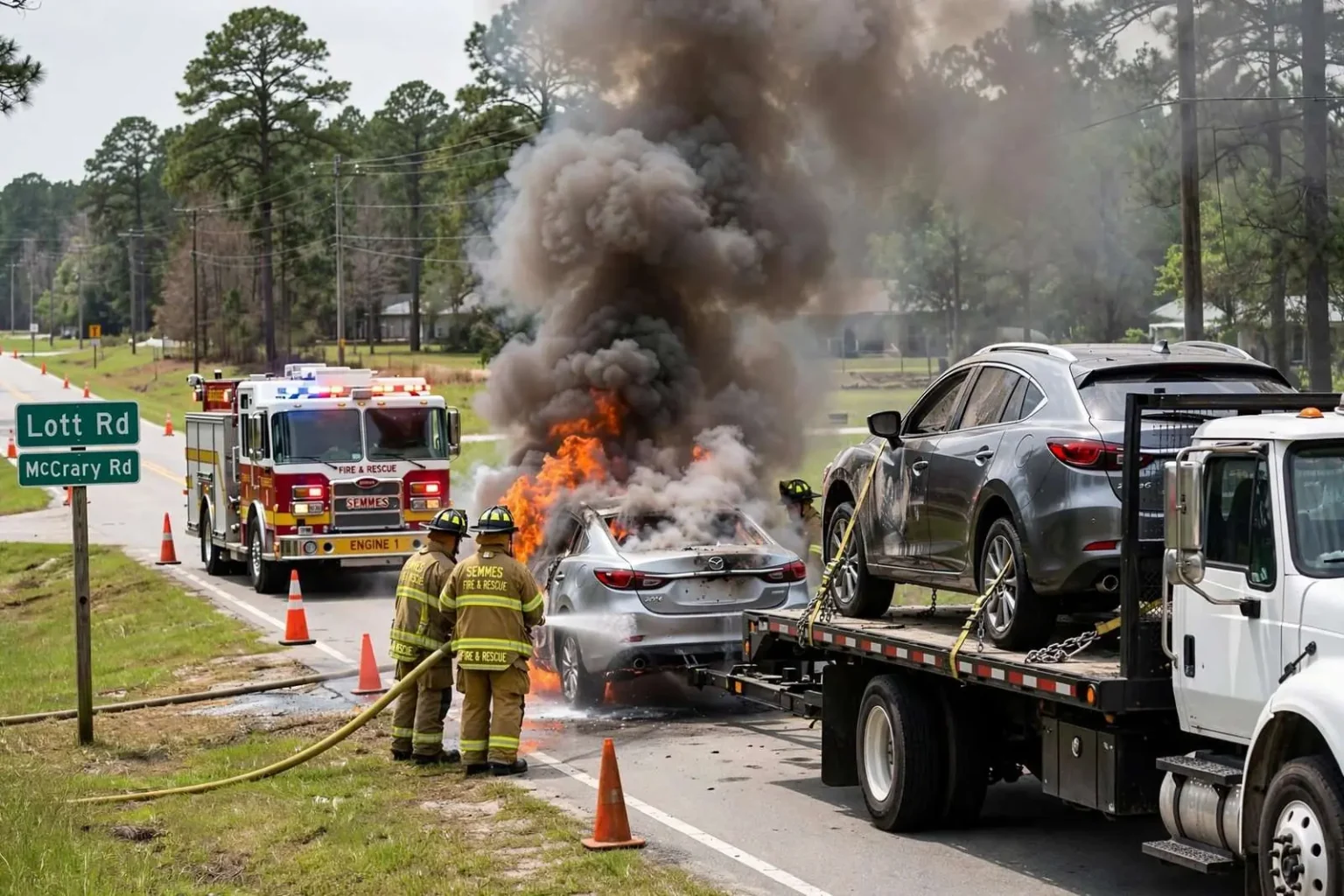
SEMMES, Ala. — A car being transported through west Mobile County went up in flames Friday morning, briefly shutting down the driver’s route along Lott Road. Semmes Fire Department Chief Brooks said a flatbed truck hauling two vehicles from Pensacola pulled over near McCrary Road around 11:45 a.m. after a 2016 Mazda6 attached behind the truck caught fire.
Crews with Semmes Fire and Rescue quickly knocked down the blaze, but the sedan was a total loss. No injuries were reported in connection with the fire.
The midday incident turned a routine transport run into an unplanned stop on one of the area’s busier rural corridors. The driver, moving two vehicles east from Pensacola, was apparently traveling Lott Road when smoke or fire from the trailing car forced him to pull over near the McCrary Road intersection. Within minutes, Semmes Fire and Rescue units arrived and extinguished the burning sedan, but the 2016 Mazda6 could not be saved, and the truck’s delivery schedule was left in pieces on the roadside.
Fires involving vehicles being hauled on flatbeds present particular challenges for responders, since a burning car secured behind a truck can’t simply be driven away from the scene. The vehicle must be extinguished where it sits, and the fate of the truck — and the vehicle riding on the bed — depends on how quickly flames from the trailing car can be knocked down before they climb toward the truck’s frame, fuel system or cargo. In Friday’s incident, crews arrived in time to contain the fire to the Mazda6.
A busy corridor with a single lane each way
The incident tied up the truck’s delivery run while crews worked the scene on Lott Road, a busy corridor connecting Semmes to communities farther west in Mobile County. Lott Road carries a steady mix of commuter, school and commercial traffic between U.S. 98 and the subdivisions that have spread across west Mobile County over the past two decades, and it intersects McCrary Road near one of the area’s main north-south connectors. A vehicle fire near that junction narrows an already two-lane road and forces approaching drivers to slow or reroute until apparatus clears.
Semmes, on Mobile County’s western edge, has grown from a small farming community into a city of roughly 4,000 residents whose school district is among the newest in Alabama. Its fire department protects a service area that spans both the city and surrounding unincorporated neighborhoods, responding to everything from residential fires to wrecks on the U.S. 98 corridor. A midday vehicle fire a short distance from the city’s main crossroads is the kind of call the department handles routinely, but each one carries the possibility of extension to nearby vegetation, especially during dry stretches.
Timing worked in responders’ favor on Friday. Midday traffic on Lott Road is lighter than the morning and afternoon school runs, and the fire broke out in daylight with the vehicle already stopped, rather than in motion on a highway at speed. Chief Brooks said no injuries were reported, a notable outcome given that vehicle fires involve fuel lines, catalytic converters that reach extreme temperatures, and in newer cars a growing list of plastics and fluids that burn hot and produce thick smoke.
Why hauled vehicles catch fire
A car that burns while being transported usually has a specific set of risk factors behind it. Vehicles in transit are often running or recently driven, with hot exhaust components positioned just inches from the tow apparatus’s straps, chains and bumper. Mechanical failures that might be a nuisance in town — a leaking fuel line, an overheating engine, a frayed wiring harness — can escalate quickly when the vehicle is subjected to the vibration, heat and airflow of highway travel behind or atop another vehicle.
Damage that is not immediately visible adds to the risk. A rear-ended car loaded onto a trailer may have a compromised fuel tank or a pinched electrical line that only shows itself miles down the road. Cross-country transport of salvage and auction vehicles — a regular business along the Gulf Coast, where dealers, dismantlers and export brokers move cars between Pensacola, Mobile and points beyond — means hauled cars are not always in roadworthy condition when they start the trip. A fire starting in a trailing vehicle is doubly dangerous because it is attached: the driver cannot separate it and drive the rest away, and the connection point sits near the truck’s own fuel and braking systems.
Firefighters arriving at a haul-vehicle fire also have to make quick decisions about what to protect. The first priority is keeping flames off the truck cab and the vehicle on the bed, which usually means attacking the burning car from angles that avoid the truck and directing foam or water streams between the vehicles. The truck’s driver is typically ordered well clear, both because of the fire and because of the possibility that straps and chains fail as they burn, releasing the wreck.
On Friday, the outcome suggests that sequence went right: the blaze was knocked down quickly, the truck and its remaining cargo were spared, and no one was hurt. The Mazda6, a midsize sedan, was a total loss, which is the usual result when fire reaches a vehicle’s passenger compartment. Fires that begin in engine bays can sometimes be stopped short of a total loss, but a fire that spreads behind the windshield generally destroys wiring, interior materials and fuel system components beyond economical repair.
West Mobile County’s changing landscape
Semmes sits along U.S. 98 about fifteen miles northwest of downtown Mobile, and its growth over the past two decades has followed the expansion of housing subdivisions westward out of the city. The area’s road network still reflects its rural origins: two-lane roads like Lott Road, McCrary Road and Schillinger Road, built for farm traffic, now carry thousands of trips a day between neighborhoods, schools and commercial strips. When any of those roads narrows for an emergency, the backup spreads quickly because there are few parallel alternatives.
The community’s fire protection has grown with it. Semmes Fire and Rescue serves a mix of new subdivisions, older homesites and light commercial properties, and its crews routinely handle vehicle incidents along the U.S. 98 and Lott Road corridors. Mutual-aid agreements with neighboring departments in Mobile County and across the Mississippi line provide backup for larger incidents, but for a single-vehicle fire like Friday’s, the first-in engine from Semmes had the capacity to handle the call on its own.
The timing also spared the area’s schools from any disruption. Lott Road serves as one of the main routes for parents and buses during morning and afternoon school hours, and a fire scene at midday avoided the worst congestion. Still, drivers passing the scene encountered the standard markings of a roadway incident — apparatus positioned to shield the work area, flares and cones pushing traffic to the opposite lane, and the lingering smoke smell that accompanies any burned vehicle.
Clearing the scene
The aftermath of a vehicle fire involves more than putting out flames. Burned vehicles leak fluids — oil, transmission fluid, coolant, fuel residue — that must be contained so they do not reach storm drains, and the wreckage has to be removed from the roadway before traffic can resume its normal pattern. Sheriff’s deputies typically assist with traffic control while the transport company arranges recovery of the truck, the burned sedan and any remaining cargo, a process that can take hours when the hauling rig itself needs inspection before it moves again.
For the truck’s driver, the fire meant more than a lost load. Transport operators are responsible for the vehicles they carry from pickup to delivery, and a burned car involves insurance claims, an incident report and a replacement run to get the surviving vehicle where it was headed. The route from Pensacola through Mobile County is a common one for transport drivers, who use connecting roads like Lott Road to reach destinations off the interstate, and Friday’s fire was a reminder of what can happen on any leg of that trip.
Semmes Fire and Rescue has not released additional details about what caused the Mazda6 to catch fire. Investigators with the department typically document such scenes and consult with the vehicle’s owner and the transport company before determining a cause, and many vehicle fires are attributed to mechanical or electrical failure rather than any improper act.
The department’s quick response limited the incident to one vehicle and one closed stretch of road, and by the following week Lott Road traffic had long since returned to normal. But the scene near McCrary Road on Friday morning was a visible demonstration of a hazard few drivers think about: not every burning car on the road got there under its own power.