
How ALDOT and Mobile Traffic Engineers Kept 2026 Mardi Gras Season Moving
As Mardi Gras 2026 parades rolled through Mobile and Baldwin counties, ALDOT and city traffic engineers worked from a dedicated monitoring center to keep traffic moving, aided by a new downtown parking deck and text alert service.
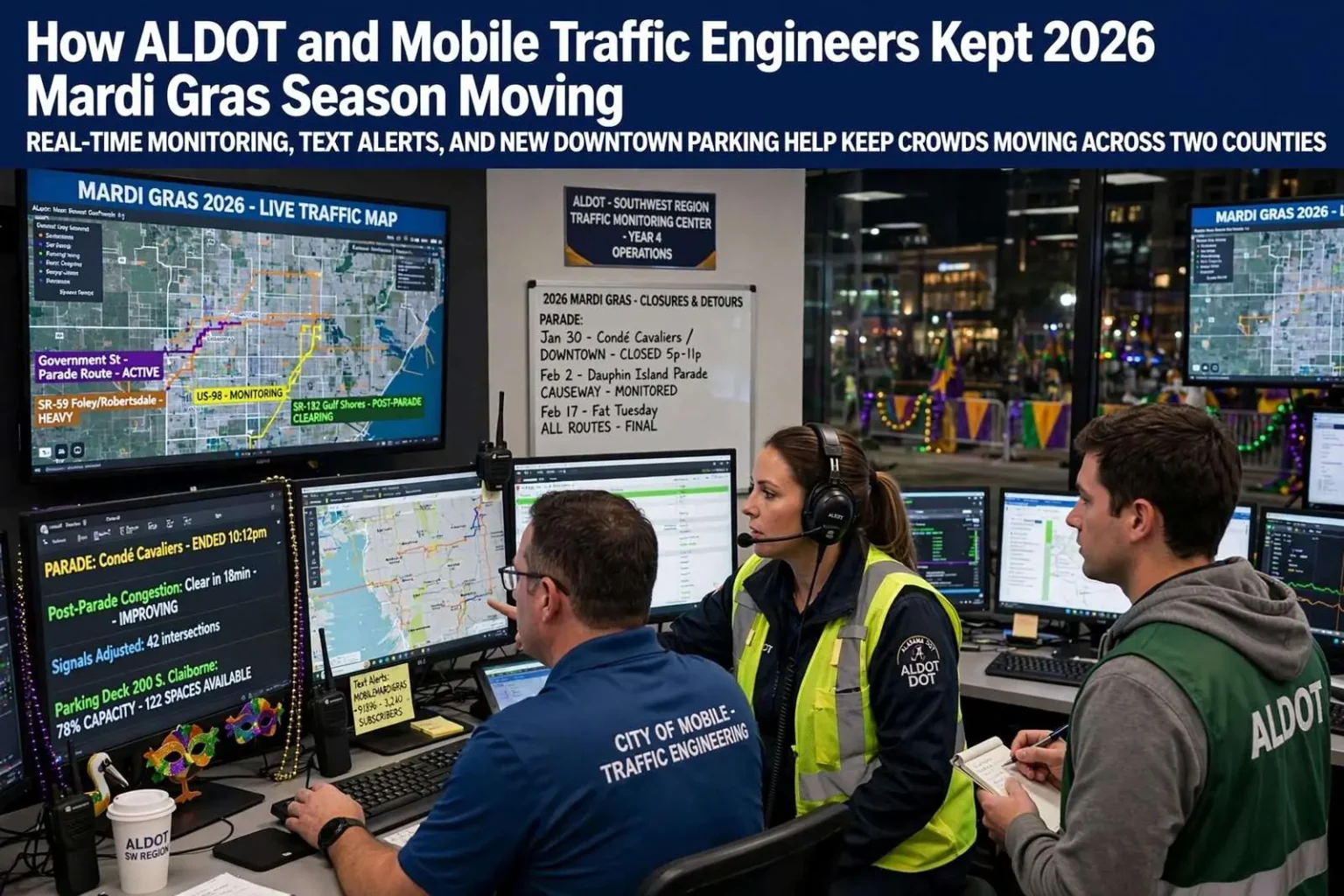
Mardi Gras season rolled back into South Alabama in 2026, bringing the region’s signature mix of parades, beads, Moon Pies, and the extra traffic that comes with it. Celebrations began early along the Gulf Coast, including Dauphin Island’s long-standing tradition as one of the first communities to parade each season, while downtown Mobile’s parade schedule got underway Friday, Jan. 30 with the Condé Cavaliers, kicking off a busy stretch of parades in the city where Mardi Gras in America began.
Mobile established the Mardi Gras tradition long before any other place in the United States, and today the celebration stretches well beyond the city limits into Baldwin County and across the broader Gulf Coast region. The city’s Mystic societies stage parades and balls through the Carnival season, which builds from the first weeks of January toward Fat Tuesday, and the streets that host the processions — Government Street, Route royal-adjacent downtown blocks and the wide runs along the parade routes — absorb crowds numbering in the tens of thousands on the biggest nights.
Keeping Traffic Moving Across Two Counties
With parades drawing large crowds across both Mobile and Baldwin counties, traffic management became an important regional effort for the 2026 season. The Alabama Department of Transportation’s goal was straightforward: keep traffic moving safely and efficiently across the entire Southwest Region, not just in downtown Mobile. In addition to the Mobile parades, festivities throughout Baldwin County affected major state highways, including SR-59, US-98, and SR-182.
ALDOT monitored and adjusted traffic signals along those corridors to help motorists get to and from parades with fewer delays. The Baldwin County routes carry some of the heaviest seasonal traffic on the coast — SR-59 funnels Gulf Shores-bound visitors through Foley and Robertsdale, US-98 crosses the county’s interior, and SR-182 runs the beach road through Gulf Shores’ front — so parade closures and detours on those highways ripple across the entire network. Signal timing adjustments give engineers a way to move residual traffic after a route reopens without waiting for congestion to clear on its own.
For the fourth consecutive year, ALDOT and City of Mobile traffic engineers operated a dedicated Mardi Gras traffic monitoring center for downtown Mobile parades. From that hub, engineers tracked traffic conditions in real time and adjusted signal timing as needed, before, during, and especially after parades, to help keep vehicles moving as smoothly as the celebration itself. The after-parade hours are typically the hardest: tens of thousands of pedestrians leave the routes at once while cars that parked in neighborhoods and lots all day try to leave simultaneously, and signal timing tuned for a normal Friday evening is badly matched to that surge.
New Parking and Text Alerts for Parade-Goers
The City of Mobile also used its traffic data to support a Mardi Gras text alert service, providing up-to-the-minute information on parking, weather, and parade-day updates for residents who signed up by texting MOBILEMARDIGRAS to 91896. The alert system has become a key tool for managing crowd movement, since a well-timed message about route closures or lot availability can redirect thousands of people before congestion forms rather than after.
Drivers also got some good news for the 2026 season: the new parking deck at 200 S. Claiborne Street opened for Mardi Gras, offering additional downtown parking beginning January 30 to help ease the seasonal crunch on street parking near the parade routes. The Claiborne Street deck’s opening date — the same night the Condé Cavaliers rolled — meant the largest nights of the season were the first real stress test for the new structure, which sits within walking distance of the downtown parade routes where street parking disappears hours before each procession.
Throughout the season, ALDOT actively monitored traffic signals across both Mobile and Baldwin counties so motorists could focus on enjoying the festivities rather than sitting in gridlock, working behind the scenes to keep the good times rolling safely across the entire region.
Behind the Scenes of Parade Season
The coordination behind a Mardi Gras season involves more than signal timing. Parade schedules are set months in advance by the mystic societies in consultation with the city, which allows engineers to build a season-long map of closures, detours and staffing. Police handle the street closures themselves, public works manages barricades and cleanup, and transit and parking operations adjust to the nightly rhythm. The traffic monitoring center ties those threads together, giving ALDOT and city engineers a single picture of what is happening across the downtown grid in real time.
Mobile’s Mardi Gras dates to the early eighteenth century, when French colonists brought Carnival traditions to the Gulf Coast, and the city’s mystic societies began organizing parades in the nineteenth century — decades before New Orleans staged its first. That heritage makes the season a point of civic identity as much as an event, and the city treats the logistics of the season as a matter of pride: a smoothly run Mardi Gras is part of the product that draws visitors to downtown Mobile every winter.
For residents, the practical takeaways are the ones ALDOT and the city repeat every season: sign up for the text alerts by texting MOBILEMARDIGRAS to 91896, plan around parade-night closures on the downtown routes, consider the new 200 S. Claiborne Street deck instead of hunting for street parking, and expect heavier traffic on Baldwin County’s highways — SR-59, US-98 and SR-182 — on parade nights in the beach communities. With the monitoring center running for its fourth straight year and the new deck adding capacity downtown, the 2026 season’s infrastructure was the most complete the region has had, and engineers say the work will continue night by night until the last float rolls on Fat Tuesday.
The regional scope of the effort reflects how much Mardi Gras has grown outside downtown Mobile. Baldwin County’s beach communities now stage their own parade seasons, with Gulf Shores, Orange Beach, Foley, Fairhope, Daphne and Dauphin Island each drawing crowds that clog the same two-lane and four-lane highways residents use daily. Dauphin Island’s parade, among the first on the coast each season, draws visitors across the ferry and the causeway onto an island with limited road capacity, making early-season coordination there a smaller but real piece of ALDOT’s work.
The Southwest Region office that covers Mobile and Baldwin counties manages signal systems along hundreds of miles of state routes, and the Mardi Gras season compresses a year’s worth of event traffic management into a few weeks. Engineers use a combination of traffic cameras, signal timing plans and field reports to track how closures affect the network, adjusting corridor by corridor. When a downtown parade ends early or a Baldwin County route draws a larger-than-expected crowd, the monitoring center is where the response gets coordinated.
Downtown parking remains the season’s most persistent challenge, which is why the Claiborne Street deck’s opening was welcomed by regulars. Street parking near the routes fills early on parade nights, and in past seasons drivers have circled for long stretches or parked far from the festivities. A new deck with capacity for hundreds of vehicles, opening exactly when the parade calendar begins, gives parade-goers a predictable option within a short walk of the routes — and gives the city’s traffic engineers one more lever for keeping the surrounding streets clear of cruising cars.
The text alert service rounds out the visitor toolkit. Mardi Gras nights in Mobile are weather-dependent as much as traffic-dependent — a cold rain can thin a crowd and reshape parking demand within an hour — so real-time updates on conditions, parking availability and schedule changes have proven their worth. Residents who signed up by texting MOBILEMARDIGRAS to 91896 got those updates throughout the season, bundled with the city’s parade-day announcements.
By Fat Tuesday, ALDOT and city crews will have managed dozens of parades across two counties, and the numbers that matter — crash counts, closure clearance times, post-parade congestion duration — will go into the planning file for 2027. The fourth year of the monitoring center has made its value clear to both agencies, and the new parking deck adds a permanent piece of capacity that will serve downtown long after the season ends. For the Gulf Coast, the message behind all of it is the same one the season itself carries: Mardi Gras here is a big, beloved operation, and the region now runs it with infrastructure to match.
Local businesses feel the difference a well-managed season makes. Downtown restaurants, bars and shops depend on the crowds that parades bring, and their owners have pushed for years toward smoother traffic flow and better parking, knowing that an easy visit means a visitor who returns for non-parade occasions. The combination of live traffic monitoring, text alerts and new deck capacity answers complaints that merchants and regulars have raised about past seasons, when gridlock after the final float could hold downtown hostage for an hour or more. As the 2026 season rolls toward Fat Tuesday, the partnership between ALDOT’s regional engineers and the city’s traffic staff continues to set the pace for the celebration that Mobile started centuries before any other American city.