How Mobile-Area Agencies Team Up to Detect and Stop Active Shooter Threats
Mobile-area law enforcement agencies, including the FBI, Mobile Police Department and Mobile County Sheriff's Office, describe how shared intelligence, camera networks and joint training help them detect and respond to terrorism and active shooter threats.
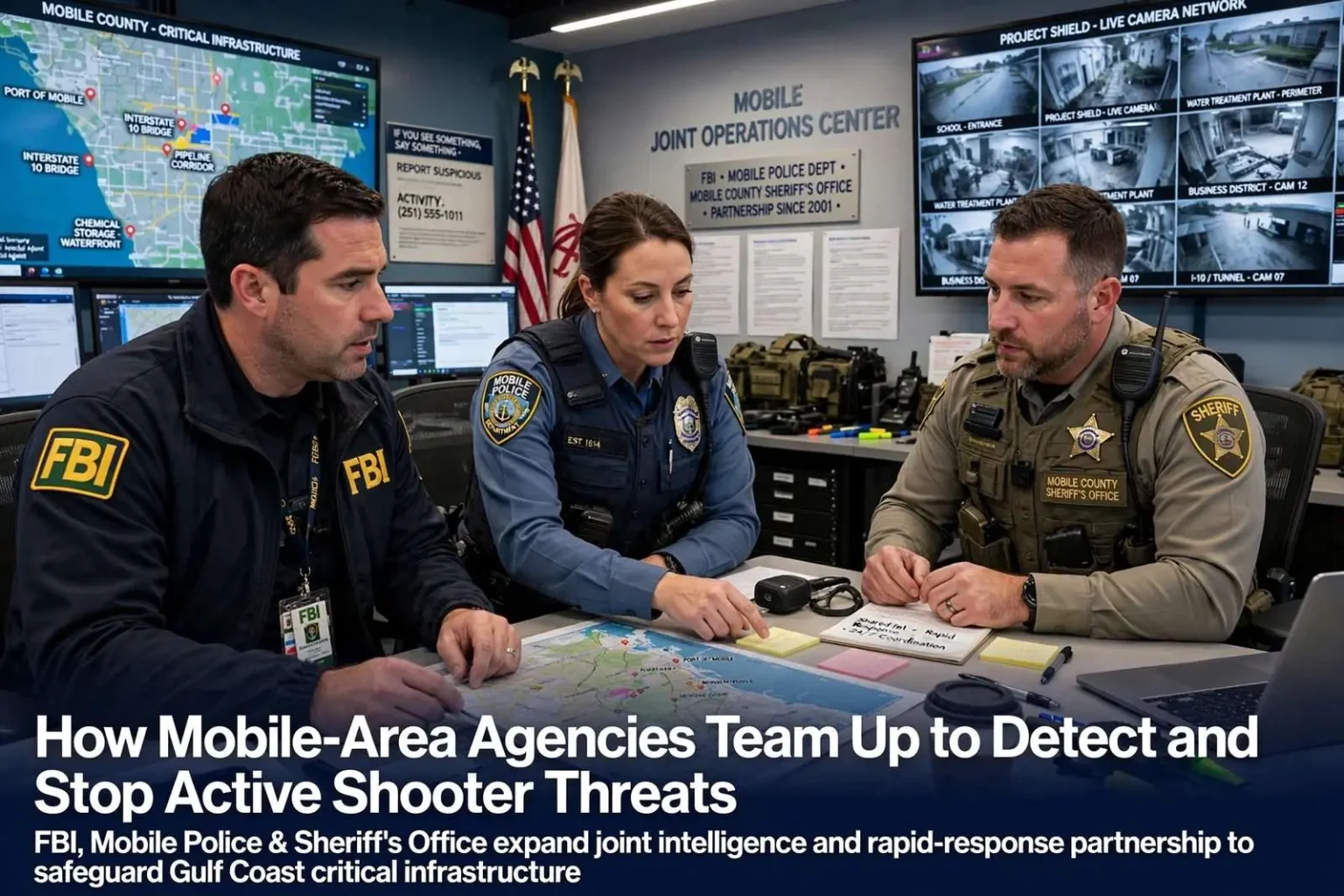
Federal, state and local law enforcement agencies in the Mobile area say close cooperation among their ranks has become one of the most important tools for preventing terrorism and stopping active shooter situations before they turn deadly. Officials describe a web of shared intelligence, joint training and rapid-response technology that links the FBI, the Mobile Police Department and the Mobile County Sheriff’s Office more tightly than at any point in recent memory.
That cooperation traces back in large part to the aftermath of the September 11, 2001 terrorist attacks, when federal authorities concluded that no single agency could adequately track and stop threats on its own. In the years since, agencies at every level of government have been required to share information more freely, both with one another and with those responsible for protecting critical infrastructure such as pipelines, water treatment plants, petrochemical storage sites, and academic and financial institutions.
Mobile’s position on the Gulf Coast makes the infrastructure list concrete rather than theoretical. The city’s port and its river terminals, the chemical and petroleum storage along the waterfront, the pipeline corridors crossing South Alabama, and the bridges and tunnels that carry Interstate 10 all fall into the category of facilities that federal guidance treats as potential targets, and all of them sit inside the patrol zones of the agencies that make up the local partnership.
The federal view
A supervisory special agent with the FBI’s Mobile field office said the partnership among local agencies is unusually strong, allowing investigators to piece together tips and observations from officers who are often the first to notice warning signs of a developing threat.
The FBI’s field office structure assigns each office a defined territory and a joint terrorism task force through which local detectives and deputies work alongside federal agents. The design assumes exactly what the Mobile officials describe: that a patrol officer who notices an unfamiliar vehicle photographing a pipeline gate, or a deputy who takes a domestic violence report that includes threats against a workplace, is producing intelligence that only becomes meaningful when it reaches someone who can see the larger pattern.
Federal officials say one of their biggest ongoing challenges is identifying so-called “lone wolf” attackers, who may be motivated by extremist ideology or by other personal grievances, and who often avoid detection by staying quiet during the planning stages of an attack.
The lone wolf problem reshaped prevention strategy nationwide. A plot involving several people produces communications, money movements and confidants — the trails intelligence services were built to follow. A single person who tells no one, plans in silence and chooses a target on short notice offers few of those openings, which is why the agencies’ answer leans heavily on the people closest to the attacker: family members, coworkers, classmates and the officers who encounter him for unrelated reasons in the months before an attack.
Inside the police department
At the Mobile Police Department, the cyber intelligence unit works to piece together publicly available digital information in hopes of spotting threats before they materialize, while also preparing the department to respond as quickly as possible if an attack does occur. Investigators say the goal is not constant surveillance of residents but a targeted effort focused on specific warning signs.
The distinction the unit draws — targeted collection against specific warning signs rather than blanket monitoring — reflects both policy limits and practical ones. Open-source investigation works through what people post and share publicly: the threat posted to a social media account, the rhetoric that draws a report from a worried acquaintance, the pattern that emerges when several unrelated reports point at the same name or address. No single post may justify action; the unit’s work is assembling them.
One tool the department has adopted is Project Shield, a public-private partnership that gives police remote access to more than 3,200 cameras installed at private businesses, schools and other locations across the greater Mobile area. Officials say the network can give officers responding to an active shooter situation critical, real-time information, such as which direction a suspect went inside a building, that could help save lives in the first chaotic minutes of an emergency.
The value of that access is measured in minutes. In an active shooter response, the first arriving officers traditionally know only what the 911 caller described; a camera feed from inside the building turns rumor into location, direction and description, and lets the response commander route officers to the right entrance while the incident is still unfolding. Project Shield’s participating businesses join voluntarily, connecting existing commercial systems to the police network rather than installing new surveillance.
The technology has changed considerably since federal requirements for information-sharing between agencies expanded in the years following the 2001 attacks, when the U.S. Secret Service was placed under the newly created Department of Homeland Security. Officials with years of experience in both federal and local law enforcement say the shift fundamentally altered how agencies communicate, pushing them toward far closer, ongoing coordination than existed beforehand.
The reorganization of federal law enforcement after 9/11 — the creation of the Department of Homeland Security and the folding of agencies such as the Secret Service, then responsible for protecting the president and investigating financial crimes, into its structure — symbolized a broader change: the assumption that state and local officers are partners in a national security mission, not merely beneficiaries of federal bulletins. Two decades on, that assumption has become routine practice in cities like Mobile.
The sheriff’s office builds its response
While Mobile police have leaned on intelligence-gathering and camera technology, the Mobile County Sheriff’s Office has built up its firepower and specialized training. The office has equipped each of its roughly 170 deputies with semi-automatic long guns and now regularly trains tactical teams for active shooter scenarios, whether tied to terrorism or to other acts of violence.
The equipment decision reflects the tactical lesson of modern active shooter response: the first officers on scene are expected to move toward the gunfire immediately rather than wait for a SWAT assembly, and a patrol rifle gives a deputy a fighting chance against a shooter armed with a long gun. Equipping every deputy — rather than a specialized subset — ensures that whoever arrives first, anywhere in the county’s more than 1,200 square miles, carries that capability.
The sheriff’s office has also begun offering active shooter training to local businesses and schools, an effort mirrored by other departments nationally as schools and workplaces look for ways to prepare employees and students to survive, escape, or, as a last resort, confront an armed attacker.
Deputies with specialized training reportedly tailor those sessions to the specific layout and needs of each business or campus, and the sheriff’s office has said it plans to expand the program with an online webinar series so more residents can access the training remotely.
Site-specific training is the practical core of the service. An evacuation plan that works in a single-story warehouse fails in a multi-floor office building; a school’s lockdown procedure depends on door hardware and classroom layout that only a walkthrough reveals. By tailoring sessions to each location, the deputies teach adults to make the decisions — escape route, shelter point, door barricade — before the emergency makes the decisions for them.
Tying it together
To tie these resources together, Mobile police headquarters houses a joint operations center where representatives from multiple agencies meet regularly and can share information in real time during an emergency, combining federal intelligence, county firepower and local surveillance capabilities into a single coordinated response.
The center is the physical expression of everything the partnership has built. Federal agents bring task force intelligence and national database access; city police bring the cyber unit’s open-source work and Project Shield’s camera feeds; the sheriff’s office brings trained, long-gun-equipped deputies across the county’s unincorporated areas and small towns. In an emergency, those streams converge in one room, where representatives already know each other from months of standing meetings — a small detail that determines how quickly a multi-agency response coheres.
Despite the expanded cooperation and technology, officials stress that residents themselves play an essential role in prevention. Law enforcement leaders continue to encourage the public to report suspicious activity, echoing the well-known guidance: if you see something, say something.
The encouragement to report rests on a pattern investigators see repeatedly: someone outside the agencies noticed something first. A neighbor who saw weapons being stockpiled, a coworker who heard a grievance turn into a threat, a clerk who noticed someone filming a building’s security cameras — each of those reports is the raw material the joint structure exists to process. Officials’ message is that the web of cooperation works best when the public feeds it, and that a call about something that turns out to be nothing costs far less than a threat no one reported.