
Hurray for the Riff Raff Plays Catt’s Avalon 360 in Mobile on Nov. 14 (2012)
Hurray for the Riff Raff brought its Acoustic Tour of Southern Listening Rooms to Mobile on Wednesday, November 14, 2012, with a stop at Catt's Avalon...
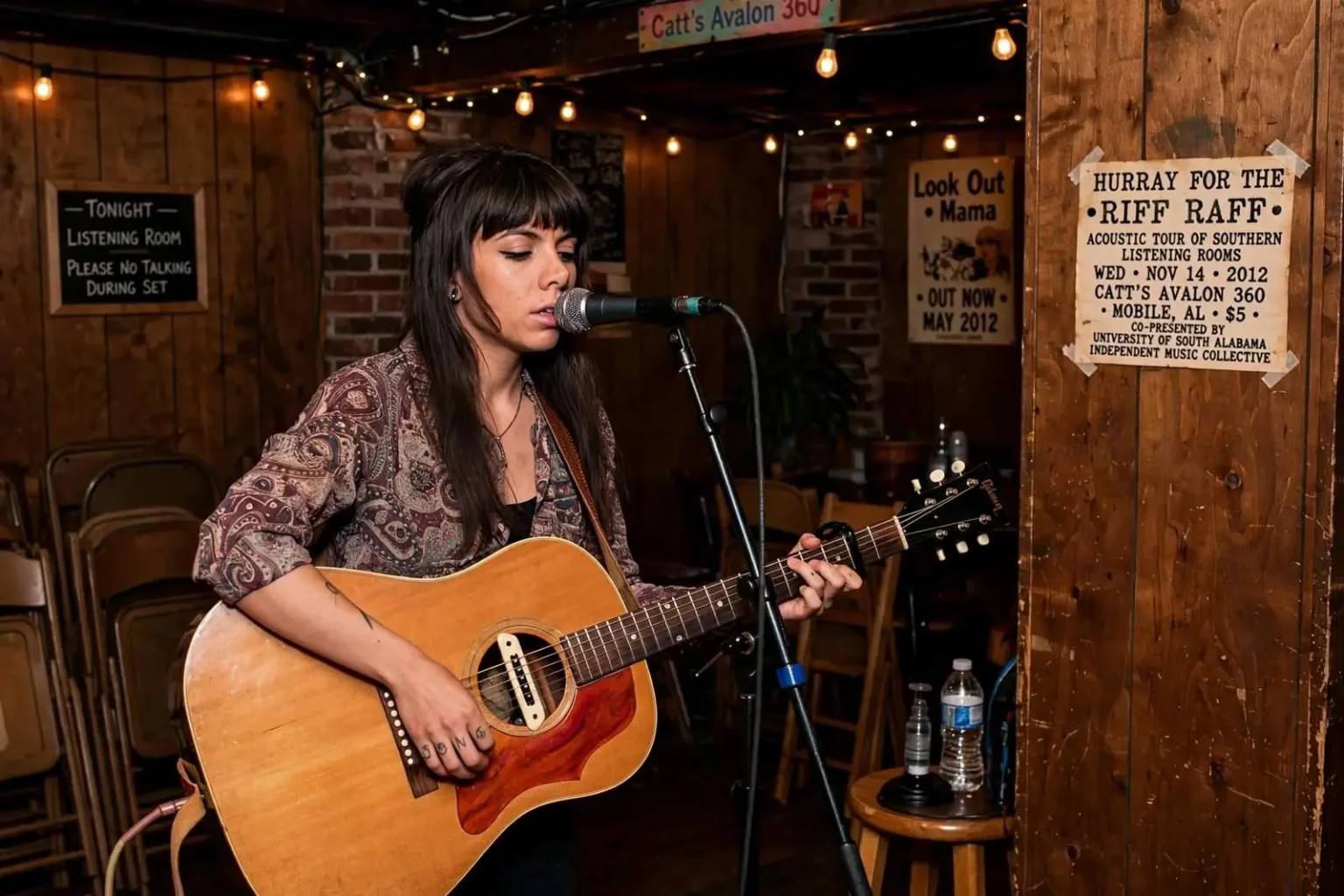
Hurray for the Riff Raff brought its Acoustic Tour of Southern Listening Rooms to Mobile on Wednesday, November 14, 2012, with a stop at Catt’s Avalon 360. Fresh off a two-month European tour, the band led by Alynda Lee Segarra framed the run as a quiet, acoustic counterpart to loud club dates, shows where the music itself was the focus. The tour supported the group’s third LP, Look Out Mama, released in May 2012 to wide praise from No Depression, NPR and UK outlets including Mojo and Uncut. The Mobile date, co-presented by the University of South Alabama’s Independent Music Collective, offered tickets for $5, a chance to hear the band in an intimate new venue.
The stop was a small landmark for Mobile’s independent music scene, bringing a nationally reviewed act to a room built for listening rather than drinking, at a student-friendly price that made the show accessible to anyone curious enough to come.
The Band on the Rise
Hurray for the Riff Raff occupied a distinctive place in the New Orleans music world by 2012. The band grew around the songs and voice of Alynda Lee Segarra, who had arrived in New Orleans as a teenager, riding freight trains and busking before forming the group and giving it a name meant to reclaim the label often slapped on outsiders. Over several years of relentless touring and self-released records, the band built a following in the roots and folk world, blending old-time banjo and guitar music with Latin rhythms, political conviction, and a songwriter’s eye for characters living at the margins.
Look Out Mama, the group’s third LP, marked the moment the wider music press caught up with what audiences in New Orleans clubs already knew. Released in May 2012, the album drew wide praise from No Depression, the long-running Americana magazine, and from NPR, and it crossed the Atlantic to favorable notices in the UK from Mojo and Uncut, the magazines that keep close watch on American roots music. For a band that had started with self-recorded releases, the review attention translated into bigger stages, festival slots, and, on this tour, audiences arriving already familiar with the songs.
The two-month European tour that preceded the Southern swing demonstrated how far the band’s reach had extended. European audiences have long embraced American roots music, and an overseas run of that length is both a financial anchor and a trial by fire for a band’s material. Coming home to play the American South acoustically gave Segarra and the band a different kind of test: stripping the songs down to voice and strings in rooms where there is nowhere to hide.
The Southern Listening Rooms Concept
The Acoustic Tour of Southern Listening Rooms was built on an idea that has shaped folk music for generations: some songs are best heard in a quiet room. Listening rooms are venues designed around attention rather than volume, where the audience sits close to the performer and conversation during songs is treated as a breach of the evening’s contract. The format favors songwriters, and it suited a band whose repertoire drew as much from Woody Guthrie and Appalachian balladry as from New Orleans second-line energy.
For the band, the acoustic format reframed the Look Out Mama material. Songs that carried full-band arrangements on the record were rearranged for the stripped-down setting, letting the lyrics and melodies stand alone. For audiences, the promise was a different experience from a loud club date: the chance to hear the words, the banjo, and the spaces between notes in a room where everyone had come to do exactly that.
The Southern routing mattered as well. Touring bands running between New Orleans, Atlanta, and Texas often pass through Mobile without stopping, treating the Gulf Coast as distance to cover rather than an audience to play for. A deliberate swing through Southern listening rooms gave cities like Mobile a night that the interstate tours skip, and it matched the band’s identity as a regional act with national reach.
Catt’s Avalon 360 and the Independent Music Collective
Catt’s Avalon 360 was positioned as an intimate new venue, and its booking of Hurray for the Riff Raff signaled the kind of programming the room intended to present. Mobile’s music venues historically clustered around downtown and the midtown corridors, ranging from clubs that book regional rock and blues to bars that host anything that draws. A room dedicated to listening, with sightlines and acoustics designed for a seated or attentive audience, added a piece the city lacked, giving touring folk and Americana acts a reason to include Mobile on Southern routes.
The University of South Alabama’s Independent Music Collective provided the co-presentation that made the date possible. Student-run music organizations play a quiet but essential role in college towns and cities with universities: they pool modest budgets, handle promotion through campus channels and social media, and take chances on acts whose appeal is artistic rather than commercial. The collective’s involvement explained the $5 ticket, a price that reflected student-run economics rather than the market, and it connected the touring act to an audience of students and young residents who might not otherwise hear about a folk show at a new venue.
The arrangement benefited everyone involved. The band got a paid date with an engaged audience between bigger markets. The venue built its reputation with a nationally reviewed act at low risk. The university organization delivered a notable show to its community, and Mobile audiences got a world-class songwriter for the price of a sandwich. This is how scenes grow, not through single blockbuster concerts but through the accumulation of evenings like this one.
The Music of Look Out Mama
The album at the heart of the tour showcased the band’s range. Look Out Mama moved between New Orleans rhythms, old-time folk arrangements, and ballads, with Segarra’s voice carrying the through line. Critics highlighted the songwriting, the ability to move from a rollicking band number to a quiet lament without losing the album’s coherence. For listeners encountering the band through the record’s reviews in No Depression, NPR, Mojo, and Uncut, the listening-room tour offered the songs in their most elemental form, close to how they were written.
Segarra’s background gave the material its distinctive texture. Raised in the Bronx with Puerto Rican roots, and formed as an artist in New Orleans, Segarra wrote from a perspective that mixed uptown city streets with Gulf Coast traditions, and that blend ran through the band’s identity. Audiences at Catt’s Avalon 360 were hearing not just a folk act but an artist whose route to New Orleans roots music ran through New York, freight trains, and a deliberate choice to build a life in the city’s music community.
By late 2012, the trajectory that would carry the band to wider national attention was already visible in reviews and touring patterns, but on the night of November 14, the setting was deliberately small. That smallness was the point of the tour, and Mobile listeners had front-row access to it.
Why Nights Like This Matter
For local audiences, the show was an inexpensive chance to see a band at the stage where attendance still feels personal, before venues get bigger and tickets get expensive. For the city’s scene, the collaboration between a new venue and a university music collective modeled the partnership that sustains original music outside major markets: shared risk, modest budgets, and audiences willing to take a chance on a name they may not know.
The date also stitched Mobile into the band’s story. Every act that becomes a major name passes through hundreds of small rooms in mid-sized cities, and the memory of those nights shapes the relationship between artist and region. A Wednesday night in November, five dollars at the door, and a quiet room full of attentive listeners was what the Acoustic Tour of Southern Listening Rooms promised, and what Mobile got.
Looking back at the booking, the value of the evening becomes clearer. Hurray for the Riff Raff would go on to wider acclaim, with later records drawing national attention and the band’s songs becoming part of broader conversations about American folk music and its politics. The 2012 listening-room tour, supporting Look Out Mama with its press praise from No Depression, NPR, Mojo, and Uncut still fresh, sits at the hinge of that story, the moment when a New Orleans band with three records and a growing reputation crossed the South in its most stripped-down form.
For the University of South Alabama’s Independent Music Collective, the co-presentation was the kind of booking that defines a student organization’s purpose: connecting the campus and city to artists on the way up, at a price that assumes curiosity rather than means. For Catt’s Avalon 360, it was an early statement of identity for an intimate new venue. And for Mobile audiences, the November 14 show was the rare combination of a nationally reviewed act, an acoustic setting built for listening, and a five-dollar ticket, all on a Wednesday night in a city that touring routes too often pass by.