Inaugural Crawfish Boil Benefit for Leukemia and Lymphoma Society Draws Top Musicians to Downtown Mobile
An inaugural crawfish boil benefit for the Leukemia and Lymphoma Society at Moe's Original Bar B Que in downtown Mobile featured Anders Osborne, Papa Mali.
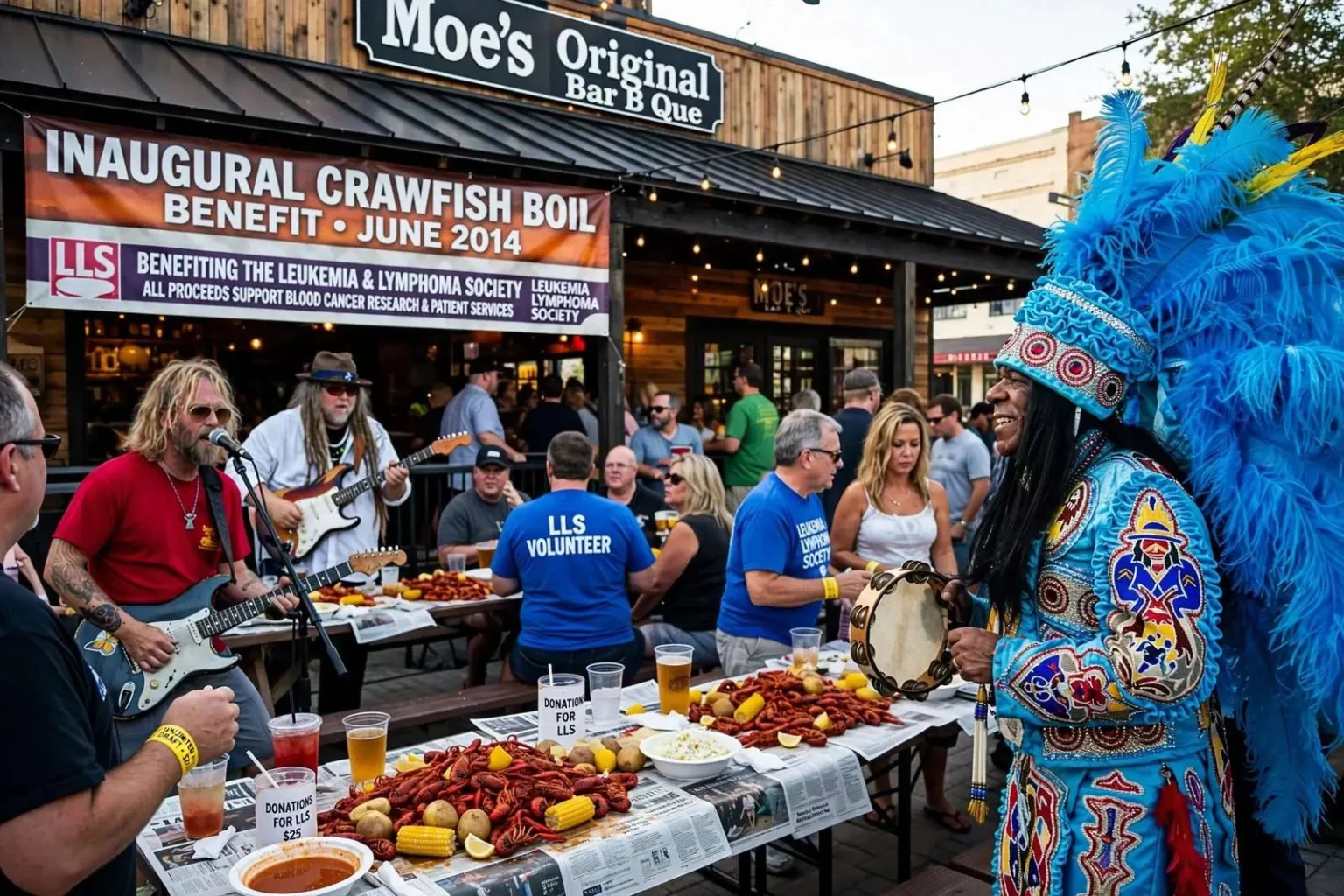
Downtown Mobile’s Moe’s Original Bar B Que played host to an inaugural crawfish boil benefit for the Leukemia and Lymphoma Society in June 2014, combining Gulf Coast culinary tradition with a lineup of nationally recognized musicians in support of the nonprofit organization’s mission to fund blood cancer research and patient services. All proceeds from ticket sales were directed to the Leukemia and Lymphoma Society, making the afternoon event both a celebration of community and a meaningful fundraising effort.
The setting suited the cause. Moe’s Original Bar B Que, on the edge of downtown Mobile, had become a regular stop for touring roots and jam bands passing through the Gulf Coast, and its patio-and-smokehouse format lent itself to a long, casual afternoon of music. Pairing a crawfish boil — a staple of Gulf Coast social life — with a fundraiser gave attendees something to eat, something to drink and something to dance to, all in the name of charity.
The Leukemia and Lymphoma Society has spent decades funding research into blood cancers, including leukemia, lymphoma and myeloma, while also providing patient services and family support programs. Benefits like the Mobile crawfish boil channel local fundraising toward that national mission, and the event’s organizers framed the afternoon as a way for the city’s music community to contribute.
A Lineup of Gulf Coast and New Orleans Talent
The benefit assembled an impressive roster of musicians with deep roots in Southern and Gulf Coast music traditions. Anders Osborne, the acclaimed singer-songwriter known for his collaborations with Phil Lesh and Friends, headlined the event. Osborne has built a reputation as one of the most respected performers on the festival circuit, blending rock, blues, and roots influences.
Papa Mali, the Shreveport, Louisiana-born guitarist known for his distinctive brand of swamp music, also performed. A fixture on the festival scene, Papa Mali has collaborated with artists across multiple genres, including work with the group 7 Walkers alongside Grateful Dead drummer Bill Kreutzmann.
Chief Monk Boudreaux and the Mardi Gras Indians brought their signature spectacle to the stage, performing in elaborate handmade suits adorned with feathers and beads — costumes that can weigh up to 150 pounds. The Mardi Gras Indian tradition, rooted in New Orleans neighborhoods, is famous for its hand-sewn regalia and its call-and-response chant style, and Boudreaux is one of its best-known figures.
Robert Mercurio, the bassist from New Orleans jazz-funk band Galactic, rounded out the bill, adding another layer of talent to an afternoon that encouraged spontaneous collaboration among the artists. With players drawn from the New Orleans scene and the broader festival circuit, the lineup practically guaranteed that musicians would wander onto the stage during one another’s sets.
That spirit of sitting in is part of what distinguishes benefit shows from ordinary concerts. Because the performers share stages during festival season and often live within driving distance of one another, the crawfish boil functioned less like a ticketed show with rigid set times and more like an extended musical gathering with a purpose attached.
Food, Music, and a Cause Worth Supporting
The event offered attendees a full afternoon of food, beverages, and live entertainment, with doors opening at 3 p.m. and performances beginning around 4 p.m. The crawfish boil format — a staple of Gulf Coast social life — provided a fitting backdrop for bringing the community together around a shared cause.
The $25 unlimited-draft-beer wristbands proved popular, and demand for barbecue was so heavy that Moe’s Original Bar B Que sold out of meat before the night ended. For a benefit, those were good problems to have: long lines at the serving window meant more money raised and a fuller house in front of the stage.
Crawfish boils occupy a particular place on the Gulf Coast calendar. The gatherings are built around a communal pot — crawfish, corn, potatoes and seasoning dumped across a long table — and they reward lingering. Organizers leaned into that rhythm, scheduling an afternoon of rolling performances rather than a single headliner slot.
Organizers expressed hope that the benefit could become an annual tradition in downtown Mobile, building on the city’s growing reputation as a destination for live music and community-driven events. Mobile’s downtown venues and festivals had spent years drawing touring acts across the bay line and along the Gulf Coast corridor, and a charity show of this scale fit squarely within that momentum.
The choice of beneficiary also connected the event to a wider cause. Blood cancers affect thousands of new patients each year, and the Leukemia and Lymphoma Society’s fundraising model supports both laboratory research and the practical needs of patients and families in treatment. Attendees buying tickets, wristbands and barbecue knew their money was headed toward that work.
Super Jam Caps a Night of Collaboration
The evening stretched to nearly eight hours of continuous music, with artists frequently sitting in on one another’s sets. A late-night super jam brought Johnny Sansone, Papa Mali, Terrence Higgins, longtime James Brown drummer Jabo Starks, Chris Speeds, and Ben Jernigan onto the stage together, and Big Chief Monk Boudreaux appeared mid-set flanked by his Mardi Gras Indians in full regalia.
The presence of Jabo Starks gave the super jam a link to soul music history. As a longtime drummer for James Brown, Starks helped define the tight, punchy groove that shaped funk and rhythm-and-blues for decades, and his appearance alongside younger Gulf Coast players made the jam a passing of the torch as much as a party piece.
Terrence Higgins, the drummer known for his work with New Orleans acts, and Johnny Sansone, the harmonica player and singer rooted in the Crescent City blues scene, added further depth to a stage already crowded with talent. Chris Speeds and Ben Jernigan rounded out the grouping as the night wore on.
Headliner Anders Osborne closed things out with a set mixing originals and covers, including a soulful take on the Grateful Dead’s “Sugaree” that drew cheers from Deadheads in the crowd, with guests adding guitar and harmonica throughout. The choice of a Dead cover nodded to the jam-band audience that follows Osborne and Papa Mali across the festival circuit.
By the time the last notes sounded, the inaugural benefit had delivered what its organizers had hoped for: a full day of Gulf Coast food, New Orleans-inflected music and collaboration, with ticket proceeds on their way to the fight against blood cancer. Whether the crawfish boil would return the following June remained to be seen, but the first edition had set a high bar.
The Mardi Gras Indian Tradition on a Mobile Stage
The appearance of Chief Monk Boudreaux and his Mardi Gras Indians gave Mobile audiences a close look at a tradition usually experienced only in New Orleans. The suits worn by the Indians are sewn by hand over the course of a year, with feathers, beads and sequins layered into designs that often depict battle scenes from the tradition’s lore. Each new year brings a new suit, and the old one is retired after its season in the streets and on the stage.
The regalia is as heavy as it is elaborate, sometimes tipping the scales at 150 pounds, which makes the performers’ dancing and chanting while wearing it all the more remarkable. Performances pair the visual display with call-and-response singing and hand percussion, drawing on songs passed down through generations of New Orleans neighborhoods.
Bringing that spectacle to a downtown Mobile patio underscored how much musical traffic runs between the two cities. Mobile’s own Carnival tradition predates New Orleans’, and the two ports have traded musicians, foodways and festival customs for more than a century. A benefit lineup blending a New Orleans jazz-funk bassist, a Louisiana swamp-blues guitarist and a Mardi Gras Indian chief fit the regional DNA of the Gulf Coast as neatly as the crawfish on the table.
Why the Cause Resonated Locally
Blood cancer fundraising has a way of reaching into every community, and Mobile was no exception. The Leukemia and Lymphoma Society’s patient services include support for families navigating treatment, and its research funding has contributed to therapies that changed survival rates for blood cancers over the decades. Attendees at the crawfish boil did not need a personal connection to understand the stakes, but many had one.
Benefit concerts of this kind also rely on donated labor and goodwill across the music business. Musicians play at reduced or donated fees, venues absorb the cost of hosting, and volunteers handle everything from ticket tables to crawfish service. That pooling of effort is part of why ticket proceeds could flow almost entirely to the charity.
The June timing placed the event in a quiet stretch of the regional music calendar, between the spring festival season and the fall touring rush. For Mobile music fans, the show filled a weekend slot with an unusually deep bill; for the musicians, it offered a chance to gather, trade solos and support a cause while the summer circuit was still warming up.
By night’s end the measure of the event was easy to read. Nearly eight hours of music had passed, the barbecue was gone, the wristband crowd had gotten its money’s worth, and the Leukemia and Lymphoma Society had a new outpost of support on the Alabama Gulf Coast. If the crawfish boil did return the next summer, it would carry forward an inaugural edition that had already proven the concept.