
Interview: Black Irish Texas on Irish Punk, Touring and Supporting Local Venues
An interview with Black Irish Texas guitarist James Fitzsimmons on Irish punk, touring and why local venues and audiences matter.
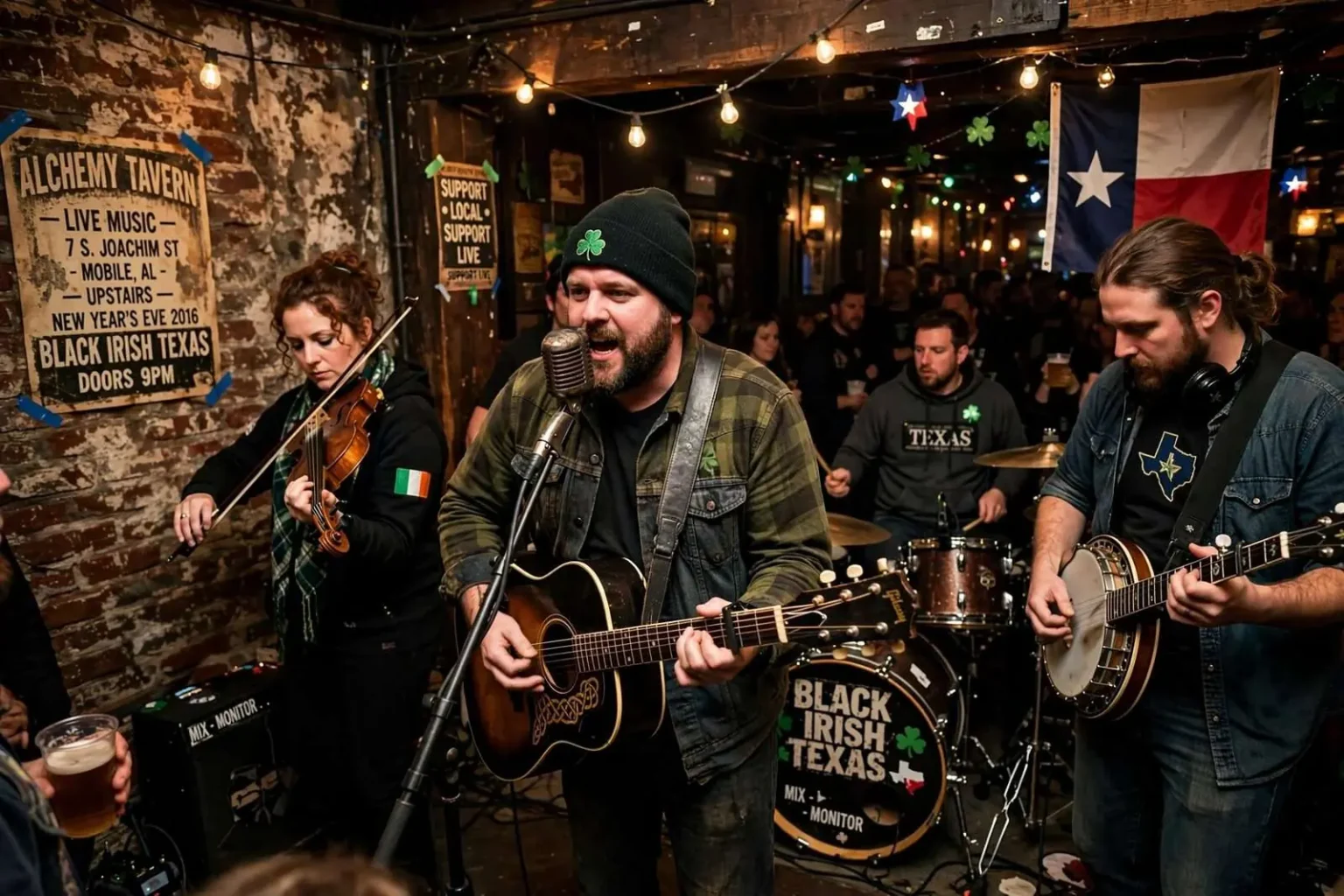
When Mobilians flocked downtown to celebrate New Year’s 2016, one of the most popular stops was Alchemy Tavern at 7 S. Joachim St. Local musician Gregg Fells handled the downstairs stage while Black Irish Texas rang in the new year with a packed house upstairs. Guitarist and vocalist James Fitzsimmons spoke about the challenges and rewards of life as an up-and-coming band.
The venue on Joachim Street sits a block off Dauphin Street in the heart of Mobile’s downtown entertainment district, a stretch of historic buildings that fills with revelers on New Year’s Eve as the city counts down to its famous midnight moon pie drop. For a touring band, a New Year’s booking on that block is about as good as a December gig gets, and the upstairs room at Alchemy has long been a proving ground for national acts passing through the Gulf Coast.
Black Irish Texas arrived at the night with a reputation built the hard way — years of road miles, a distinctive sound and a willingness to play anywhere that would have them. The band’s name captures its identity: Irish roots, Texas address, and a sound that refuses to sit still between the two.
A Sound All Their Own
“I grew up on Irish music my whole life. One day in Texas we switched it up and it felt right,” Fitzsimmons said. Black Irish Texas blends traditional Irish instrumentation and themes with punk rock and other genres, landing opening slots for acts such as Dropkick Murphys and Flogging Molly while resisting easy categorization.
The hybrid the band plays has a storied lineage. The Pogues famously fused Irish folk with London punk in the 1980s, and in the decades since, Dropkick Murphys in Boston and Flogging Molly in Los Angeles built stadium-sized careers on the same idea — fiddles, tin whistles and mandolins driving through distorted guitars and a full drum kit. Sharing stages with two of the genre’s biggest names is both a career milestone and a statement of where the band believes it belongs.
Making the fusion work is a technical challenge as much as a musical one. Amplifying banjo and fiddle loudly enough to keep up with a full rock drummer took trial and error. “The instruments may not be meant to be with each other in the first place, but we try hard to make it work,” he explained.
Acoustic instruments designed for parlors and pub sessions were never engineered to cut through amplifiers, and countless folk-punk bands have wrestled with the same problem. Solutions typically involve pickups, microphones and endless adjustments to monitor mixes, and the band’s persistence in solving them shows in a live set that keeps its traditional textures intact at punk volume.
Building an Audience City by City
The hardworking band has toured the United States repeatedly, building repeat fans one stop at a time. “This band has relentlessly put in hours on the road and stuck with each other in small quarters,” Fitzsimmons said. “You gotta find your grassrooting in small battles and hard work.”
That ethic describes how most independent bands survive. Without label money or radio play, touring acts grow by returning to the same cities, playing the same rooms, and converting first-time listeners into regulars who bring friends the next time through. Van tours mean long drives, small guarantees, and band members packed together for weeks — an arrangement that has ended many groups before their sound matured. Fitzsimmons credits the band’s togetherness as much as its musicianship for getting past those early years.
That persistence fueled tours and a tradition of playing South by Southwest on St. Patrick’s Day. The Austin festival each March draws thousands of acts and industry watchers to Texas, and for a band with an Irish-punk identity, a St. Patrick’s Day slot is a natural fit — the biggest audience of the year for the music it was built to play, in the city where the band’s members eventually settled.
The band was working on a Spring 2016 album with Kurtis Machler of Million Dollar Sound in Austin, Texas, presenting a more diverse sound than its roots. Recording in Austin placed the band in one of the country’s most active studio markets, and working with a producer from outside the band gave the sessions an outside ear at a moment when the group wanted to stretch beyond its established formula.
On Supporting Local Music
On supporting local music, Fitzsimmons was direct: “It is very important to support people on a local level. If you are not supporting bands you appreciate, you will not have many stand outs.”
The argument is a familiar one to venue owners and musicians in Mobile and cities like it. Local scenes only produce touring-caliber acts when audiences show up for the early bills, buy the merchandise and keep the rooms that host them in business. Every nationally known band started as an opener playing to a handful of people, and the health of a city’s music economy — stages, sound engineers, promoters, fans — determines whether its best players stay home or leave to find an audience elsewhere.
Mobile’s Stage and the Band’s Road Ahead
For Mobile audiences, the New Year’s show offered a close look at a band that has spent years refining its craft on other cities’ stages. Alchemy Tavern has built its booking reputation on exactly that kind of act — regional and national touring bands one album away from bigger rooms — and its upstairs stage has hosted them in a setting intimate enough that the distinction between performer and crowd mostly disappears.
The downtown setting added to the night. New Year’s in Mobile belongs to the whole city center, from the moon pie drop on Dauphin Street to the clubs and bars that keep the doors open until well past midnight. Bands playing that night compete with street parties, fireworks and a dozen other stages, which makes a packed upstairs room its own kind of endorsement. The crowd that chooses to spend the hours inside a venue is the crowd that came for the band.
The band’s approach to its craft has remained consistent even as its sound widens. Fitzsimmons frames the group’s work in craftsman’s terms — hours on the road, small battles, hard work — rather than in the language of breakthrough or luck. That mindset, more than any single release or slot, is what separates the bands that endure from the ones that dissolve when the touring gets hard.
What Comes Next
With the spring album in production and a fan base that has grown stop by stop, the band entered the new year in the position it has worked hardest to reach: a place on stages like Alchemy’s, a sound audiences recognize from the first bar, and a schedule that keeps the wheels turning. For a group that measures itself in small battles won, the new year’s first one — holding a packed downtown room on the biggest party night of the year — was already in the books.
Local music supporters who caught the band that night saw the textbook version of the scene Fitzsimmons described: a touring act with roots in another state, an audience gathered in a historic downtown room, and a local musician on the downstairs stage — the kind of ecosystem that only stays healthy when people keep showing up for it.
The Road Behind Them
None of the band’s milestones arrived quickly. Opening slots for nationally touring acts are earned through relationships built over repeated tours, shared stages and professionalism night after night. Promoters remember bands that draw, deliver and are easy to work with, and those bands move up the bill over time. Black Irish Texas’s path through venues across the country followed that slower route — no single viral moment, just a sound distinctive enough that audiences remembered it and bookers kept calling.
Life on the road also shapes what a band writes and how it plays. Songs get tightened by repetition in front of strangers, arrangements get trimmed until only what works survives, and the set list becomes a live document refined city by city. By the time the band walked into an Austin studio, its material had already been stress-tested for months in rooms exactly like Alchemy’s — a process that tends to make for leaner records than bands that write and record without touring first.
The genre the band works in rewards that kind of endurance. Irish punk crowds expect energy, singalongs and a sense of occasion, and the bands that last in the scene are the ones that can deliver a full-throated show on a Tuesday in a half-full room as convincingly as on a holiday weekend. Fitzsimmons’s description of the band’s philosophy — grassrooting, small battles — is effectively the job description for surviving in that world.
For the Mobilians who spent New Year’s Eve upstairs on Joachim Street, the night delivered what the band’s growing following has come to expect: traditional instruments at full volume, a catalog that bridges two musical continents, and a group that plays like it has somewhere bigger to be. Whether the spring record pushes the band into larger rooms or not, the formula it has followed — relentless touring, mutual support, and local audiences willing to show up — remains the one that got it this far.