
Interview: Chronic Blues on Two Decades in the Mobile Music Scene
An interview with Mobile band Chronic Blues on two decades in the local scene, Alchemy Tavern and playing aboard the USS Bataan.
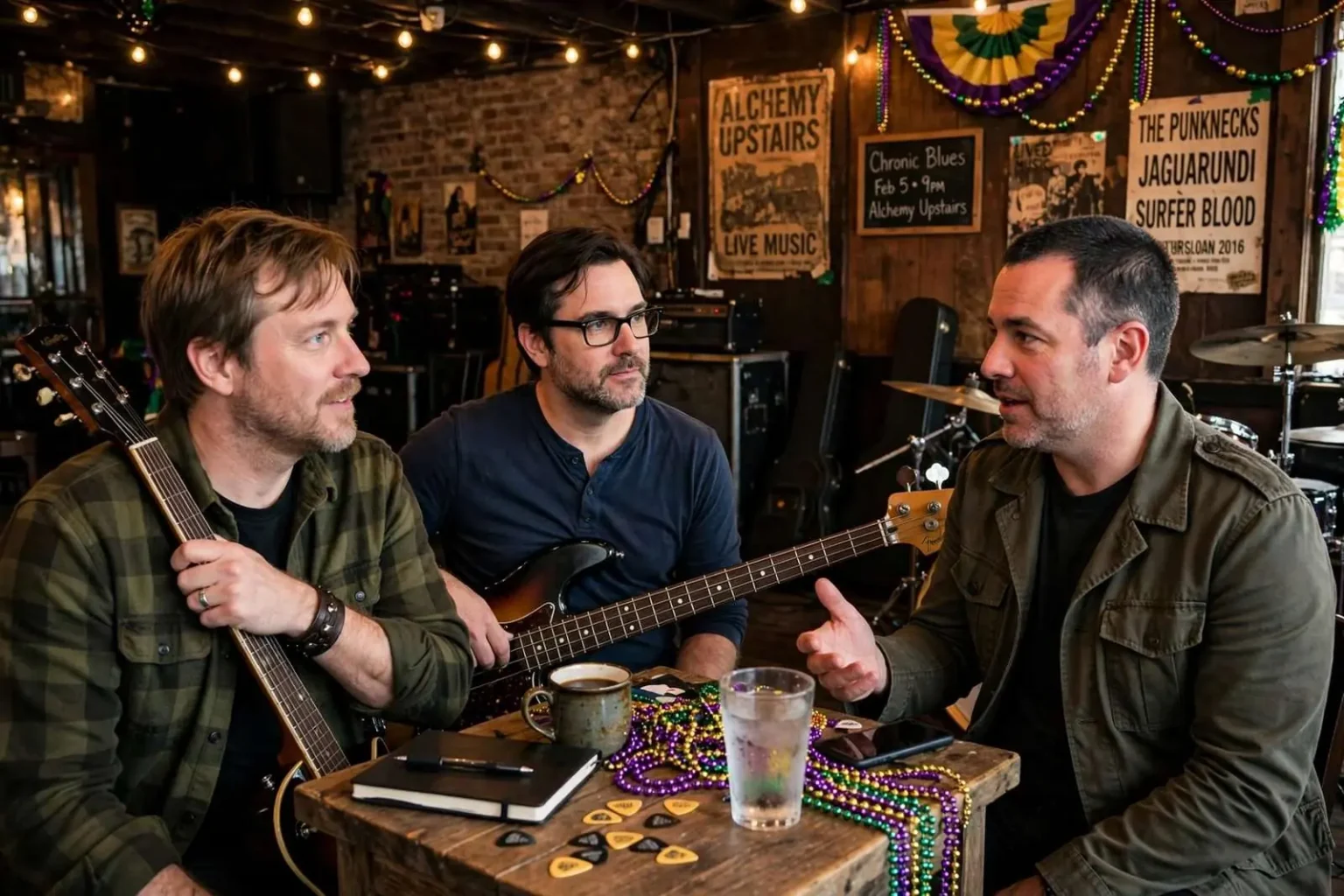
During Mardi Gras 2016, the Mobile music scene offered visitors and locals alike an unusually rich stretch of live shows, with national and regional acts playing alongside the homegrown bands that keep the city’s stages busy the rest of the year. Among the touring names in town that season were The Punknecks, Jaguarundi and Surfer Blood, but one of the standout performances came from a local band with two decades of shared history: Chronic Blues, which played Alchemy’s Upstairs stage on Feb. 5.
Guitarist and vocalist David Frost, bassist Daniel Dees and drummer-vocalist Randy Howe sat down to talk about their place in the area scene, a career of fits and starts, and why the band has never quite gone away. What emerged was a portrait of a group that treats longevity as a friendship first and a band second, and that has found its audience grows even in the years when it barely plays.
Brothers in Music
The band’s origin story begins in college. “We started back in 2000 when we were all in college,” Frost said. The trio came together as students, playing the kind of rock and roll that fills campus bars and small stages, and for the better part of a decade Chronic Blues was a regular presence around Mobile, building a following show by show.
The first interruption came in 2008, when life pulled the members in different directions. Frost moved to Texas, and Howe went active duty in the Navy, leaving the band without a drummer and its front line scattered across state lines. Rather than let the group dissolve, the three made an agreement that has defined the band ever since. “We made a pact when we dispersed to remain really good friends and always make the effort to come together every year for a couple of shows in Mobile,” Frost said.
That pact has held through deployments, moves, and everything else the years brought. Each winter the band reconvenes, rehearses, and plays a short run of hometown dates, and each winter the crowds have grown rather than shrunk. Despite playing far fewer shows than a typical working band, Chronic Blues kept gaining fans, a phenomenon Frost attributes to a simple principle. “Quality over quantity,” he said. A band that only appears once or twice a year, the thinking goes, has to make every appearance count, and the scarcity itself becomes part of the draw.
The arrangement mirrors a pattern familiar across the Gulf Coast, where military service and economic migration regularly scatter working musicians and then bring them home for holidays and Mardi Gras. Mobile’s calendar, with its dense cluster of events and parties during carnival season, gives returning players a natural window to reunite, and Chronic Blues has turned that window into an annual institution.
Why Local Venues Matter
When the conversation turned to the health of the local scene, Frost offered a comparison between a music venue and someone’s chosen career, arguing that the two deserve the same loyalty. “When you are a patron to these places you are contributing to their livelihood,” he said. The point, he explained, is that clubs like Alchemy exist only as long as customers keep walking through the door, and every ticket and tab is a direct investment in whether original music continues to have a home in the city.
Frost credited Alchemy’s owner for making the venue special, singling out the care that goes into booking and running a room that supports live acts year-round. Rooms like Alchemy’s Upstairs stage occupy a particular niche in Mobile’s entertainment landscape: small enough for a band to reach the audience directly, established enough to draw dedicated music fans, and committed enough to original rock that bands like Chronic Blues can play material rather than only crowd requests.
For Frost, the mission of that kind of room and that kind of band come down to one sentence. “Good rock and roll is art to which people can dance,” he said. The formulation captures the band’s outlook: songs can be crafted and serious, but a show succeeds when the floor moves. It is a philosophy well suited to a city that measures its entertainment in dance floors and parade steps, and it explains why the band has never chased trends away from the straightforward, danceable rock it has played since 2000.
The Reward of Live Performance
Asked what keeps the three of them coming back, Frost described live performance as a conversation without words — the nonstop exchange between drummer, bassist and guitarist, and between the band and the crowd, that no rehearsal or recording can replicate. After decades of playing together, the members of Chronic Blues read each other instinctively, and Frost said they play for two people the same way they would for 2,000. Whether the room is half empty on a cold February week or packed during carnival season, the performance gets the full effort.
That approach has produced some unlikely stages. The band’s most memorable show came around 2010, when Chronic Blues performed aboard the USS Bataan in the Atlantic, playing for servicemembers returning from an 11-month Mediterranean deployment. The stage was built from bomb carts, the Navy’s flat ordnance-handling equipment repurposed as a riser for the band. Playing rock and roll on the flight deck of an amphibious assault ship, for sailors and Marines who had been at sea for the better part of a year, gave the band a perspective on its own work that no bar gig could match.
The connection between the band and the military runs through Howe, whose active duty service was one of the reasons the group stepped back in 2008. The Bataan show put the band on the other side of that equation, performing for a deployed command, and it remains the benchmark the members measure other gigs against when they talk about why the annual reunion is worth the effort.
Chronic Blues in the Mobile Scene
The Feb. 5 show at Alchemy placed Chronic Blues alongside the visiting acts that came through town for Mardi Gras 2016. The Punknecks, Jaguarundi and Surfer Blood each brought their own followings to Mobile that season, but the local trio occupies a distinct slot: a band that audience members have watched grow up with, that knows the regulars by name, and that returns each year to a room it helped fill in college. That history is part of the act, and the Feb. 5 set doubled as a reunion for fans who have followed the group since its early days.
Mobile’s scene rewards that kind of persistence. The city’s calendar is anchored by carnival season, but clubs like Alchemy book live music all year, and the bands that survive are the ones willing to treat a slow winter Tuesday with the same seriousness as a festival weekend. Chronic Blues’ model — a tight annual run of high-energy shows rather than a grinding tour schedule — has proven durable enough to carry the band past its second decade while the members pursue careers and family life around the music.
Two Decades In
Looking back across the band’s history, Frost’s answers kept returning to the same themes: the pact, the friendship, and the decision that playing less does not mean playing worse. Many college bands from the early 2000s dissolved the first time a member moved away, and the ones that endure usually do so because the personal relationship outlasts the professional one. Chronic Blues made that priority explicit from the start, and the yearly Mobile shows are the visible result.
The band’s endurance also reflects the specific chemistry of its three members. Frost’s guitar and vocals, Dees’ bass lines, and Howe’s drumming and singing give the group a full, self-contained sound that works on a small stage without additional players, and the shared history lets the trio improvise in ways newer bands cannot. In a scene where lineups shift constantly, the same three musicians playing together for more than fifteen years is itself a statement.
For the audiences who filled Alchemy’s Upstairs stage on Feb. 5, the formula remains simple: a hometown band that shows up once a year, plays like the room is full, and treats every set as its most important one. Twenty years after three college students started the band, the conversation continues, without words, every time they plug in.
The formula that has kept Chronic Blues alive also explains why its reunion shows carry weight beyond the band itself. Regulars who attend every February know they are part of a continuing story, and newer fans discover a group that plays with the confidence of musicians who have shared a stage for more than fifteen years. In that sense, the band functions as a bridge between generations of the Mobile scene, connecting the college bar circuit of the early 2000s to the venues and audiences of today.
Alchemy’s role in that story is difficult to overstate. The venue’s Upstairs stage has been a proving ground for original bands across the city, and Frost’s point about patronage cuts both ways: bands that commit to a room help the room survive, and a surviving room gives the next generation of players somewhere to develop. Chronic Blues’ decision to schedule its annual reunion shows in Mobile rather than wherever the members have settled is, in effect, a vote for that local infrastructure.