Interview: Dead Stars on Indie Rock and Mule Fest at The Blind Mule
Brooklyn indie rockers Dead Stars discuss Mule Fest, The Blind Mule and their loud melodic sound in this Mobile interview.
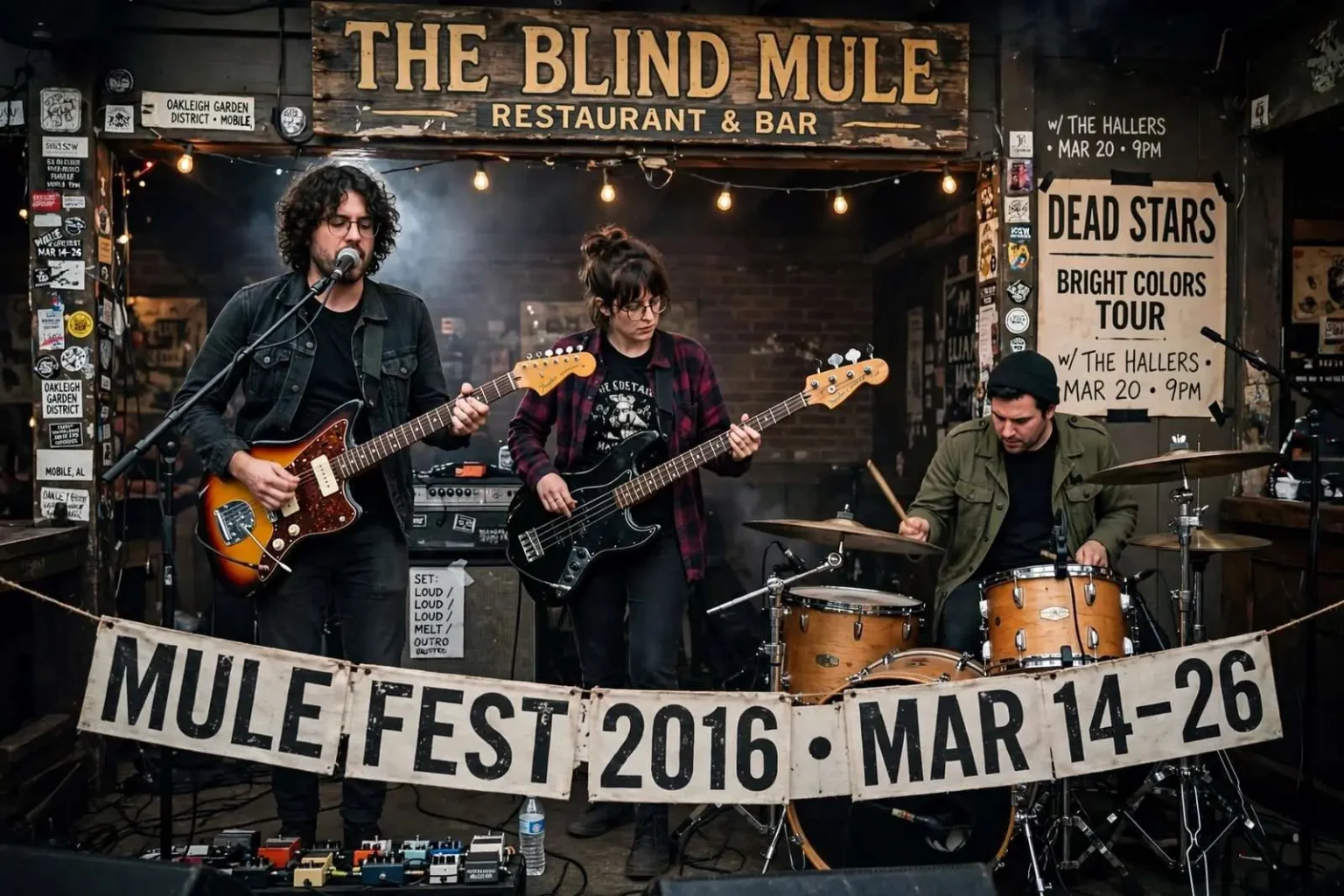
MOBILE, Ala. — Northern band Dead Stars arrived at The Blind Mule Restaurant and Bar on March 20, 2016, fresh from SXSW, touring behind their album Bright Colors. The trio, known for loud explosions of sound mixed with melodic interludes, played with local act The Hallers as part of Mule Fest 2016 — fourteen straight days of music and comedy from March 14 to 26 that turned the Oakleigh Garden District venue into a nightly stop for anyone following the Gulf Coast’s independent scene.
The timing mattered. SXSW in Austin consumes the middle of March every year, and the bands that play it spill out of Texas on the interstate highways afterward, routing through the Southeast on their way home. Mobile sits squarely on that circuit, and venues that book the post-festival week get touring acts at their freshest — road-tested bands with new records to push and a week of Austin exposure behind them. Dead Stars landing at The Blind Mule on March 20 put them exactly on that route, in the middle of Mule Fest’s second week.
Bright Colors, the album the tour supported, collected the band’s signature combination: hooks buried in volume, verses that break open into noise and pull back again. The trio’s catalog reads as a love letter to 1990s guitar music, filtered through a Northern indie sensibility — songs built for basements and small stages, where the loud parts land hardest and the melodic parts carry the room between them.
Southern vs. Northern Crowds
Asked about differences between audiences above and below the Mason-Dixon line, the band quipped that Southern audiences “tend to clap with a Southern accent,” while Northeastern audiences “clap with their middle fingers.” The joke compressed a real observation about regional character into a punchline: Southern rooms tend toward warmth and hospitality even for strangers on a bill, while Northern rooms show their approval with a tougher, more withholding edge that the band clearly found as endearing as it was bracing.
Touring bands accumulate these impressions quickly. A trio playing fourteen-night stretches across the country experiences the regional differences up close — how crowds gather, how long they listen, how they say goodbye at the merch table. The Blind Mule’s room, with its kitchen still serving and its neighborhood regulars mixed in with the show-goers, represents the Southern version of the experience: audiences that treat a strange band like guests rather than act-breaks.
The Indie Life
The positives of indie rock, they said, include no corporate overlords and a shared bond among town scenes. The negatives include no corporate support and occasional mutual resentment between scenes. The trade is one every independent band understands: freedom in exchange for hustle. No label is scheduling tours, hiring publicists or paying for videos, but no label is steering the music either, and the network of venues, promoters and fans that holds the underground together runs on the same mutual-aid logic the band described.
The occasional resentment between scenes is the indie world’s darker footnote. Cities sometimes guard their own bands jealously, and traveling acts occasionally find a cold room where a local scene feels protective of its stage. Bands like Dead Stars navigate this by doing what they did at Mule Fest — playing loudly and gratefully, making friends with the local acts on the bill, and letting the music argue their case.
Venues like The Blind Mule, they argued, are “a vital national resource” giving local artists and touring bands a harbor. Coming from a band fresh off the highway, the endorsement carried weight. A touring trio needs certain things from a city: a stage with decent sound, a promoter who pays the door fairly, an audience willing to listen, and a place to park the van. Rooms that deliver all four are rare enough that touring musicians remember them by name, and The Blind Mule had earned that reputation by programming two full weeks of original music when most venues would have spread the same bill across a season.
Mule Fest 2016 itself was an argument for that approach. Fourteen consecutive days of music and comedy meant the venue bet its calendar on the idea that Mobile audiences would come out night after night — for locals, for touring bands, for the connective tissue between scenes. The March 20 bill, pairing a road-tested Northern trio with hometown favorites The Hallers, was the festival’s model in miniature: two acts from different circuits sharing a room because the room believed in both.
What to Expect
“From our performance fans can expect LOUD. And LOUD. And LOUD,” the band said, promising a vibrant, passionate barnstormer of a show. The description fit both the band and the room. The Blind Mule’s Attic stage rewards volume — a close space where a trio’s full assault fills every corner — and Dead Stars’ live reputation was built on exactly that physicality: songs that start loud, stay loud, and reveal their melodies in the process rather than in spite of it.
The barnstormer promise also described the band’s approach to dynamics. Volume alone is monotony; the band’s songs work because the loud parts have soft parts to crash against. The explosions of sound land harder after a melodic interlude, and the interludes breathe because the explosions are coming. Fans who heard the band on record got the architecture; fans at The Blind Mule got the weather.
Citing Ian MacKaye, “The record is the menu. The show is the meal,” they stressed the importance of contrasting heavy and soft dynamics to keep the music interesting. The line, borrowed from the Fugazi frontman and punk institution builder, has become shorthand among independent musicians for a work ethic: recordings advertise, performances deliver. For Dead Stars, the show at The Blind Mule was the meal — loud, dynamic, and served to a Southern audience the band had already decided it liked.
The Hallers as the Perfect Local Counterpart
Pairing Dead Stars with The Hallers made sense on every axis. The Hallers, fixtures of the Mobile scene and SouthSounds alumni, draw the hometown crowd that a visiting band needs most — and they share the visiting trio’s commitment to guitars played at volume. Local bands on bills with touring acts do double duty: they sell the tickets that make the date possible, and they show the visitors that the scene they’re passing through has its own standard of quality. For The Hallers, a slot against a band on a post-SXSW run was its own kind of audition — a chance to trade audiences with a trio that had just played the industry’s biggest showcase.
That exchange is how regional scenes level up. A local band that holds its own next to a touring act wins credibility with the crowd and the booker alike; a touring band that finds a strong local opener leaves with a good story and a reason to route back through town. Mule Fest’s structure — fourteen nights, mixed bills, locals and travelers interleaved — was designed to produce exactly those exchanges, night after night.
Why March Belongs to Mule Fest
The festival’s mid-March slot also made it the local alternative for music fans priced out of, or worn out by, the SXSW circus. Austin’s festival has become expensive and overwhelming even for industry regulars, and the weeks around it send a glut of talent onto the roads in every direction. A venue that books the post-festival week captures bands at a moment when they want to keep playing and audiences want a show that feels like a show rather than a trade show.
The comedy on the bill rounded out the two weeks. Music-and-comedy festivals share an audience in the independent world — fans who follow original entertainment of any kind — and stacking both into a fourteen-day run gave the venue a reason to stay in the conversation for half a month. Regulars could plan around the calendar, drop in on the nights that matched their taste, and count on the room feeling alive every time they walked in.
For Mobile’s broader music community, Mule Fest 2016’s two weeks demonstrated the model that local scenes elsewhere have copied: concentrate the energy, mix the bills, and let the audiences cross-pollinate. Dead Stars came away with the Southern audiences they had already affectionately diagnosed; The Hallers added another out-of-town counterpart to the list; and The Blind Mule extended the reputation its booker had been building — the harbor the visiting band described, operating at full capacity for two straight weeks in March.
The night itself delivered what the band promised: loud, dynamic, passionate, and over far too soon. And the morning after, the van pointed north again — with a Mobile date on the list of rooms worth returning to, which is the only review a touring band really files.