Interview: Jaguarundi on Four Years in the Mobile Music Scene
An interview with Mobile band Jaguarundi on four years in the local music scene, performing live and supporting independent venues.
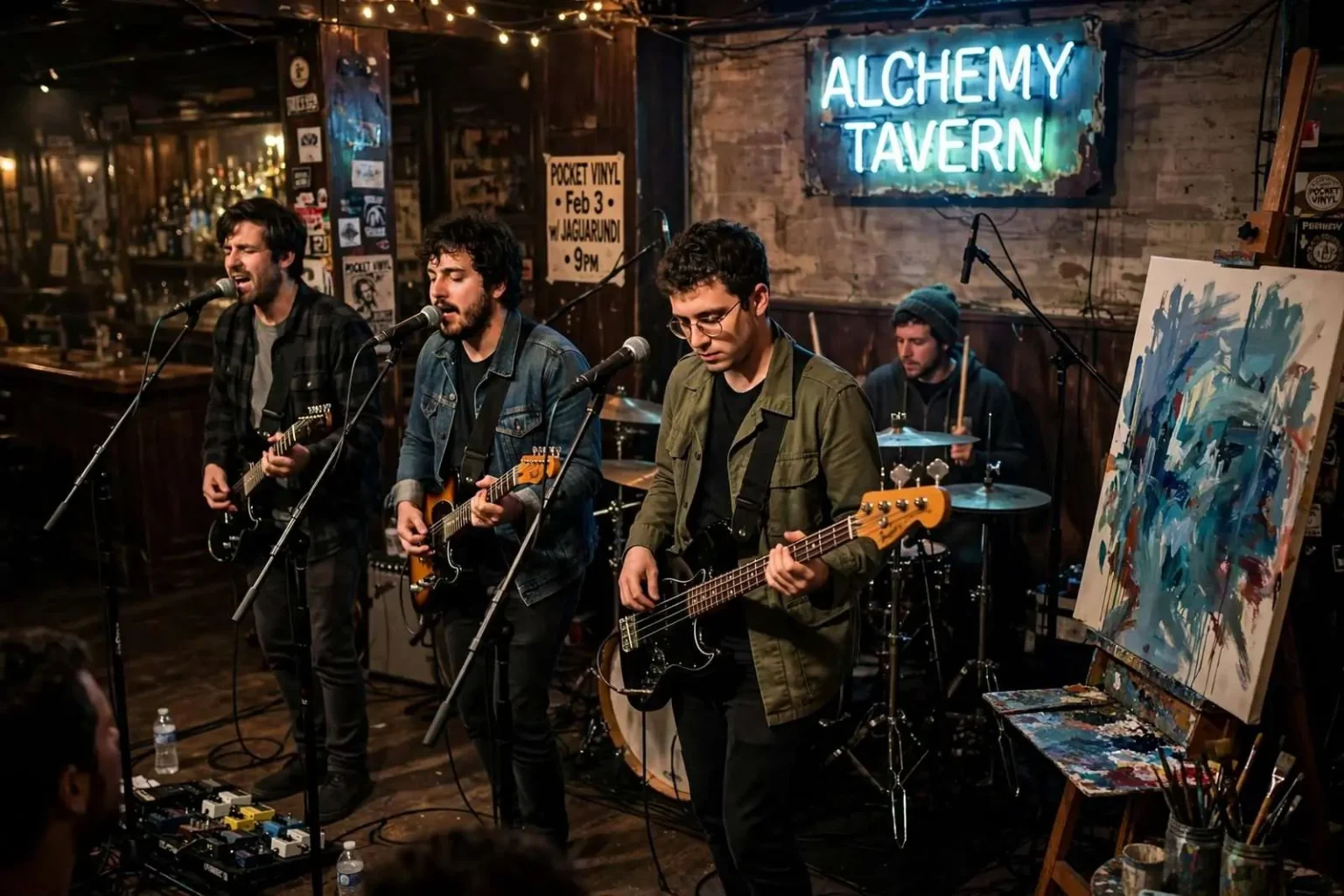
On Feb. 3, 2016, Mobile band Jaguarundi performed with art-music duo Pocket Vinyl at Alchemy Tavern, with doors at 9 p.m. The midweek pairing of a raucous local four-piece with a touring act known for blending music and live art gave Dauphin Street’s independent music crowd something out of the ordinary — and gave the host band a chance to mark four years in the Mobile music scene.
Alchemy Tavern has long been one of the stops on the Dauphin Street circuit where original local bands share bills with traveling acts. Its stage has hosted generations of Mobile’s rock acts, and shows there draw the mix of musicians, artists and regulars that keeps the city’s underground scene alive from week to week.
Pocket Vinyl, the touring art-music duo sharing the bill, built its reputation on performances that pair original music with live painting, turning each show into a piece of visual art created in real time alongside the set. Booking a duo of that description alongside a punk-influenced local band is the kind of genre-bending pairing that independent venues trade in, and it gave the Alchemy Tavern audience two very different reasons to show up on a Tuesday.
A Punk Rock Band That Learned Scales
Jaguarundi is a four-piece: Matt Lasecki and Alfredo Piccini on guitars, Cody Megehee on bass and Ian Pontius on drums. The members share vocal duties and describe themselves as a punk rock band that learned scales but still listened to too much Tom Waits — a self-assessment that hints at the band’s mix of raw energy, technical ambition and left-of-center songwriting.
The band’s name, borrowed from the wild cat native to the Americas, fits a group that has always operated a bit outside the mainstream. Four years into performing locally, Jaguarundi had moved through the usual stages of a young band: early shows, lineup adjustments, the slow accumulation of songs and the mutual understanding that comes from hundreds of hours of rehearsal.
Lasecki grew up listening to Mobile bands and always knew he would join the scene. “I think having a strong local scene is important because I grew up sort of ‘looking up’ to the older bands who have come before me,” he said.
That lineage matters in a city like Mobile, where the music community is tight-knit enough that younger musicians learn their craft watching the ones ahead of them. The Port City’s scene has produced rock, punk, metal, hip-hop and singer-songwriter acts across the decades, sustained by the venues along Dauphin Street and the surrounding blocks that give those bands places to play.
For Jaguarundi, the Feb. 3 show represented both a milestone and an ordinary gig in the life of a working local band — four years in, playing a weeknight show with a touring act, hoping the crowd shows up. That reality shapes how bands like Jaguarundi think about their audience and their future.
Give Everything You Have
After four years performing locally, the band’s mutual respect has outweighed disagreements. “Whenever Jaguarundi takes the stage, only one thing is certain; we are going to give everything that we have,” Lasecki emphasized.
The audience can expect a high-energy rock ‘n’ roll show, the kind of set built on volume, velocity and the physical commitment that has always distinguished live punk and garage-influenced rock from its recorded versions. Bands that share vocal duties across four members tend to build sets that shift in texture from song to song, and Jaguarundi’s blend of punk energy and melodic ambition gives it room to move.
Like many area performers, the band values community support. “Without the venues to play at, local music would die,” Lasecki said, urging fans to support independent businesses and the stages that give musicians their chance.
His point underlines the economy of a local music scene. Independent venues operate on thin margins, dependent on door receipts and bar sales to survive week to week. When audiences stay home, shows get canceled, bands lose stages, and the pipeline that produced Mobile’s musicians for generations weakens. Attendance at weeknight shows like the Feb. 3 date is the difference between a scene that grows and one that fades.
Mobile’s downtown entertainment district has been both a blessing and a challenge for original music. The bars along Dauphin Street draw big crowds, but cover bands and DJs compete for those same patrons, and original acts often play to smaller, more dedicated audiences on weeknights. Venues willing to book touring indie and art acts alongside local bands fill a role that the district’s larger party bars do not.
The Local Scene as an Ecosystem
A healthy local scene works as an ecosystem: venues give bands stages, bands give venues a draw, fans give both a reason to continue, and the whole cycle trains the next generation of musicians. Lasecki’s account of growing up watching older Mobile bands describes how that cycle renews itself, and his band’s four-year run shows what it produces.
The ecosystem also depends on touring acts connecting with local bands on the same bill. When a duo like Pocket Vinyl passes through town and shares a stage with a local opener, both acts reach new listeners, and the local audience gets exposure to music it would not otherwise hear. Bookers who make those matches — pairing artists by temperament as much as genre — do much of the invisible work that keeps regional music circuits alive.
For the musicians themselves, the economics remain modest. Local bands practice in garages and storage units, haul their own gear, and split door money four ways after the venue takes its share. What sustains them is the same thing Lasecki described: the commitment to give everything on stage, and the community of bands, fans and venue owners who make it possible to keep playing.
Looking Ahead
Four years in, Jaguarundi occupies the stage of its development where the songs are tested, the sound is defined and the audience is built one show at a time. Bands at that stage live on momentum — each gig leading to the next, each new song sharpening the set.
The band’s members balance music with the ordinary demands of life in Mobile, as most working local musicians do. Rehearsal schedules, day jobs and the logistics of coordinating four schedules shape what a young band can commit to, and the ones that last are the ones that find a rhythm — exactly the kind of durability four years represents.
For the audience at Alchemy Tavern on Feb. 3, the show offered a look at a band mid-climb: confident enough to share a bill with a touring act, hungry enough to treat a weeknight date like a headline performance. That combination — craft and urgency — is what local music scenes run on, and what the bands who came before Jaguarundi passed down to them.
Music fans in Mobile will have more chances to catch the band as it continues to play the local circuit. And if Lasecki’s advice is followed — support the venues, support the independent businesses, show up for the bands — the scene that raised his generation of musicians will be there to raise the next one, too.
The Feb. 3, 2016, date itself says something about how local scenes operate. Weeknight shows are the proving ground where bands build their chops, and Alchemy Tavern’s willingness to put a local four-piece on stage with a touring act gave Jaguarundi exactly the kind of opportunity young bands need: a real stage, a real audience and a real reason to rehearse hard that week.
Pocket Vinyl’s brand of art-music performance also broadened what the night could be. Duo performances that merge music with visual art draw a different slice of the audience than a straight rock bill, and when that audience mixes with the home crowd of a local punk-influenced band, the crosscurrents are part of what makes small-venue shows memorable. The collaboration between booking and artistry is subtle, but nights like that one are how Mobile’s audiences learned what their own scene was capable of hosting.
Jaguarundi’s four-year mark is also a testament to the band’s persistence in a market where original rock competes with everything else competing for a Tuesday night. The band members’ shared vocal duties and multi-songwriter approach spread the creative load, a structure that tends to keep young bands together longer than one dominated by a single writer’s vision.
As the band continues on the local circuit, the advice Lasecki offered stands as the scene’s operating manual: the venues need patrons, the bands need stages, and the audience that shows up on a weeknight is the difference between a thriving music community and a fading one. Four years in, Jaguarundi is doing its part — showing up, plugging in and giving everything it has.