
Interview: Mobile’s Glass War Makes Its Concert Debut Alongside Bantam Foxes
A one-two punch of Bantam Foxes and Glass War was set for Alchemy Tavern on June 25 at 9 p.m., in the heart of downtown at 7 S. Joachim St.
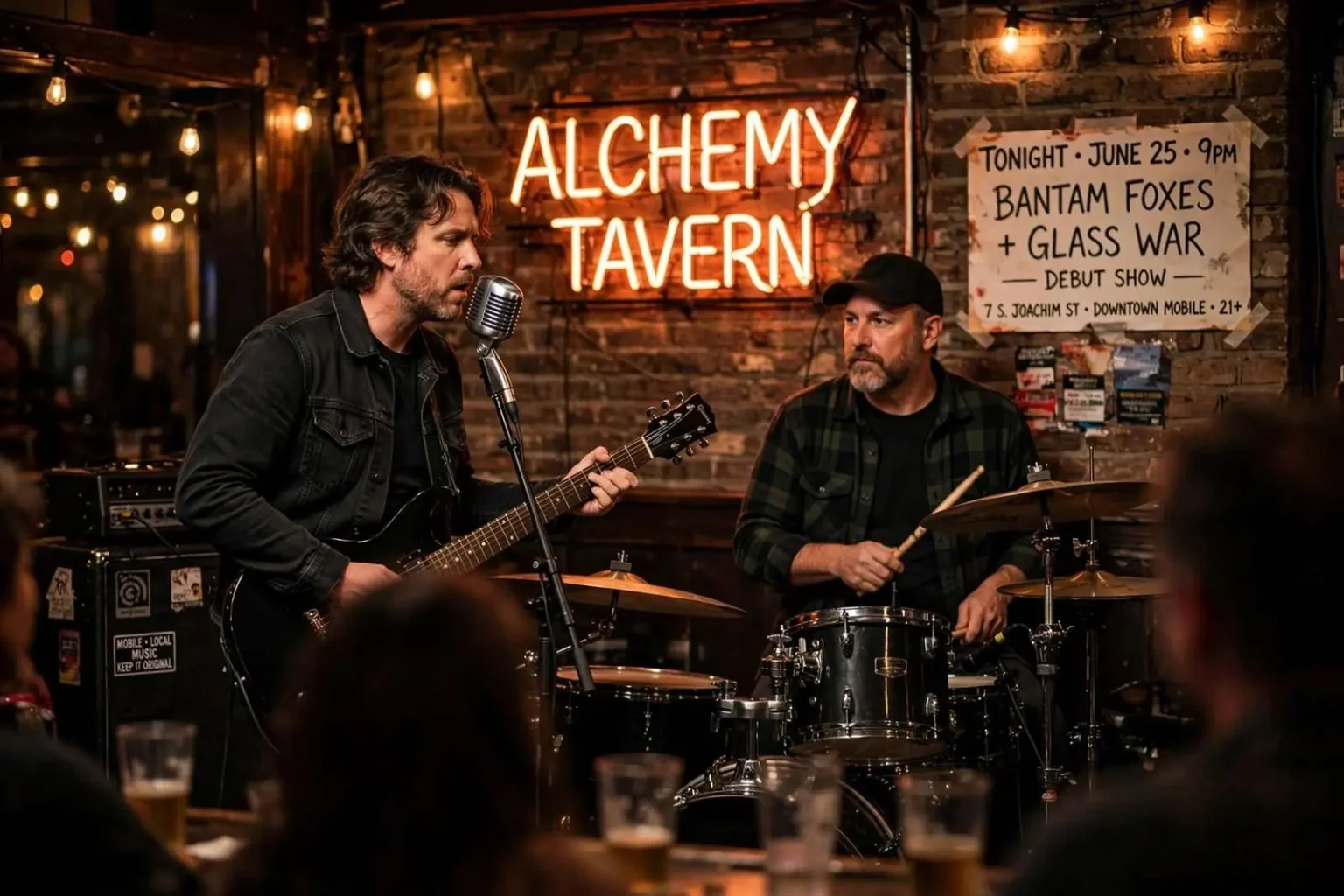
A one-two punch of Bantam Foxes and Glass War was set for Alchemy Tavern on June 25 at 9 p.m., in the heart of downtown at 7 S. Joachim St. While Bantam Foxes needed little introduction, the night also marked the concert debut of Mobile-area duo Glass War.
Debut nights carry a particular electricity in a club setting. A band playing its first show has no set-list history with the room, no established expectations, and no habits yet — only the material and the chemistry that brought the group together. Alchemy Tavern, with its intimate footprint and its reputation for putting rising and established acts on the same bill, is a natural launching point for exactly that kind of night, and pairing a new duo with a known draw gives the debut an audience it would not otherwise have on its own.
How Glass War Formed
Multi-instrumentalist Brian Wattier, formerly of Underhill Family Orchestra, teamed with drummer Daniel Howard. The two had circled each other for months with other players before Howard approached Wattier at Hayley’s Bar and insisted they try something different. The chemistry was immediate. Howard described a long search for a new project after his last band ended in 2008, and said the match was what he had been seeking.
The origin story is a familiar one to anyone who has watched a local music scene work. Musicians in a city the size of Mobile tend to cross paths constantly — at shows, behind bar counters, in the orbit of other bands — and the strongest projects often emerge not from auditions but from two players recognizing that they should be working together. That Howard and Wattier had circled each other for months before the direct approach suggests the pairing had been building in both musicians’ minds, and that the bar-room conversation was the moment the idea finally became a plan.
Wattier’s background with Underhill Family Orchestra gave the new project an interesting starting point. That group’s arrangements ran large, layered, and communal — the kind of band whose sound depends on many contributors playing off one another. Stepping from that format into a two-piece is a dramatic reset, demanding that two musicians fill sonic space that eight occupied before.
The Sound: Blues Roots, Punk Energy, Prog Ambition
Alchemy Tavern owner Matt Charnetski described Glass War as a blend of Robert Johnson, the Dead Kennedys, and Tool. The band’s sound draws on progressive, blues, and punk influences.
That three-name shorthand sketches a genuinely unusual territory. Robert Johnson stands at the root of the blues tradition — the Delta legend whose spare guitar work and haunted songwriting set the template for everything from Chicago electric blues to British rock. The Dead Kennedys represent the opposite end of the energy spectrum: confrontational, politically sharp punk whose songs move fast and hit hard. Tool, meanwhile, contributes the progressive dimension — odd time signatures, patience with dynamics, and arrangements that build over long arcs rather than sticking to verse-chorus convention. A band trying to hold all three in one sound is attempting something few duos attempt at all.
The two-piece format makes the ambition feasible in one specific way: with only two people playing, there is nowhere to hide, but there is also no dilution. Duos in the blues-punk tradition have long demonstrated that a guitar-and-drums configuration can carry a room — the format forces both players to their limits, and the audience hears every decision in real time. For a drummer like Howard, it means playing both timekeeping and melodic support; for a multi-instrumentalist like Wattier, it means the guitar, the voice, and any additional instruments all carry structural weight.
Making It Personal
Wattier said the two-piece format grants freedom to create something both are deeply invested in. He praised Howard’s role as equal to his own, and said stripping things down has been a welcome change from the eight-person arrangements of his previous group. The debut promised an energetic, personal set for Mobile listeners.
The emphasis on equality between the two players is telling. Large bands operate by compromise and coordination; duos succeed only when both members function as genuine partners, each carrying half the sound and sharing the creative decisions. Wattier’s description of the change from his eight-piece past — welcome rather than a step down — frames Glass War as a deliberate creative choice rather than a circumstance of who was available.
For Howard, the project closes a long chapter. Ending a band in 2008 and searching for the right new configuration for years afterward is a patient path, and his insistence that the match was what he had been seeking suggests Glass War arrived at the right moment for both musicians. Bands born from that kind of deliberation often show a maturity in their first shows that many debuts lack — the songs have usually been argued over, rebuilt, and road-tested in practice rooms long before an audience hears them.
Alchemy Tavern and the Downtown Scene
The venue itself is a meaningful part of the story. Alchemy Tavern sits on South Joachim Street, a block off Dauphin Street in the heart of downtown Mobile’s entertainment district, and it has built its reputation as a room where original music is the point rather than an afterthought. Owner Matt Charnetski’s booking philosophy has consistently mixed touring acts with local bands on the rise, giving Mobile audiences a steady diet of guitar-driven rock, metal, and alternative music in a room where the stage is close enough to the crowd that a debut set genuinely feels like an event.
South Joachim Street and the surrounding blocks have become one of downtown’s liveliest stretches on weekend nights, with bars, restaurants, and music rooms drawing the after-dinner crowd between Dauphin Street’s larger venues. For a band playing its first show, that foot traffic matters: debuts live or die on whether the curious wander in, and a well-located room with a strong opening act maximizes the chance the room is full when the new band takes the stage.
Bantam Foxes’ role as the known quantity on the bill is likewise strategic. Audiences arrive for the band they know and stay for the one they don’t, and a high-energy pairing gives the newcomer’s first set the best possible context. For Mobile listeners, the June 25 show offered a double opportunity — a night with an established favorite and a first look at a new project built by two of the area’s more traveled musicians.
What the Debut Meant
First shows don’t come with second chances at a first impression, but they do come with advantages. No one in the room has a fixed idea of what Glass War is supposed to sound like, and the band is free to define itself in real time — an opportunity that the duo’s blend of blues roots, punk urgency, and progressive ambition should let them use fully. The chemistry that formed at a bar conversation months earlier would now be tested in front of the city both players call home.
For Mobile’s original-music scene, a night like June 25 is the pipeline working as intended: established acts bringing crowds, new projects getting their first stage, and a local room providing the platform. Whether Glass War’s sound develops into a lasting fixture or remains one chapter in two musicians’ careers, the debut marked the moment the project stopped being an idea and became a band.
The Two-Piece Tradition
Glass War joins a long lineage of two-piece bands that have made small numbers an advantage rather than a limitation. The guitar-and-drums configuration has produced some of rock’s most distinctive acts, from the raw blues-punk of the American underground to arena-filling duos that built entire careers on the tension between two instruments. The format strips a band’s communication to its essentials: eye contact, timing, and an intuitive sense of what the other player will do next. When it works, audiences often describe duo shows as more intense than full-band performances precisely because there is no cushion between idea and execution.
For Wattier, the move also puts his multi-instrumentalist range to work differently. In a large ensemble, a player’s contributions sit within an arrangement; in a duo, everything a musician brings — singing, playing, switching instruments mid-set — reshapes the whole band’s sound in the moment. The freedom Wattier described is real but demanding, and the debut was the first public test of how the two musicians’ approaches fit under stage lights rather than in a rehearsal space.
Mobile’s Scene in Context
The debut also reflects the health of Mobile’s original music community. The city has long produced musicians who work across multiple projects, collaborating freely across genres and lineups, and the story of Glass War’s formation — two players circling each other through other configurations before committing — is the scene’s standard method of generating new bands. Rooms like Alchemy Tavern, bar conversations like the one at Hayley’s, and established acts willing to share a bill all form the infrastructure that lets a project like this reach a stage at all.
Hayley’s Bar itself deserves mention in that chain. Long one of Mobile’s most durable neighborhood music bars, it has served for decades as a meeting point for the city’s musicians — a place where lineups reshuffle, ideas circulate, and the next project gets sketched on a napkin. That Glass War’s founding moment happened there is fitting, and it underlines how much of a local scene’s life happens between the shows rather than during them.
With the debut behind them, the duo’s next steps — more local shows, a growing set of originals, recordings — would follow the well-worn path Mobile bands have traveled before. June 25 was the starting line, in a downtown room built for exactly these nights.