
Interview: Penny and Sparrow Bring Harmonies to Callaghan’s Irish Social Club
Penny and Sparrow joined Oh Jeremiah! at Callaghan's Irish Social Club on August 28, for a Sunday evening performance running 7 to 11 p.m.
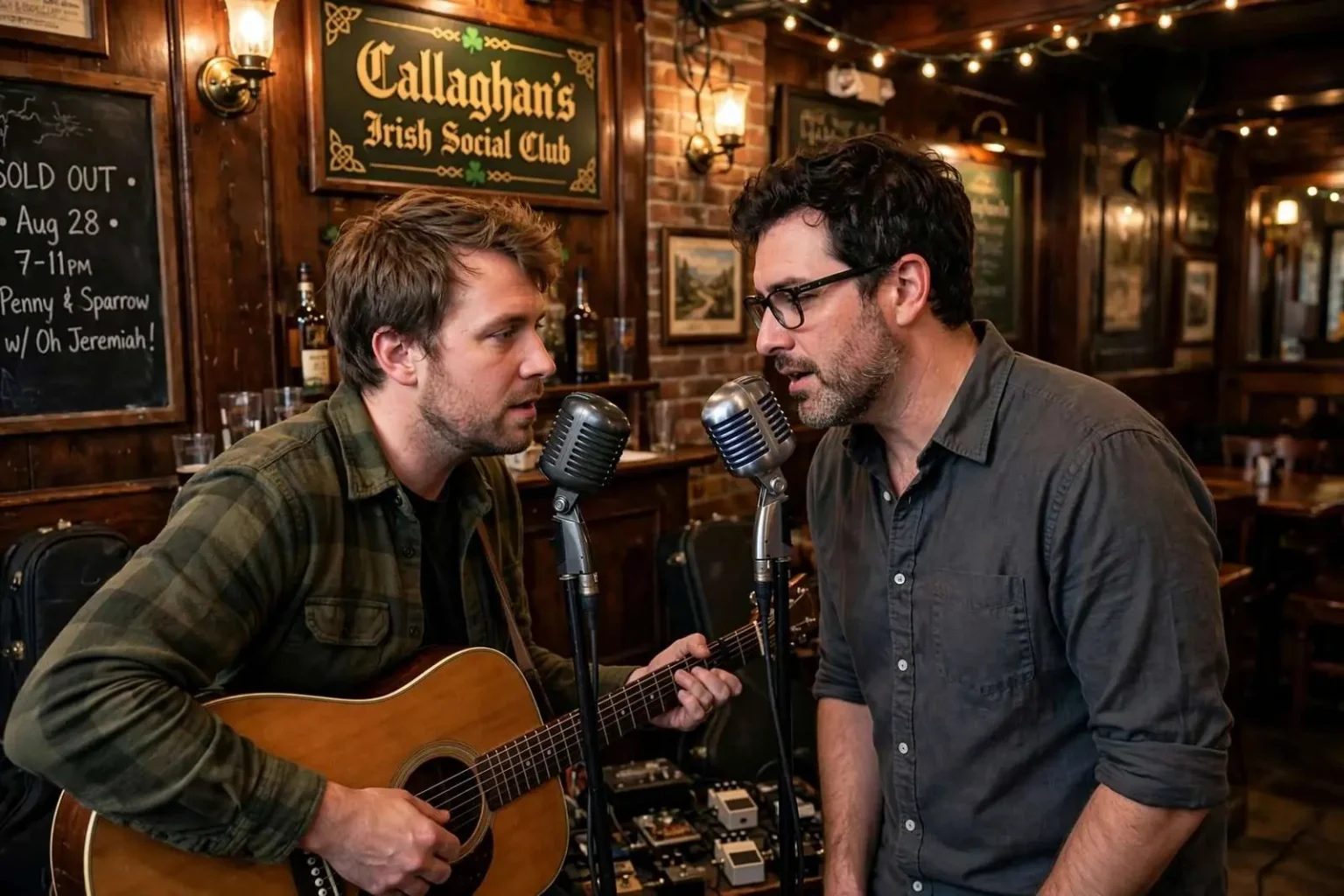
Penny and Sparrow joined Oh Jeremiah! at Callaghan’s Irish Social Club on August 28 for a Sunday evening performance running 7 to 11 p.m. The show was one of Mobile’s most intimate bookings of the season: limited to 50 tickets and selling quickly, the evening paired the touring duo with a regional opener in a room better known for burger-and-beer Sundays than for hushed listening sessions. For the 50 people who secured seats, the night offered something increasingly rare on the Gulf Coast — a nationally touring act performing within arm’s reach of its audience, no stage lights or barriers in between.
Penny and Sparrow is the partnership of Andy Baxter and Kyle Jahnke, singer-songwriters from Austin, Texas, who share vocals over guitar for a stripped-down, melodic sound. The pair, who met as University of Texas roommates, were touring behind their release “Let a Lover Drown You” at the time of the Callaghan’s show. What began as two friends harmonizing in a college apartment has matured into one of the more distinctive acts in the independent folk world, with a catalog built on close two-part harmony and arrangements that leave every note exposed.
An Austin Duo With a Deliberate Sound
The duo’s origin story shapes everything about its music. Baxter and Jahnke met as roommates at the University of Texas and discovered a vocal blend that would become the foundation of their career. Unlike bands that assemble around instruments and add voices later, Penny and Sparrow grew from harmony outward — the two voices came first, and the instrumental arrangements exist to frame them. The result is a sound that translates perfectly to rooms like Callaghan’s, where no amplification trickery can hide behind the vocal blend.
“Let a Lover Drown You” continued the duo’s practice of pairing spare instrumentation with emotionally direct songwriting. The record found the pair refining a formula that has earned them a devoted national following: compositions that move at a deliberate pace, built to reward close attention rather than to fill a bar with noise. We spoke with guitarist and vocalist Jahnke ahead of the Callaghan’s performance, and his comments about the duo’s creative approach apply directly to what audiences heard that Sunday evening.
The Case for the Small Room
Jahnke said small independent venues like Callaghan’s simply give musicians a place to play and champion art over everything else. That observation carries weight coming from a touring artist who has played festival stages and club dates across the country. Small rooms occupy a unique position in the music economy: they rarely generate large gate receipts, but they take chances on acts that larger venues will not book, and they cultivate the audiences that eventually fill bigger halls. For a duo whose music depends on dynamics and silence, the distinction matters doubly — a 50-capacity room lets the quiet passages of a song land with their full effect.
Callaghan’s Irish Social Club, a neighborhood fixture on Mobile’s Oakleigh Garden District edge, has built its reputation on exactly that kind of booking. The bar’s calendar regularly features original touring songwriters alongside local acts, and its audiences have a reputation for listening. A Sunday 7 to 11 p.m. show there follows the room’s familiar rhythm, but the 50-ticket limit signaled from the start that this would be a seated, attentive evening rather than a typical bar gig.
Creative Freedom and Staying Original
Jahnke described the folk and singer-songwriter genre as broad enough to grant endless creative freedom, and said the best way to stay original is to craft songs that matter to you. The two ideas work together. In a genre whose borders stretch from traditional balladry to indie-pop experimentation, an act like Penny and Sparrow can wander widely without losing its identity — the constraint that keeps the duo honest is not stylistic but personal, a commitment to writing only songs the two of them genuinely care about.
That philosophy shows in the duo’s release history. Each record has found Baxter and Jahnke adjusting their approach — layering more instrumentation in some places, stripping songs to voice and guitar in others — while the core blend of their voices remains the fixed point. “Let a Lover Drown You” arrived with the pair already veterans of years of relentless touring, and its songs reflect the confidence of writers who know exactly what their instrument, the two-part harmony, can and cannot do.
Two Voices, One Sound
The duo’s interlocking harmonies add texture to minimal arrangements, and live performances put that craft on full display. Jahnke said songs usually begin with a melody, with lyrics built around it — a compositional order that explains the music’s immediate, almost physical appeal. Melody-first writing gives Penny and Sparrow’s songs a hummable, memorable spine, while the lyrics accumulate around it like details in a well-drawn portrait. Hearing the process in person, in a room of 50 people, means catching every shift in the vocal lines and every space the duo leaves between phrases.
The intimacy cuts both ways for the performers. With no full band to share the load, every breath, every missed entrance and every perfect unison moment is audible to everyone in the room. Duos that survive the touring grind at this level develop a telepathic precision, and Callaghan’s audiences were positioned to hear the result of thousands of miles and hundreds of shows’ worth of practice compressed into a Sunday evening.
Oh Jeremiah! and the Regional Connection
The booking paired the Austin duo with Oh Jeremiah!, giving the regional act a support slot in front of a full, attentive house. Support slots like this one are the connective tissue of the independent touring network: local and regional openers bring their own fans, soften the room, and get the exposure of sharing a bill with a national touring name. For Mobile listeners, the pairing also served as a showcase of the region’s own singer-songwriter talent, proving the local scene can hold the stage beside a touring act of Penny and Sparrow’s reputation.
The evening’s structure — 7 to 11 p.m. on a Sunday — suited the material as well. Rather than competing with a rowdy weekend crowd, the show occupied the quieter end of the week, when audiences come specifically to listen. It is a scheduling approach that recognizes what the music asks of its listeners: patience, attention and a willingness to sit with songs that deal in emotional complexity.
What the Audience Takes Home
Above all, the pair hopes audiences leave having taken away whatever they needed — a laugh, a cry, or a little hope in the mix. The statement captures why the duo has built such a devoted following without radio support or major-label machinery. Penny and Sparrow’s concerts are framed less as performances than as shared experiences, and the 50-ticket format at Callaghan’s made that framing literal: everyone in the room was close enough to see the duo exchange glances and hear the harmonies resolve a few feet away.
For Mobile’s music community, the show was also a reminder of what small venues make possible. A 50-capacity booking with a nationally recognized touring duo does not happen in an arena or a casino showroom — it happens because rooms like Callaghan’s exist, book ambitiously and cultivate listeners who show up. Jahnke’s point about independent venues championing art over everything else found its proof that Sunday evening: two University of Texas roommates, one guitar between them, and a Mobile room full of people hearing every note.
Austin’s reputation as a singer-songwriter city looms over acts like Penny and Sparrow, and the duo embodies both the promise and the pressure that come with the hometown label. The city’s club density — rooms dedicated to original music within walking distance of one another — gives developing writers far more stage time than most American cities, and its audiences arrive trained to listen. Baxter and Jahnke came up in that ecosystem, and the work ethic it instills shows in their touring schedule, which has kept them on the road for much of each year since their earliest releases.
The economics of a two-person act also shape the duo’s reach. With no band payroll and minimal equipment, Penny and Sparrow can route tours through mid-size and small markets that a five-piece act would pass by — markets like Mobile that support original music but sit off the main interstate corridors of national touring. The Callaghan’s date is exactly the kind of show that model makes possible: a duo driving between larger Southeast cities can detour for an intimate, well-paying room without the logistics that burden bigger bands.
The Listening-Room Revival
The 50-ticket format also connects to a broader trend in live music: the resurgence of the listening room. As ticket prices for large venues have climbed and arena shows have become visual spectacles first, audiences hungry for genuine musical connection have increasingly sought out small-capacity shows. Artists have noticed. Many touring acts now structure entire tours around house concerts, dedicated listening rooms and intimate bar shows, trading volume for depth of experience. Penny and Sparrow’s material — built on harmony, dynamics and lyrical detail — is tailor-made for that circuit, and the Callaghan’s show brought the format to Mobile in its purest form.
The duo’s vocal arrangement deserves specific mention for anyone unfamiliar with the catalog. Rather than trading lead duties in the conventional way, Baxter and Jahnke often sing in tight intervals throughout, their two lines crossing and re-crossing so that the ear loses track of which voice is carrying the melody. Arrangements built this way reward live listening in particular — recordings compress the blend, but in a small room the two sources are physically distinct, and the phantom third voice that emerges between them seems to float in the air of the venue itself.
A Sunday Evening in the Oakleigh Garden District
The setting added its own character. Callaghan’s Irish Social Club has spent years establishing itself as one of Mobile’s essential neighborhood bars, a place where the kitchen’s reputation draws diners early and the back room’s stage draws listeners late. Shows there follow a familiar script: the crowd assembles gradually, conversation quiets as the first act begins, and by the headline set the room operates under an unspoken listening agreement. For touring artists, that reputation makes Callaghan’s a requested stop — the rare bar gig where the audience behaves like a concert hall’s.
Pairing that room with a Sunday 7 to 11 p.m. slot turned the evening into a complete neighborhood outing. Attendees could arrive for dinner, catch Oh Jeremiah!’s opening set as the tables thinned, and settle in for the headliner with the week ahead temporarily forgotten. The 50-ticket cap guaranteed that everyone who attended had made a deliberate choice to be there — and deliberate audiences are the ones touring songwriters remember and return to play for.
The Broader Gulf Coast Circuit
The Mobile date fit a Southeastern swing that took the duo through the region’s small-venue network, from the Florida Panhandle through south Alabama and beyond. That circuit — a handful of committed rooms strung along the Gulf Coast — has become viable precisely because acts like Penny and Sparrow invest in it, returning city by city rather than treating the region as flyover territory. Each visit builds the audience for the next, and each sold-out small room demonstrates to other national acts that the Gulf Coast will support intimate original-music shows.
For the 50 ticketholders at Callaghan’s on that Sunday evening, the value was simpler: a chance to hear “Let a Lover Drown You” and the rest of the duo’s catalog in its ideal setting, with Oh Jeremiah! opening, the bar’s kitchen at full strength, and the kind of close-up performance that stadium economics will never offer. Jahnke’s hope that audiences leave with whatever they needed — a laugh, a cry, or a little hope in the mix — found an ideal laboratory in that small Mobile room, where every listener left having been close enough to the music to feel it as more than sound.