
Interview: Surfer Blood on Playing The Merry Widow During Mardi Gras
Florida band Surfer Blood discusses playing The Merry Widow during Mardi Gras and life on the road in this Mobile interview.
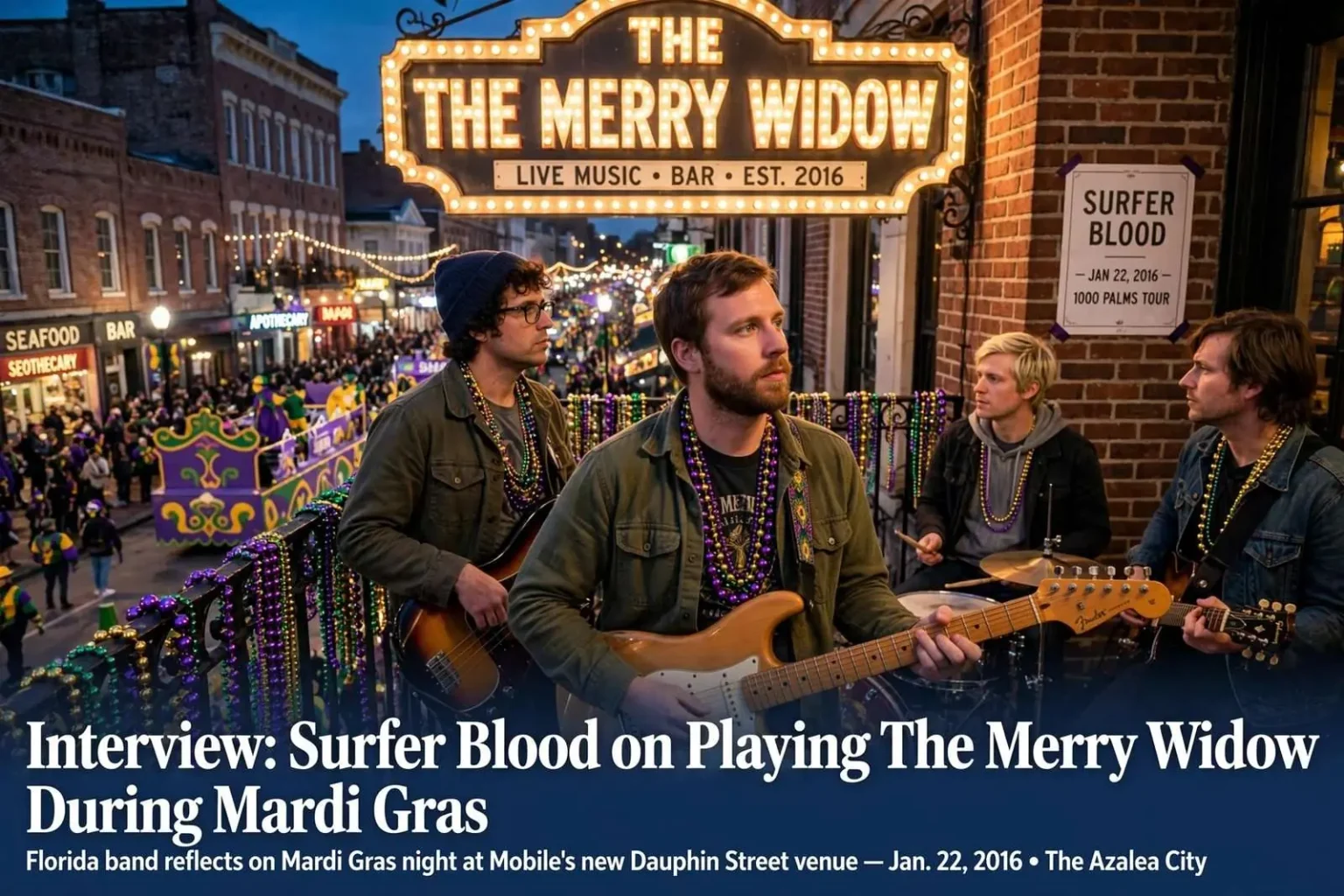
During Mardi Gras season, we spoke with several touring acts that stopped in Mobile. Regional band Surfer Blood performed at the recently opened Merry Widow on Jan. 22, 2016. Here is our Q&A with the Florida band about its experience in the Azalea City.
The stop came as part of the band’s steady touring schedule in support of its then-new album, and it landed at a moment when downtown Mobile’s music landscape was shifting. The Merry Widow, a new room on Dauphin Street’s entertainment corridor, had just opened its doors, adding a venue sized for mid-level touring acts to a block already known for nightlife. That the band arrived in the heart of Mardi Gras season meant the visit came wrapped in the parades, beads and street life that make Mobile’s carnival season unlike any other stop on a national tour route.
A New Downtown Venue
The Merry Widow impressed the band as “a intimate room that sounds surprisingly punchy.” Sound quality in a new club is never a given — rooms often take months of adjustment before the mix settles — but the band found the space delivered an unexpectedly full sound from the stage. That first impression mattered for a group whose songs lean on interlocking guitars and vocal harmonies that can be swallowed by a bad room.
The Mardi Gras timing gave the night a flavor no ordinary club date could. The band watched the parade from the upstairs balcony and collected thousands of beads by night’s end, even recognizing faces from a show at the Alabama Music Box five years earlier. That detail said as much about Mobile as it did about the band: five years is a long stretch in touring life, and Mobile’s music fans had been there both times, in one venue and then in the next. The Alabama Music Box had been a mainstay of the city’s independent music scene before it closed, and its regulars clearly carried over to the new room on Dauphin Street.
For a band passing through town on a winter tour, the balcony view of a Mardi Gras parade is the kind of experience that stays with a group long after the date is played. Mobile’s carnival tradition predates New Orleans’ by years, and touring bands routed through the Gulf Coast in January and February often find themselves swept into the season whether they planned for it or not.
On Recording and Performing
Surfer Blood’s album 1000 Palms had generated positive buzz, but the band sees recording as its own reward. “The greatest reward of all is seeing people sing along to your songs when you come to their town on tour,” a member said. The comment captured the band’s priorities as it moved into its second era: the studio work matters, but the connection with the crowd is the point of the whole enterprise.
1000 Palms marked a notable chapter for the West Palm Beach band, arriving after their early recordings had made them one of the most talked-about acts to emerge from Florida’s indie scene. The album’s positive reception kept the band on the road, and by the time they reached Mobile in January 2016 they had logged years of national and regional touring behind the record.
Playing roughly a hundred shows a year, they keep a few song endings open to improvisation so each night differs; one fan compared them to the Grateful Dead. That openness at the end of songs is a deliberate choice for a band built on tight pop structures. Leaving room for the set to breathe gives repeat concertgoers a reason to come back, and the Dead comparison — however loose — reflects a live philosophy that trusts the band and the audience to go somewhere unplanned together.
A hundred shows a year is a demanding pace for any group, and the band’s approach to it reflects a touring ethic shaped in the college-circuit and club-circuit economy of the 2010s, when bands survived by staying on the road and turning every city’s small crowd into a returning one. The Mobile crowd singing along, five years after a first Alabama show, was proof of that approach working.
Southern Roots and the Road
The band toured relentlessly in its early days, often playing to empty rooms in a beat-up van. “I do not know if we would have ever gotten noticed if we had not taken a leap of faith,” they said.
That early grind is a familiar story for bands that broke out of Florida in the era of blogs and DIY touring. Long drives between modest cities, sparse crowds on weeknights, and the faith that the room would someday fill — the band’s leap of faith was the choice to keep playing through the empty nights until notice arrived. By the time they played the Merry Widow, the rooms had filled, and the band could look back on the van years as the necessary price of the career that followed.
Crowds in Georgia, Alabama and Florida tend to be a little rowdier than elsewhere, which the band has always enjoyed. Southern crowds bring a physical energy to indie rock shows that bands notice on the regional leg of a tour, and Surfer Blood — a Florida band with Southeastern roots — has long counted the tri-state Gulf region among its most reliable territories. Mobile, sitting between Florida panhandle towns and Mississippi on the tour route, draws fans from across the central Gulf Coast to Dauphin Street shows.
The Merry Widow date itself joined a string of 2016 appearances that kept the band connected to its Southeastern fan base. For Mobile listeners, the chance to see a nationally recognized indie act in a brand-new downtown room, during Mardi Gras season, with beads still drifting down from the balcony rail, made for one of the more distinctive nights on the venue’s opening calendar.
The interview also offered a window into how a band sustains itself across a decade: record when there is something to say, tour steadily, leave room for the music to change nightly, and treat every crowd — including the ones in unfamiliar towns — as the reason the whole thing works. Five years after their first Mobile show, the faces in the Merry Widow crowd that recognized them were the answer to their own question. The leap of faith had landed, and the Azalea City had caught them.
Dauphin Street itself deserves a note in the story. The corridor has long served as downtown Mobile’s entertainment spine, a stretch of bars, restaurants and music rooms where a touring act can play to an audience that walks in off the street during carnival season. The addition of the Merry Widow gave the block a mid-sized room suited to bands that had outgrown dives but not yet reached theater capacity, filling a gap in the city’s venue ladder. For regional acts like Surfer Blood, whose crowds in the Southeast can sustain a club show but not a hall, that size of room is exactly where the band and the audience meet best.
Mardi Gras season adds a wrinkle that visiting bands rarely expect. On parade nights the streets fill with families and revelers hours before showtime, parking tightens for miles around downtown, and moon pies and beads drift through the crowd long after the floats pass. A band arriving on Jan. 22, 2016 — early in the season but deep in its rhythm — found the city already in motion, and the balcony at the Merry Widow offered the ideal vantage: above the crowd, close to the stage, with a clear view of the parade route below.
The memory of collecting thousands of beads from that perch is the sort of detail that makes a tour story last. Bands log hundreds of similar rooms and similar nights, and the ones that stand out are rarely the biggest crowds. They are the nights when the city itself participated — when a club show turned into a carnival, when the balcony filled with new friends, and when faces from five years earlier turned up to sing along again. Mobile gave Surfer Blood that night in January 2016, and the band’s affection for the Gulf Coast’s rowdier crowds was on full display.
For local fans, the show also marked a hopeful moment in Mobile’s venue history. The closing of the Alabama Music Box had left a hole in the circuit that touring bands relied on, and every opening date at a new room carries the question of whether the city will support it. The Merry Widow’s Mardi Gras-season debut with a name act like Surfer Blood suggested the audience was there. Recognized faces from five years earlier, thousands of beads on the balcony rail, and a room that sounded “surprisingly punchy” from the first note all pointed the same direction: Mobile’s appetite for independent music had outlasted the venue changes, and the city remained a reliable stop on any Southeastern tour route.