Jack Edwards Airport Moves Ahead on Plan for Commercial Air Service in Gulf Shores
Gulf Shores funds engineering for a commercial airline terminal at Jack Edwards National Airport as FAA tower approval nears.
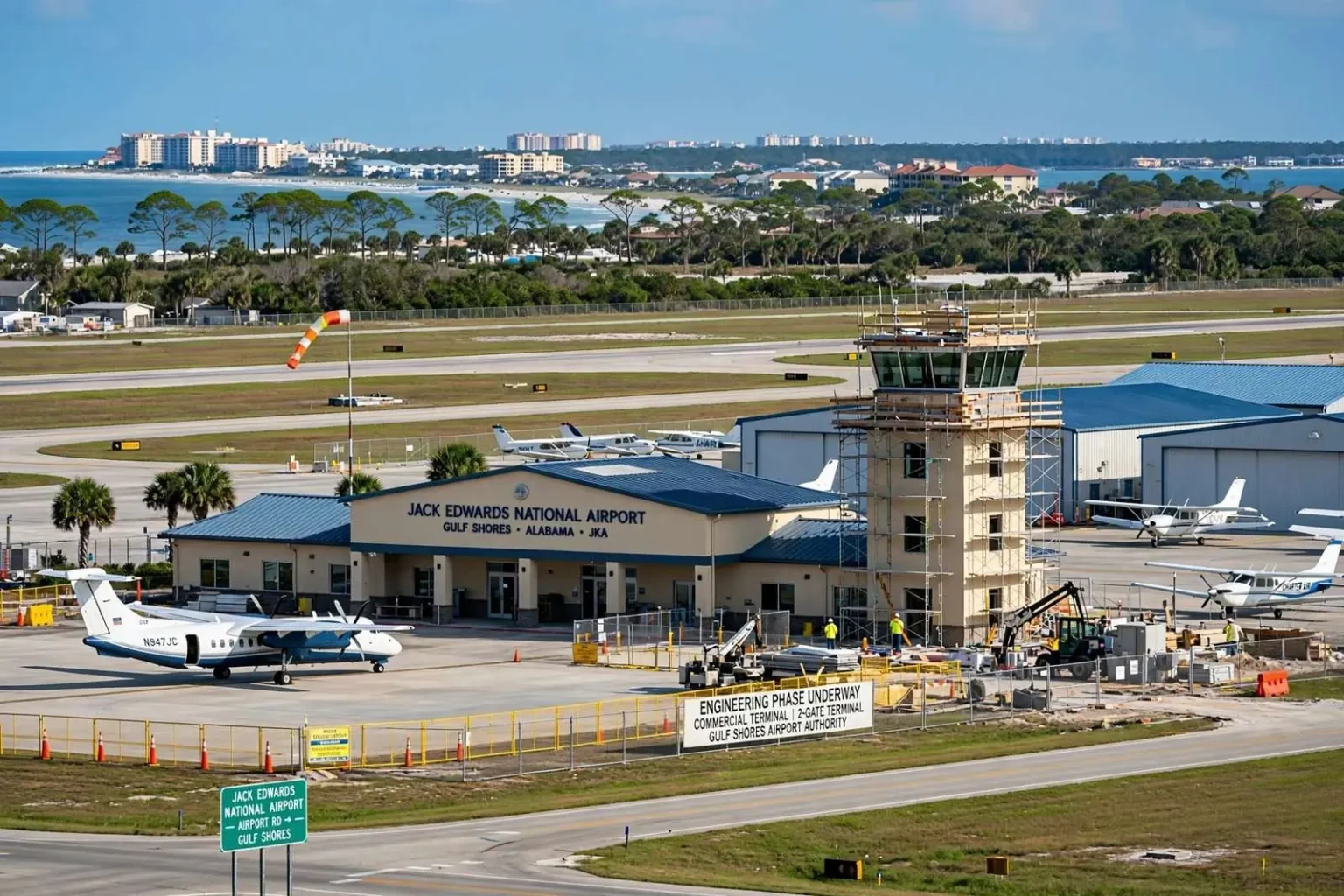
Gulf Shores is a step closer to having commercial airline service. The Gulf Shores Airport Authority has voted to fund the engineering phase of a commercial airline terminal at Jack Edwards National Airport, setting the stage for passenger carriers to serve the beach town within the next couple of years. Already one of the busiest general aviation airports in Alabama, Jack Edwards is targeting roughly 10,000 air travelers annually once service launches. The first phase calls for a two-gate terminal built onto the existing apron along the south side of the airfield, sized initially for commuter-class aircraft.
The decision represents a deliberate escalation of the airport’s ambitions. Engineering is the phase where runway weights, terminal footprints, taxiway connections and utility capacity are turned into buildable plans, and funding it signals that the authority intends to move past feasibility studies into construction-ready work. A two-gate terminal sized for commuter-class aircraft is a modest footprint by commercial aviation standards, but it is the configuration that regional carriers flying 30-to-70-seat aircraft require, and it can be expanded if the market grows the way local officials hope it will.
Control Tower Seen as Key to Landing a Carrier
Airport officials were also expecting final Federal Aviation Administration approval on an air traffic control tower within weeks. Airport Manager Scott Fuller said the added safety and structure a tower brings is a crucial piece of convincing a commercial carrier to commit to the market. The logic runs through the way airlines evaluate new destinations: commercial service into an airfield with scheduled passenger operations, mixed with the busy general aviation and charter traffic Jack Edwards already handles, is dramatically easier to certify and insure when a control tower is sequencing movements. A tower also raises the ceiling on how many operations an airfield can safely handle per hour, which matters to any airline projecting growth.
Fuller said demand from travelers is already there, pointing to frequent complaints that visitors must drive to reach the beaches because the area lacks scheduled air service. Gulf Shores sits at the end of a long drive for most of its visitor base. Travelers from the Midwest and Northeast currently fly into Pensacola, Mobile or Destin-area airports and then spend an hour or more in a rental car finishing the trip, while would-be visitors without a car have effectively no direct option at all. An airport inside the city limits shortens that final leg to minutes and puts arriving passengers within reach of the beachfront lodging market that drives the local economy.
Market research identified five key origin markets for the airport: Washington D.C., New York, Chicago, Houston, and Dallas. He framed the effort largely as an attempt to pull tourists out of their cars on congested Highway 59. The list tracks with Gulf Shores’ established visitor pattern, in which drive-market states dominate but a substantial and lucrative slice of guests arrive by air from the major metros of the Northeast, Midwest and Texas. Highway 59 through Gulf Shores is infamous in summer, funneling the entire beach-bound traffic load of the eastern Baldwin County shore through a two-lane commercial corridor, and every arriving family that never touches the highway relieves pressure on it.
Private Operators Growing Alongside
Charter operators are already expanding at the field. Charter Air and Intensive Air Care, which operates there, has added air ambulance services amid rising charter demand and currently runs two aircraft with plans to add three more. The company’s chief pilot and operations manager predicted the airport will eventually see traffic volumes comparable to Destin and other Emerald Coast airports, with heavier, larger aircraft arriving within five to eight years. Air ambulance work in particular reflects the region’s growth as a destination: a resort economy with seasonal population surges generates medical transport demand that a smaller general aviation field historically could not have supported.
The comparison to Destin is the one that shapes every projection about Jack Edwards’ future. The Destin-Fort Walton Beach area transformed from a drive-market beach town into a destination with substantial air service as its visitor base and lodging inventory grew, and Baldwin County officials have watched that trajectory for years while their own airport handled charters, corporate jets and private aircraft. A commuter-class terminal at Jack Edwards would put Gulf Shores on the same path, with scheduled flights building toward the kind of volume that eventually attracts larger regional jets and more carriers competing on price.
The economic stakes for the city extend well beyond the airport fence. Every scheduled flight that lands in Gulf Shores delivers visitors who sleep in local condos, eat in local restaurants and pay the lodging and sales taxes that fund a large share of the city’s budget. Tourism officials across the Gulf Coast have long argued that direct air access is the single biggest lever for growing out-of-market visitation, because it converts distant metro areas that are too far to drive into realistic long-weekend destinations. The five origin markets identified in the research read exactly like a list of cities airlines evaluate when deciding whether a leisure market can support year-round or seasonal service.
The Price Tag
The terminal project carries an estimated cost of about $5 million, funded by the Gulf Shores Airport Authority with potential contributions from the FAA and interested airlines. Officials said it remains too early to project fares for passengers flying in and out of Gulf Shores. The funding structure is typical for a project of this scale, in which a local authority carries the initial cost and federal aviation programs and carrier agreements offset portions of the work. Airline participation is often the decisive factor, since carriers that commit to serving a market will sometimes contribute toward terminal improvements that their operations require.
The two-gate first phase also keeps the city’s exposure limited. Rather than building a full-scale terminal on speculation, the authority is funding engineering now and sized the initial construction for the commuter aircraft most likely to launch service first. If ridership develops the way the charter operators expect, gates, holdrooms and apron space can be added in later phases, and the airport’s existing role as one of Alabama’s busiest general aviation fields means the underlying infrastructure — fuel, hangars, maintenance and ground services — is already in place and paying for itself while the commercial buildout proceeds.
For residents of Gulf Shores and the surrounding Baldwin County communities, the project’s milestones will come quickly if the FAA tower approval lands as expected. The engineering phase gives way to construction, construction to certification, and certification to the first scheduled departure, all within the couple of years that officials have sketched out. The airport that generations of local pilots and charter customers have relied on is preparing to add the one capability the beach town has never had, scheduled commercial airline service, and the vote to fund the engineering work marks the point where that goal moved from discussion to drawing board.
What Commercial Service Would Mean for Travelers
For the traveling public, the practical difference begins with the trip itself. A family flying in from Chicago or Dallas today lands at a regional airport an hour’s drive away, pays for a week of rental car, and navigates unfamiliar highway traffic with children and luggage before ever seeing the beach. From a terminal inside Gulf Shores, the same family could land minutes from its condo, take a short shuttle or rideshare, and leave the car behind entirely. For Gulf Shores property owners who fly in for long weekends several times a year, scheduled service turns a half-day of travel into a morning, and that convenience historically translates directly into more frequent visits.
The airport’s existing character would shape the airline experience as well. Jack Edwards is a compact, easy-to-navigate field, the kind of airport where parking is close, security lines are short and the terminal scale keeps departures low-stress. Travelers accustomed to the long walks and crowded concourses of the larger Gulf Coast airports often describe small-field flying as a genuine relief, and the two-gate design would preserve that character even after commercial service begins. Commuter-class carriers flying turboprops and regional jets are built around exactly this kind of operation.
Seasonality will be one of the interesting questions once flights begin. Gulf Coast beach markets swing sharply between summer crowds and shoulder-season lulls, and airlines serving similar destinations typically respond with heavier schedules in summer and scaled-back offerings in winter, sometimes shifting aircraft to ski or warm-weather markets in between. Local officials have framed the 10,000 annual passenger target as a starting point rather than a ceiling, and the origin-market research suggests the airport is aiming at metros large enough to support year-round demand from both tourism and the region’s growing population of remote workers and part-time residents.
The next checkpoints are clear: final FAA action on the control tower, completion of the terminal engineering, and the authority’s pursuit of carrier commitments and federal cost-sharing for construction. Each one moves Gulf Shores closer to joining the short list of Alabama communities with scheduled commercial airline service, and each has a defined timeline measured in months rather than years. For a city whose economy depends on getting visitors to the sand, the vote to fund engineering was the moment the airport’s commercial future left the planning documents and became a project with dates attached to it.