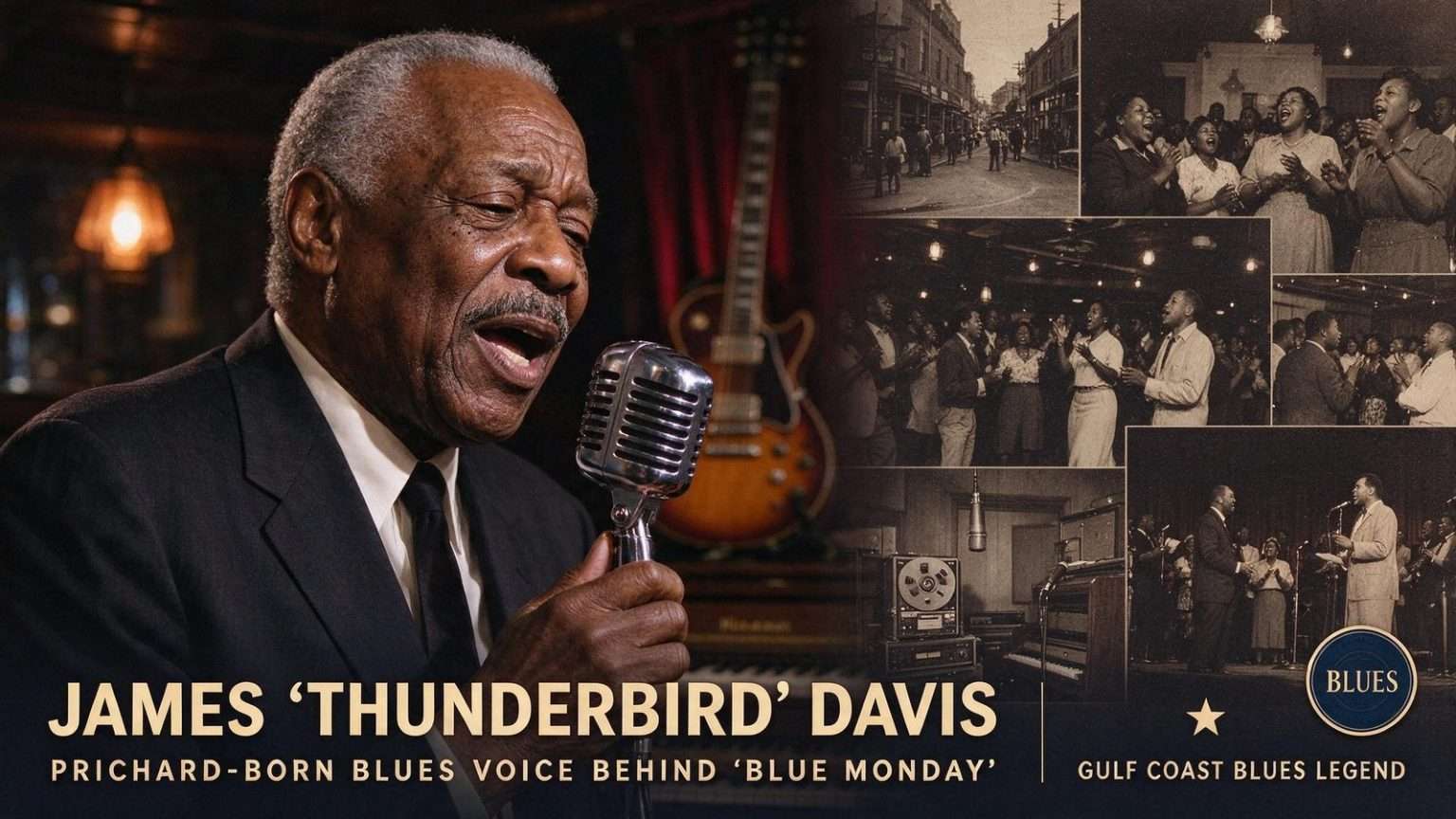
James Davis was born in Prichard, Alabama on November 10, 1938, raised in a religious family and first schooled in music through gospel choir. His path from the choir lofts of a working-class industrial suburb of Mobile to the blues stages of Texas and Louisiana made him one of the more improbable figures in Gulf Coast music history — a baritone whose biggest records were nearly lost to time before a late-life rediscovery returned him to the spotlight.
A chance encounter with New Orleans guitarist Guitar Slim changed everything. Slim was playing Mobile with the Lloyd Lambert Orchestra when the teenager asked to sing a song before the show. Both Slim and Lambert were stunned by the young baritone and hired him on the spot, pulling a Prichard teenager into the orbit of one of the most electrifying blues performers of the 1950s.
For three years, until Slim’s death in 1959, Davis served as the guitarist’s valet and opening act, traveling with a band whose leader was famous for wild stage antics and a Guitar Slim spectacle that stretched across early rhythm and blues. The apprenticeship taught Davis the road life of a working bluesman, and Lambert’s orchestra gave him his grounding in the swamp blues sound that Louisiana bands carried across the Gulf South in that era.
Slim also gave Davis his famous nickname. During a drinking contest at the band’s home base in Thibodaux, Louisiana — where Davis stuck to cheap Thunderbird wine because his wages wouldn’t cover anything stronger — the singer became so ill he needed a hospital trip. He never touched the wine again, but Slim never let him forget it, and “Thunderbird” stuck for life.
The nickname followed Davis through every phase of his career, a badge of the hard traveling that defined the 1950s chitlin circuit. In an era when Gulf Coast bands moved between juke joints, dance halls, and one-nighters from Mobile to Houston, a memorable handle was worth as much as a hit record, and Davis carried his until the day he died.
Losing Slim in 1959 could have ended the story before it started. Guitar Slim was among the most influential bluesmen of the decade, a guitarist whose amplified sound and flamboyant showmanship pointed the way toward the electric blues of the 1960s, and his band was a proving ground for Louisiana players. Davis instead carried the experience forward, and the Lloyd Lambert Orchestra connection — the bandleader who had helped hire him as a teenager — would prove decisive again decades later, when Davis was pulled out of obscurity by the same network of Gulf Coast musicians.
Duke Records and the Houston Years
In 1961, label boss Don Robey brought Davis to Houston to work for Duke Records, cutting demos of new material for the label’s roster — including numbers later recorded by Bobby Bland such as “I Pity The Fool.” Duke was one of the most powerful independent labels in American blues and soul, and demo work there put Davis inside the machinery that shaped the genre’s commercial sound through the 1960s.
Allowed to record on his own time, and backed by session greats like pianist James Booker, Davis surprised Robey with two of Duke’s biggest singles of the 1960s: “Blue Monday” and “Your Turn To Cry,” both of which became blues standards covered by Z.Z. Hill, Little Milton, Otis Rush, and others. For a singer hired to help other artists, out-recording the roster was an unexpected turn.
“Blue Monday” in particular traveled far beyond its original release, becoming a song that Gulf Coast and Texas bands treated as essential repertoire. The record’s endurance says as much about Davis’s delivery as the song itself — a plainspoken baritone reading that later singers borrowed wholesale, even as the man who cut it receded from the business. Cover versions by Z.Z. Hill, Little Milton, and Otis Rush kept the song in print and on stage through the decades when its original singer was doing laboring work and singing nowhere but church, a strange inversion in which the song grew famous while its author disappeared.
Davis left Duke in 1966 after years with little financial return, a familiar outcome for artists on 1960s independent labels whose contracts rarely matched their sales. He went back to warming up for acts like Joe Tex, O.V. Wright, and Albert Collins, working the same one-night circuit he had traveled with Guitar Slim a decade earlier.
By the mid-1970s he had largely quit music for laboring work, singing only in church. The retreat from the business was nearly total — no local club residencies, no recordings, no manager — and for more than a decade one of Duke Records’ most reliable voices supported himself far from any stage.
Declared Dead, Then Rediscovered
When Rounder Records’ 1982 compilation Angels In Houston revived his Duke-era sides, its liner notes declared him dead. He wasn’t. The mistake was an honest one in an industry that had lost track of him, but it briefly made Davis a cautionary tale — a singer celebrated on reissue liner notes for a career that scholars believed had ended a decade earlier.
A short-lived 1984 comeback fronting the late Z.Z. Hill’s band fizzled, and Davis slipped back into obscurity. Hill’s death that year removed the platform the comeback depended on, and Davis returned to the quiet life in Louisiana he had settled into years before.
The rediscovery came four years later, when Black Top Records producer Hammond Scott and Davis’ old bandleader Lloyd Lambert tracked him down — working at a dog pound in Thibodaux. Overjoyed to reunite with Lambert, Davis signed immediately, closing a circle that had opened more than thirty years earlier when the two men first heard him sing in Mobile.
Davis cut Check Out Time (1989) with an all-star band including Anson Funderburgh, Earl King, Ron Levy, Grady Gaines, Lambert, and Clarence Holiman, featuring a reworked “Your Turn To Cry” alongside new material like the title track. The album introduced a singer in his fifties whose voice had weathered into something deeper than the young baritone Duke had recorded, and it connected him with a new generation of blues listeners built on the reissue market.
Black Top showcased his return at its annual Blues-A-Rama during the New Orleans Jazz and Heritage Festival, and Davis added session work on records by Carol Fran and Hubert Sumlin. The festival showcase placed him alongside the Louisiana blues establishment he had first joined as a teenager, and the session work made him a working musician again in his adopted home state.
A Voice Lost Onstage
The comeback ended abruptly on January 24, 1992. While recording final chords of “What Else Is There To Do?” at The Blues Saloon in St. Paul, Minnesota, the 53-year-old suffered a heart attack and died onstage. For a singer whose career had twice collapsed into silence, dying mid-song on a club stage was an ending blues fans have repeated ever since, equal parts tragedy and testament.
He was buried from St. Luke’s church in Thibodaux, where he had long sung in the choir — weeks before he was due back in a studio. The church had been his musical refuge during the decades when no label wanted his voice, and it was the congregation that sent him off. Black Top, the label behind his comeback, was left with an artist it had just reintroduced to the blues world and a catalog that now stands as the final chapter of his recording life.
Davis’s story is inseparable from the Gulf Coast music corridor that runs from Mobile through New Orleans to Houston. Prichard produced him, Mobile introduced him to Guitar Slim, Thibodaux named him, Houston recorded him, and New Orleans brought him back. Few artists spanned every node of that circuit so completely, and his recordings remain a bridge between the swamp blues of the 1950s and the soul-blues of the 1960s.
His rediscovery also became part of the larger story of the blues reissue movement of the 1980s, when labels like Rounder and Black Top resurrected careers the industry had discarded. The Angels In Houston compilation that mistakenly killed him off is the same record that renewed interest in his music, and without it Hammond Scott might never have gone looking in Thibodaux.
Today, Davis is remembered through the standards he left behind. “Blue Monday” and “Your Turn To Cry” still turn up in the repertoires of Gulf Coast blues bands, sung by musicians who may not know the man who first recorded them was born in Prichard, once worked a dog pound, and died with a microphone in front of him — a blues life as complete as any the coast ever produced.